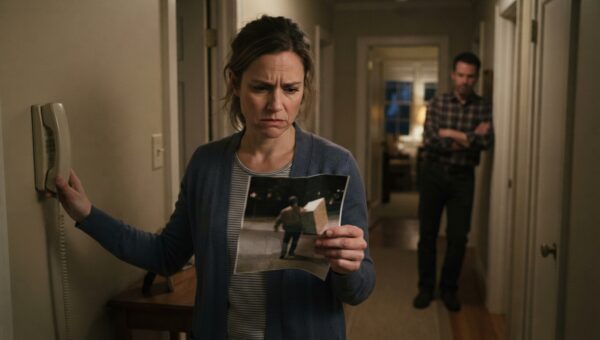
We sat at the long dining table with thirty-two people crammed into a room that smelled heavily of roasted turkey, pine boughs, and my mother’s heavy cinnamon cider. My mother spent three full days prepping that meal, bustling from the kitchen with flour dusting her apron strings and her voice echoing through the drafty old house. But Aaron sat three chairs down from me, staring straight ahead at a silver gravy boat like it held the secrets of the universe.
He hadn’t touched his second plate, and when my uncle poured a heavy splash of red wine into his glass, Aaron barely lifted a finger to steady it. Ten minutes earlier, in the chilly mudroom right after we parked the car, he had tried to convince me to turn the station wagon around and drive straight back to our quiet apartment.
“We don’t have to stay the whole evening, Clara,” he had told me out there in the dark, his fingers gripping the steering wheel so tight the knuckles looked like bleached river stones. “My chest has been tight all day. We can just say I came down with something.”
That was when the first cold knot formed in my stomach, because Aaron never faked sick, and he never ran away from a holiday roast. Ten years ago, my sister Clara had packed a battered suitcase, loaded up a rusted sedan, and driven twelve hundred miles east to chase some vague dream of art school and city life that never actually materialized.
We lost touch in jagged, uneven pieces until she called me out of the blue eight months ago, her voice shaking over the line as she announced she was back in town for good. She was flat broke, sleeping on a lumpy spare mattress at a cousin’s place across the county, and drowning in temp work that barely paid for her gas. I felt that familiar, heavy pull of sibling guilt that always seems to trap the one who stayed behind in the hometown.
I thought I was being a good sister when I walked into Aaron’s office downtown and asked if his department had an opening for someone with administrative experience. Aaron was a senior operations analyst at a mid-sized logistics firm, a quiet and serious man who spent his evenings reading dense history books and only truly opened up when it was just the two of us in our kitchen.
He had looked up from his dual monitors that Tuesday afternoon, blinked twice behind his wire-rimmed glasses, and agreed without hesitation just to keep me happy. “If she needs a fresh start, I can see what HR has on the entry-level board,” he had said, his voice level and steady as always.
Within three weeks, she had a desk three doors down from his in the corporate wing, right across the central hallway where the copy machines hummed all day. At first, it seemed like a minor miracle of modern networking, a neat little paragraph in our weekly phone calls where Clara would gush about how helpful Aaron was with the software training. But somewhere around month four, the rhythm of our evenings started to warp in ways I couldn’t quite name. Aaron started coming home fifteen minutes later than his usual 5:30 slot, then thirty, then a full hour, muttering something about inventory audits or end-of-month reconciliation reports.
When I asked him at the kitchen island why he looked so wrung out, he would just rub the back of his neck and say everything was fine with a tight, unconvincing smile that never reached his eyes.
“You’ve been awfully quiet lately,” I told him during dinner while my mother argued loudly with my cousin about local zoning laws down the table.
Aaron didn’t look up from his napkin right away. “Just a heavy quarter at the plant, Clara. Lots of moving parts.”
“You used to love the new logistics software,” I pressed, keeping my voice low so the relatives on either side wouldn’t catch the sudden edge in my tone. “Now you look like you’re carrying ten tons of gravel every time you walk through the front door.”
He finally raised his head, and the raw, exhausted panic in his eyes made me stop breathing for a second. Across the room, my sister was laughing a little too loudly at a joke my uncle told, her blonde hair flipped over one shoulder in a way that felt performative and sharp. She caught Aaron looking and gave him a quick, familiar little wave, the kind of casual greeting reserved for people who share daily inside jokes behind closed office doors. Aaron looked away instantly, his jaw tightening until a muscle leaped in his cheek. That micro-expression of dread was the second clue, and it clicked into place with the sickening force of a heavy deadbolt sliding home.
We stayed until the pecan pie was sliced and half the relatives had retired to the living room to watch a noisy football rerun on the small television. The drive home was thirty-four miles of suffocating, unbroken silence, broken only by the rhythmic slap of windshield wipers against the wet December sleet. Neither of us turned on the radio, and every time I glanced sideways at his profile illuminated by the pale green dashboard lights, he looked like a man walking toward a firing squad. When we finally pulled into our gravel driveway, he cut the engine immediately but left the headlights on, casting long, distorted beams against the brick wall of our garage.
“We are not going inside to sleep until you tell me what is actually going on,” I said, my hand resting flat on the cold plastic of the center console.
Aaron stared out the front windshield at the dark, dripping oak tree near our property line. “Nothing is going on, Clara. You’re making things up out of nowhere.”
“You tried to ditch my family Christmas,” I said, my voice dropping into that flat, dangerous register that usually ended our rare arguments. “You haven’t looked me in the eye for three months, and every time my sister’s name comes up at dinner, you look like you’re about to throw up. You’re going to tell me right now, or I’m driving over to her apartment tonight and asking her myself.”
He let out a long, shuddering breath that fogged the driver-side glass in the freezing cab. “Don’t do that,” he whispered, his voice cracking on the final syllable. “Please just don’t do that.”
“Then talk to me.”
He put both hands over his face, his fingers pressing hard against his temples as if he were trying to physically crush a migraine. “She comes into my office three, four times a day,” he mumbled through his palms, the words tumbling out in a rush he couldn’t stop anymore. “At first it was just questions about spreadsheets or the company directory. But then she started staying after hours. She’d sit in the visitor chair by my desk and just… start talking about how lonely she is here, how she regrets coming back, how she has nobody else in this town who understands her.”
I felt my fingers curl into tight fists against my lap. “She has me. She sees me every weekend.”
“She said you don’t get it,” Aaron said, finally dropping his hands to reveal a face gray with shame and utter exhaustion. “She told me you have your own life, your own marriage, and that I was the only person at that company who actually knew what it was like to feel stuck in a rut. She started venting about her past relationships, her money troubles, the guys she went to high school with who turned out to be losers. Every time I tried to draw a line and tell her to talk to HR or an outside counselor, she’d start crying right there in my cubicle. She’d look at me with these big, desperate eyes and say I was the only safety net she had left in the world.”
The silence in the car became so heavy I could hear the faint ticking of the cooling engine block beneath the hood. “And you just took it?” I asked, my voice barely a hiss. “For eight months, you let her treat you like her personal therapist while you watched me invite her over for Sunday pot roast?”
“I didn’t know how to stop it without blowing up your entire family,” he said, turning his head to look at me, his eyes shining with unshed tears in the dim dashboard glow. “If I went to HR, she would lose her job and your mother would blame me for being cold-hearted. If I told you, I knew you’d march down there and start a war that would tear your family apart forever. I was trying to absorb it all myself so you wouldn’t have to carry it. I just wanted to keep the peace, Clara. I swear to God, I just wanted to keep the peace.”
“She weaponized your quietness,” I said softly, the realization settling into my bones like lead. “She knew you hated conflict more than anything else in the world, and she used it to bypass every normal boundary.”
“She was in my office again yesterday afternoon,” he whispered, his voice dropping to a broken mumble. “Right before we left for your parents’ house. She sat on the corner of my desk, leaned right in, and asked if I was going to abandon her just like everyone else did ten years ago. That’s why I tried to skip the dinner. I couldn’t sit across from her and pretend we were just a happy little extended family after the things she’s laid on my shoulders.”
I sat there in the dark car for a long time, watching the sleet turn into tiny, frozen pellets against the windshield. The anger didn’t explode out of me the way I thought it would; instead, it pooled into something cold, clear, and absolute. We sat in that driveway for twenty minutes while Aaron let out every wretched detail he had been carrying in secret since late spring, his voice shaking as he confessed every late-night conversation, every desperate plea for reassurance she had cornered him into making.
The next morning, I didn’t wait for Sunday dinner or a polite phone call. I drove straight to her rented bungalow before noon, walked right past her startled look at the screen door, and laid down the law in terms that left no room for interpretation. I told her that her professional lifeline at Aaron’s company was officially severed, that any future contact with either of us would go through proper, distant channels, and that if she ever walked into his department outside of absolute company necessity again, she would answer to me first. She tried the waterworks, the trembling lip, the accusation that I was abandoning my own blood just like the rest of the town. But I didn’t blink, and I didn’t offer her a shoulder to cry on.
By New Year’s Day, the air in our house had changed from suffocating smoke to something clean and sharp, like the smell of pine after a hard freeze. Aaron and I sat together on the braided rug in front of the living room fireplace around nine o’clock at night, long after the holiday decorations had been packed away into dusty cardboard boxes in the attic. We didn’t talk about my sister, and we didn’t rehash the nightmare of the office across the hall. We just held matching mugs of black coffee between our palms, listening to the logs settle into red-hot embers in the grate, sharing an absolute, unbroken silence where nothing was left unsaid.