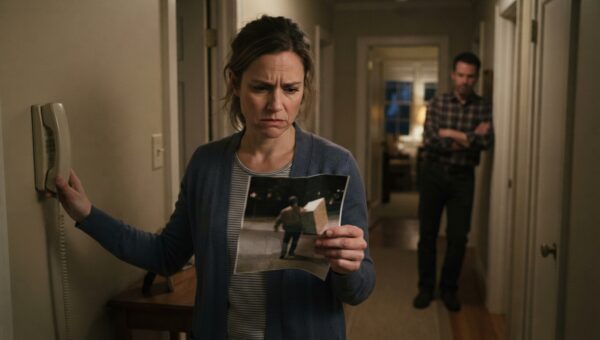
The coffee maker was still hissing on the counter when I got up to check on the hot water heater. It was 2:14 in the morning by the microwave clock, glowing that harsh, steady green. I didn’t mean to go out to the garage. I just heard the low murmur through the drywall while I was standing by the pantry, a sound like somebody talking to themselves in an empty room, and my feet carried me down the short hall before I even thought about it.
The door to the garage was cracked an inch. I pushed it with two fingers, the metal track giving that familiar little squeak I’d been meaning to grease since autumn.
Cal was sitting on the old wicker storage trunk we used for winter blankets. He had his phone pressed hard to his ear, his thumb white against the glass, and his voice was low and ragged. Not angry. Pleading. The kind of tone you use when you are begging someone to stay on the line because you are afraid of what will happen if they hang up.
When the latch clicked, he jerked around so fast he nearly dropped the device into the sawdust.
“Wrong number,” he said.
His voice was thick, like he’d swallowed gravel. He didn’t stand up. He just sat there in the dim light of the overhead bulb, swiping his thumb across the screen to kill the call, and then he reached up with his sleeve to swipe hard across his eyes.
Cal wasn’t a crier. In all the twelve years we’d been married, through my mother’s passing and the time the transmission dropped out of his truck on the interstate, I had never seen him leak a single drop.
“At two in the morning?” I asked.
“Just a wrong number,” he said again, louder this time, his jaw working like he was chewing on glass.
I let it go. That was my first mistake, or maybe my first mercy, though at the time it just felt easier to turn around and walk back to bed than to stand in the cold concrete smell of motor oil and argue about a ghost in the wires. I went back to sleep, or tried to, listening to the rhythmic hum of the refrigerator through the wall and the sound of Cal staying out there in the dark for another twenty minutes before he finally shut the side door and came back to bed without taking off his socks.
It happened again ten days later. Then twice the week after that.
The pattern was always the same. He’d wake up around two, muttering something about the heat or his back, and slip out of bed. I started keeping track without meaning to, my eyes snapping open at the exact moment the mattress leveled out on his side. I’d wait five minutes, listening for the muffled drone through the floorboards, and then I’d roll over and stare at the ceiling until the sun came up and painted those pale yellow bars across our curtains.
You spend twelve years thinking you know the square footage of a man’s mind. You know how he takes his coffee, you know the exact rhythm of his breathing when he’s finally dropped off to sleep, you know every scar on his hands from thirty years in the machine shop. You think that leaves no room for anything else to hide.
By the third week, the quiet was getting heavy enough to crack the drywall.
I didn’t confront him again because I was scared of what he’d say, and honestly, I was more scared that he wouldn’t say anything at all. When a man starts keeping secrets in the middle of the night, your brain does terrible things with the empty spaces. I told myself it was another woman. It’s the obvious story, the cheap story, the one you see on the local news every time some middle-aged couple down the street suddenly packs up their life and leaves a note on the fridge. I pictured some woman three towns over, someone from his past or someone he met while picking up spare parts at the supply house, calling him up when the house got too quiet.
So I did the thing I told myself I was too proud to do.
I waited until he went down to the hardware store for a new set of drill bits on a Tuesday morning, and I sat at the kitchen island with our laptop. I pulled up the online account for our family cell plan, downloaded the itemized call history for the last three months, and started running down the rows of numbers like a bookkeeper checking a bad ledger.
There it was, every single time. A string of digits starting with a 910 area code, always dialed between 1:45 and 3:00 a.m., lasting anywhere from twelve minutes to nearly an hour.
I highlighted the digits with my cursor and dropped them into a search engine.
The address came up in a small town outside of Wilmington, North Carolina. A residential street near a salt marsh. I pulled up the map view, staring at the little blue pin dropping onto a modest ranch house with an overgrown azalea bush by the front steps. Then I searched the name tied to the local land registry for that parcel.
Linda Hayes.
I spent an hour digging through public records, property taxes, and local business licenses until I found her. She owned a little storefront bakery downtown called The Flour Barrel. I clicked over to the bakery’s public Facebook page, looking for a face to match the late-night voice on the other end of Cal’s phone.
It was a normal page. Photos of cinnamon rolls stacked high on wire racks, decorated birthday cakes with neon frosting, and three different rescue mutts sleeping on a braided rug by the cash register. Linda herself had short graying hair, sensible wire-rimmed glasses, and a flour-dusted apron that looked like it had seen twenty years of hard flour and butter. She looked tired, regular, and completely harmless.
Then I scrolled back. Way back, past the sourdough loaves and the golden retrievers, down into the photo archives from 1996.
My finger froze on the touchpad.
It was an old Polaroid scan, faded around the edges with that slight yellow tint of mid-nineties film. A young man with dark, thick hair and grease-stained hands stood in the doorway of a small clapboard house, laughing at something off-camera. He was twenty years younger, but the jawline and the way his left shoulder dipped slightly lower than the right were unmistakable. It was Cal.
Standing right beside him, her arm looped securely through his with a familiarity that made my stomach drop like an elevator, was Linda. And tucked in the crook of her other arm, wrapped in a blue flannel blanket, was a newborn baby.
I sat there at the island for a long time while the refrigerator hummed its steady, indifferent note.
The screen saver kicked on after ten minutes, shifting to a slideshow of our own vacation photos from the Smokies, Cal and me smiling in front of the waterfall with our arms around each other, looking like people who had nothing to hide from the world.
I didn’t clean up. I didn’t close the laptop. I just left the 1996 photo glowing right there in the middle of the screen, tilted the lid halfway down so it wouldn’t go to sleep, and waited for the sound of his truck pulling into the gravel drive.
When the F-150 door slammed outside at noon, my hands were steady, which surprised me more than anything else.
Cal walked through the back door carrying a brown paper bag from the hardware store, smelling of galvanized iron and old cedar. He tossed his keys onto the laminate counter, right beside the framed studio portrait of us from our fifth anniversary, and reached for the kettle.
“The line at the register was backed up all the way to the fasteners,” he said, his back to me as he pumped the handle on the tap. “Old man Miller was arguing about a refund on a pipe wrench.”
I didn’t say anything. I just reached out, grabbed the top edge of the laptop screen, and pushed it all the way up until the glowing face of Linda Hayes and the baby in the flannel blanket sat right between our coffee mugs.
Cal went very still. The water running from the tap kept splashing into the metal sink, loud and rushing, until he finally reached out and turned the handle until the house fell dead silent.
He didn’t look at the screen. He looked at my face, and whatever he saw there made the color drain right out of his cheeks, leaving him looking older than his fifty-four years.
“I found the number, Cal,” I said. My voice didn’t shake. That was the other strange part. “And I found the bakery. And I found the year before we met.”
He caught the edge of the counter with both hands, his knuckles turning that dead, bloodless white I’d seen when he nearly took the tip of his thumb off on the lathe. He looked down at the formica, his chest rising once in a long, shuddering breath that sounded like a dry pump trying to catch water from a dry well.
“I didn’t want to bring it here,” he whispered.
“Who is she?”
“Linda is my first wife,” he said, the words coming out flat and heavy, like stones dropped into mud. “We were married twenty-nine years ago. Back when I was working the yards in Charleston. It didn’t… we were kids, Clara. We didn’t know how to keep anything together. When it fell apart, it fell apart all the way to the studs. We split up before the paperwork even cleared in my head.”
“And the baby?” I asked, my voice dropping an octave because the screen saver had finally gone dark and I couldn’t see the little face anymore.
He didn’t answer right away. He walked over to the kitchen table, pulled out one of the heavy oak chairs, and sat down hard, burying his face in his large, calloused hands. When he finally looked back up at me, his eyes were red-rimmed and wet, the exact look I’d caught in the garage at two in the morning.
“She’s twenty-eight now,” he said, and his voice cracked right down the middle on the last word. “And she just got diagnosed. That’s why I’ve been calling. That’s why I’ve been crying.”
The kitchen seemed to shrink until the walls were pressing right against my shoulders.
“Diagnosed with what, Cal?”
“Lymphoma,” he said, and the name came out like something he had to drag up from the bottom of a well. “Aggressive. They caught it late. Linda found my number through an old mutual acquaintance from the yard down there. She didn’t want anything from me. She just… our girl wanted to know if her father had her eyes. That was the first thing she asked Linda on the phone when the test results came back from the lab.”
He let out a short, wet laugh that had no humor in it at all, just pure, rusted-out pain.
“And I couldn’t even tell her,” he muttered, staring down at his boots. “I couldn’t tell her anything because I was too scared of what you’d think, Clara. I was too damn cowardly to walk into this house and tell you that a life I thought I buried in the dirt twenty-five years ago had just walked back through the front door with a terminal chart in its hand. I thought you’d look at me the way I looked at myself. Like some kind of fraud.”
I stood there by the counter with the laptop between us, listening to the quiet tick of the wall clock above the pantry.
For twelve years, I had believed that our life together was complete, that we had started clean and built something solid out of nothing. Finding out there was another foundation underneath it, poured in another state with another woman and a baby girl who grew up without a father while we were out buying our first couch, felt like finding out the house was built over an old graveyard.
“You’ve been crying in the garage,” I said softly.
“Every time I hang up with Linda,” he admitted, his voice dropping to a harsh whisper. “Because she’s sitting down there in North Carolina taking care of our daughter, and I’m up here sleeping next to you in a nice bed, acting like I never had another name before I met you.”
The anger didn’t come in a rush. It came in slow, heavy waves, the kind that leave salt behind on the rocks when the tide goes out.
I looked at him sitting there at the table, his shoulders rounded under his flannel shirt, looking smaller than he ever had in all the years we’d shared. I thought about what it must take to get a call like that at midnight, to listen to a woman you haven’t spoken to since the Clinton administration tell you that your flesh and blood is fighting for a bed in an oncology ward three hundred miles away. I thought about the sheer, grinding weight of carrying that alone out in the cold garage because he was too terrified of losing the life we’d built to trust me with the truth of who he was.
“You should have told me on day one,” I said.
“I know.”
“If you’d told me, we could have done something besides hiding in the dark like thieves.”
He looked up then, his eyes wide and uncertain, searching my face for the door I was supposed to be slamming.
“You’re not mad about her,” I said, and it wasn’t a question anymore. “You’re terrified she’s going to die before you get to say you’re sorry.”
Cal didn’t answer. He just let his chin drop back down to his chest, and his shoulders started shaking with that quiet, ugly sob that men his age only let out when there’s nobody else left to be strong for.
I walked around the island, pulled out the chair right beside his, and sat down. The wood was cold against my legs. I reached across the grain of the oak and put my hand over his, feeling the rough skin of his knuckles and the wedding band we’d picked out together in Richmond all those years ago.
“Call Linda back,” I said.
He blinked at me, his face slack with surprise.
“Not from the garage,” I added, my voice hardening just enough to let him know I meant it. “Do it from the kitchen table. And put her on speaker. If we’re going to carry this, Cal, we’re going to do it with the lights on.”
He stared at me for a long, heavy second, like he couldn’t quite believe the ground beneath his feet hadn’t given way entirely. Then his fingers curled around mine, cold and trembling, and he reached out with his other hand to pick up the phone.
The afternoon sun finally broke through the clouds outside, casting a long, clean rectangle of light across the kitchen floor where the old photograph lay waiting.