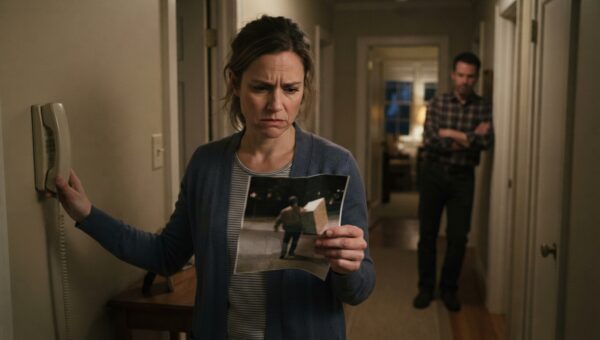
The rain had that gray, stubborn way of settling over the valley that made you feel like the sun was just a rumor you used to hear about. Arthur was gone. Just like that, on a Tuesday afternoon, a stretch of wet blacktop on Route 9 had taken him out of the truck he loved so much. I spent the morning of his funeral standing by the open gravesite in a borrowed black wool coat that smelled faintly of mothballs, nodding at neighbors and church folk I had known since we were kids.
We had been married for twenty-seven years. I thought I knew the weight of every breath he took, the rhythm of his snoring, the exact way he liked his coffee with two sugars and just a splash of cream. Then she walked up.
She wasn’t loud about it. She wore a dark, heavy coat that looked too warm for October and kept her chin tucked down against the wind. When she reached the polished oak of the casket, she didn’t bow her head or pray the way the others did. She pulled a single white rose from inside her coat, laid it right on the center of the lid, and leaned in close. I was standing three feet away, my hand tucked firmly inside my sister Mae’s elbow, when I heard her voice drop into the quiet space between the hymns. “I’ll take care of them.”
My hand left Mae’s arm before I even processed the motion. I caught the stranger by the wrist just as she turned to walk away.
My fingers clamped down on the thick wool of her sleeve harder than I meant to. “Take care of who?” My voice came out cracked and sharp, cutting right through the low murmur of the mourners.
She didn’t flinch. She just pulled her arm away with a dry, practiced jerk, looked me dead in the eye with a face that looked hollowed out by something heavier than grief, and said, “Let go of me.” Then she turned on her heel and disappeared down the gravel path toward the parking lot before I could take another step.
That night the house was too big and too quiet. Mae had gone home to her own place across town, leaving me with a cold casserole on the counter and the ticking of the grandfather clock in the hall that Arthur had oiled every Sunday after church. I couldn’t sit still. The memory of that white rose and those six words sat on my chest like a wet stone.
I walked out through the back kitchen door, past the rusted lawnmower and the rows of empty clay pots, and straight into the dark garage where Arthur had spent half his life tinkering with small engines and half-built cabinets.
I turned on the overhead fluorescent light, the old tubes buzzing and flickering twice before flooding the concrete floor with that harsh, yellow glare. Arthur’s workbench was a mess of copper wire, old sockets, and dried sawdust. Underneath the main table sat his heavy, red steel toolbox, the one with the dented corner from the time he dropped it off the tailgate back in ninety-eight. The latch was stiff, but I forced it open with a dull snap that echoed off the cinderblock walls.
I dug past the combination wrenches, the rolls of electrical tape, and the jars of rusted drywall screws. Way at the bottom, tucked underneath a greasy rag and wedged against the side wall of the metal casing, was a small, black object I had never seen before.
A burner phone. The plastic casing was scuffed, and when I pressed the side button, the screen lit up with a harsh blue glow. It wasn’t locked with a password. It didn’t need to be, out here in the quiet country where nobody ever expected a ghost in the toolbox.
I sat down hard on an upturned five-gallon bucket of joint compound, my knees suddenly refusing to hold me. I opened the message app. The threads went back years, hundreds of them, packed with photos of soccer games, birthday cakes with melting candles, and a little boy with Arthur’s exact nose grinning at the camera. There were domestic check-ins about groceries, dentist appointments, and bedtime routines. Fourteen years of messages. Fourteen years of another life running parallel to mine while I packed his lunchboxes and washed his flannel shirts every Sunday night.
I kept scrolling until my thumb went numb, jumping from year to year like a woman reading a book written in a language she almost understood. Then I saw the address. A neat, single-story ranch home out in Portland, Oregon, purchased in 2016 for $890,000. My heart gave a heavy, sickening thud against my ribs. I pulled out my own phone with shaking fingers, typed the address into the county assessor database using the public Wi-Fi signal, and stared at the digital document on the screen. There was Arthur’s name right next to another one. Elena Vance. The deed was signed and notarized eight years ago.
I did the math in my head, slow and stupid, because my brain refused to accept the columns. The youngest boy in the photos was four years old. Four. I sat there in the cold garage with the hum of the freezer coming from the utility room, and I traced the dates back on the calendar we kept hanging on the kitchen wall. Four years ago. That would have been the autumn we took that two-week anniversary trip to the Big Island in Hawaii. Arthur had stayed behind in Honolulu for three extra days on a “contractor supply conference” while I flew home early to check on my mother’s hip surgery. He had been in Portland. Or maybe he had been on a plane between two lives, smiling at me across a hotel breakfast buffet and then flying north to play daddy to a different family.
My throat felt dry, like I’d swallowed a mouthful of sand. I didn’t cry. There was no room for crying when the floor had dropped out from under the whole foundation of my existence. I looked back down at the burner phone sitting on my knee. The screen had gone dark, but the recent call log was still glowing in my memory. One number at the top of the list, saved with a simple heart emoji.
I didn’t wait for morning. I didn’t call a lawyer or wake up Mae. I punched the numbers into my own phone, holding the receiver to my ear while the dial tone buzzed twice in the empty garage.
It picked up on the very first ring. A woman’s voice, tired and raspy, came across the wire before I could even draw a breath.
“I’ve been waiting for you to call,” Elena said. “He told me you agreed to share him, but I always knew it was a lie.”
The words hit me like a splash of freezing river water. I sat there on the joint-compound bucket, staring at the dust motes floating in the yellow light above the workbench, and my voice came out flat and small. “What did you just say to me?”
“He said you had an arrangement,” she whispered, her voice cracking slightly at the edge. “He said you lived back East for your mother’s sake and that you two hadn’t been husband and wife in twenty years. He told me he was only waiting for the youngest to start school before he made it official with us.”
“We were married twenty-seven years,” I said, and the sound of my own voice telling her that felt absurd, like reciting a fairy tale to a stranger on a bus. “He slept in my bed every Sunday of my life.”
There was a long, terrible silence on the other end of the line, broken only by the faint sound of a child crying in the background somewhere out in Oregon. “He lied to both of us,” she finally whispered. “Didn’t he?”
I didn’t answer her. I hung up the phone, placed it back into the bottom of the red metal toolbox, and snapped the metal lid shut with a dry, final bang.
Two days later, I bought a one-way ticket to Portland out of a separate savings account I had kept hidden since my father left me his lumber store inheritance back in ninety-one. I didn’t tell anyone where I was going. I just packed a single canvas duffel bag, locked the front door of the house on Elm Street, and boarded a Boeing 737 that carried me three thousand miles away from everything I thought I knew.
We met at a quiet, nondescript coffee shop near the river, surrounded by gray drizzle and the smell of wet pine. Elena looked smaller in person than she had at the gravesite. She wore a faded denim jacket, her dark hair pulled back into a messy clip, and she had dark circles under her eyes that told me she hadn’t slept since the highway patrol knocked on her door, either. She brought a thick manila folder tucked under her arm.
“Here,” she said, sliding it across the laminate table between our paper cups of black coffee. “These are the mortgage papers. The insurance policies. The birth certificates for the boys.”
I opened the flap and looked at the names. Arthur James Miller. Father. Provider. Husband. He had signed his name with the exact same looping script he used on our grocery lists and our joint tax returns.
“I didn’t know about you until two years ago,” she said, stirring her coffee with a little wooden stick until it splintered. “I found a receipt for a jewelry store back in your town. When I asked him about it, he cried. Arthur could cry on cue whenever he needed to. He told me you were unstable, that you refused to sign divorce papers because of your church community, and that he was trapped supporting a woman who didn’t love him anymore.”
I looked at her across the table, at the young mother who had been fed the same steady diet of poison I had swallowed for half a lifetime. I didn’t feel anger toward her anymore. The rage had burned itself out somewhere over the Rocky Mountains, leaving behind a cold, clear space where only facts mattered.
“He used my father’s store money to help buy this house,” I said quietly, tapping the corner of the property deed. “I checked the wire transfers before I got on the plane. He skimmed thirty thousand dollars from our joint contracting ledger in sixteen to cover the down payment.”
Elena flinched, her hands dropping flat against the table. “I swear to God I didn’t know where the cash came from. He said he had a silent partner in a commercial build out in Boise. He was always traveling. Always talking about blueprints and zoning permits.”
“He was a very good builder,” I said, looking out the plate-glass window at the steady Oregon rain drumming against the street. “He just forgot to check the load-bearing walls before he walked away.”
We sat in silence for a long time after that, two women comparing notes on a ghost who had lied to both of us with the same crooked smile. We didn’t yell. There was nothing left to fight over except the wreckage, and the wreckage belonged entirely to him. I spent the next three days with a probate attorney in downtown Portland, signing away any claim to the Oregon property in exchange for a clean legal separation of our remaining estates back home. I didn’t want his house. I didn’t want his second life. I just wanted my name off his balance sheets so he couldn’t reach back from the grave and take the last piece of ground I had left to stand on.
When I flew back into town, the autumn leaves had turned brown and crunchy, blowing across the front lawn in ragged piles that nobody had raked up. Mae was waiting on the porch with a key and a thermos of hot coffee, but I waved her off gently, telling her I needed an hour alone to breathe my own air.
I walked out to the garage, stepping over the threshold that Arthur had poured himself back when we first moved in. The overhead light flickered once before holding steady. The heavy steel toolbox was still sitting where I left it on the workbench, its lid propped open to the afternoon sun slanting through the high window. I walked over, reached down, and picked up the empty black tray where the burner phone used to be.
There was nothing left inside except a few stray drywall screws and a thick layer of gray sawdust. I didn’t cry. I didn’t look back toward the house. I just stood there in the quiet, listening to the old floorboards settle under my boots, waiting for the scrap metal yard truck to come by tomorrow and pick the rest of it up.