The linoleum behind the deli counter at the local Walmart has this weird little scuff mark shaped like a half-moon, and I was staring straight at it when the woman blocked my cart. She didn’t say excuse me. She just stood there with her hand hovering over a plastic container of potato salad, her fingers twitching against the lid. I thought she was going to ask me to move out of the way for her cart.
Instead, she just stared. Ten seconds of dead silence in the middle of a Tuesday afternoon rush, right next to the sliced turkey and the humming refrigerator units.
You look exactly like someone I used to know, she said. Her voice was thin, like paper that had been folded too many times.
I blinked and shifted my grip on the handle of my wire cart. Who? I asked.
A girl named Catherine, she said. She died in 1987. Car accident.
I actually almost laughed, though I don’t know why. My name is Catherine. I was adopted in 1987. It felt like some kind of weird coincidence, the sort of trivia you mention at a dinner party to make small talk. But the woman didn’t laugh back. Her face went completely still, and then she dropped her red plastic basket right onto the linoleum with a sharp plastic clatter that made the deli clerk look up from the slicer.
She reached out and grabbed my bare left wrist with a grip that was surprisingly hard for someone her age.
What’s your birthday? she demanded. Her fingers were cold against my skin.
March 14, I told her, and the words barely made it out of my mouth before she covered her mouth with her other hand.
That was her birthday, she whispered behind her fingers.
Back in 1987, my adoptive parents always told me the agency was entirely legitimate, though they admitted the paperwork was sparse. They paid $12,000 in cashier checks, a huge sum back then, handed over to a private facilitator who worked out of an office downtown before the whole operation vanished four years later. The agency closed its doors permanently in 1991, leaving behind locked filing cabinets and empty desks. My parents never pushed too hard for answers because they had me, and I had them, and for a long time that felt like enough to fill up the empty spaces in our family tree.
But standing there by the cold cuts with a stranger holding my wrist, the silence of those missing records felt heavier than ever.
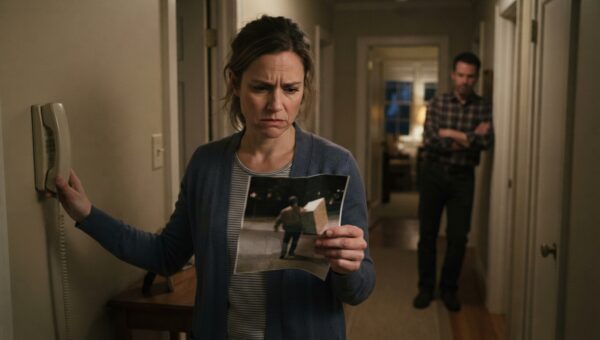
Elena invited me to sit with her at the diner down the block the next morning, the kind of place with red vinyl booths that squeaked every time you shifted your weight. She slid a faded plastic wallet photo across the sticky laminate table between our coffee cups. The edges were worn down to white fuzz, and the surface had tiny creases from being carried around in a pocket for nearly forty years. In the picture, a young woman with dark hair pulled back into a messy ponytail was holding an infant wrapped in a pink flannel blanket. On the tiny wrist of that baby, right near the base of the thumb, was a faint, irregularly shaped birthmark that looked almost like a smudge of ink. I turned my own left wrist over under the fluorescent diner lights.
The exact same mark sat in the exact same spot, pale and persistent.
She was your mother, Elena said, her voice dropping so low I had to lean across the table to catch the words. The girl in the photo. Her name was Catherine, too. We shared a two-bedroom apartment over on 4th Street that spring.
I stared down at the photograph, my chest tightening until it was hard to draw a normal breath. My brain felt like it was trying to run backward through years of quiet birthdays and family photo albums that never quite matched my face.
She didn’t die in the crash alone, did she? I asked.
Elena shook her head slowly, her eyes fixed on her coffee cup. No. They said the car rolled three times down the embankment off Route 9. It was raining hard. Everyone in town read the paper the next morning. It said the young mother didn’t make it. But nobody ever talked about what happened to the baby in the back seat. The police reports were a mess. The agency stepped in before the state could even sort through the intake logs.
The search for paper trails took us three days through the damp basement of the county historical library, where the old microfilm machines hummed like angry hornets. We scrolled through reel after reel of 1987 local newspapers until we found the small, buried paragraph on page four detailing the highway accident on a rainy Tuesday night in late autumn. The report mentioned an unidentified infant taken into protective custody by a private placement worker before being transferred to an unnamed facility. The pieces started snapping together with a cold, terrifying logic that made my hands shake on the plastic knobs of the machine. The agency hadn’t found me a home. They had found an empty cradle and a surviving infant with no immediate family present to claim her, and they turned a highway tragedy into a $12,000 transaction.
Elena didn’t have all the answers, but she had the memories that the state records had scrubbed clean. She told me how the original Catherine loved old folk records and kept a jar of yellow pencils on the kitchen windowsill because she liked how they looked in the morning light. She told me how my mother had worried herself sick about what kind of future she could offer a newborn while working two shifts at the local laundry. Listening to her talk, I realized I wasn’t just some blank slate dropped on a doorstep by random chance. I was the continuation of a life that had been cut short on a wet stretch of highway while the world kept right on spinning.
On Saturday afternoon, Elena and I drove out to a small, neglected cemetery on the edge of town where the headstones lean slightly to the left from decades of frost heaving. We didn’t talk much on the drive, just the quiet rhythm of the tires against the asphalt and the low hum of the radio playing old songs from another lifetime. The grave was marked by a modest granite stone half-covered by creeping periwinkle and dry oak leaves that had blown in from the treeline. We knelt down in the damp grass, and Elena brushed the dirt off the carved letters with her bare fingers.
She would have loved you so much, Elena whispered, her voice cracking just a little bit as she set a small bundle of white carnations against the gray stone.
I reached out and touched the cool granite, feeling the roughness of the stone beneath my fingertips. For thirty-nine years, I had carried the story of an orphan whose history began with a closed door and a defunct agency. Kneeling there beside Elena, looking out across the quiet field of old graves, that story finally fell apart to make room for something true. I wasn’t left behind by a stranger. I was the child who made it out of the wreckage, carried forward by people who traded on my survival while my real mother’s name stayed buried in the dark.
When I got home that evening, the house was entirely quiet except for the faint hum of the refrigerator in the kitchen. I walked down the narrow hallway and stood by the front window as the last gray light of dusk faded from the sky. I turned on the small porch light, casting a pale yellow glow across the wooden floorboards, and pulled my left sleeve back to look at the faint outline of the birthmark on my wrist. It didn’t feel like a mystery anymore. It felt like a signature written in ink that wouldn’t wash off, left behind by someone who held me for just a few short months before the road took her away. I walked over to the mantelpiece where my family photographs sat in their heavy wooden frames, and right beside a picture of my adoptive parents, I propped up the small, framed copy of Elena’s faded wallet photo, letting both worlds finally rest in the same room.