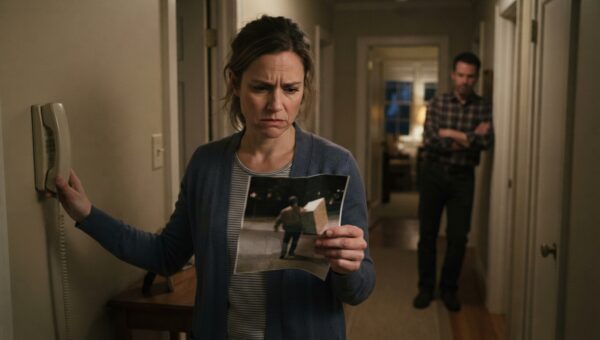
The locksmith was changing my locks. It was routine really, just something Sarah insisted on after Dad passed away in March. Halfway through the front door he stopped, held the old cylinder up to the light, and asked me who else had keys to this house. I said nobody, just family. He set the cylinder down real careful, like it might go off, and told me somebody had been copying this key recently, more than once, and that whoever it did it paid a professional to keep it quiet.
Then he asked me a question that put ice straight down my back. He asked if I had been finding things.
I am 68 years old, and yes, God help me, yes, I had. My late husband, Frank, always said I was imagining it. Little things like the coffee canister turned wrong, the closet light left on, or papers in the desk sitting slightly different than I left them. He would pat my hand and tell me, Judy, the house is just settling, and you would notice if even one dust bunny went missing. He was not wrong about me noticing things. He was wrong about the house settling. Frank had been gone since March, and the things kept moving after he was in the ground.
The locksmith packed his tools into a heavy metal box that rattled against the linoleum. His name was Roy, and he had lines around his eyes from thirty years of dealing with broken doors and lost things.
He didn’t look at me when he spoke again. He just kept his hands busy wrapping a blue cloth around a brass latch.
“You got family that drops in unannounced, Mrs. Vance?” Roy asked.
“My daughter Sarah,” I said, though my throat felt dry as cedar shavings. “She lives over in Knoxville. But she uses the front door like anybody else, and she doesn’t sneak around.”
“This wasn’t a rushed job with a file in a basement,” Roy said, tapping the old cylinder against his palm. “Clean cuts. Professional mill work. Somebody took an original to a shop that doesn’t ask questions. You want the new deadbolt keyed different?”
“Yes,” I told him. “Put in whatever you have that’s the strongest.”
When Roy finally gathered his gear and walked down the brick path to his truck, the silence came back into the house like cold water filling a boot. I stood in the hallway with my hand resting on the smooth oak banister.
The wood was worn down where Frank’s palm used to hit it every morning on his way down to coffee. For eight months, every time a floorboard creaked in the empty parlor or a draft stirred the curtains in the guest room, I told myself I was just feeling the ghost of a thirty-four-year marriage. I told myself grief plays tricks on a woman’s nerves.
The coffee canister turned wrong. I remembered that Tuesday morning in April, just six weeks after the funeral. I had walked into the kitchen before the sun was fully up, wanting nothing more than the routine of spooning chicory into the tin. The lid was rotated three degrees to the left, so the little brass handle didn’t line up with the painted roses. Frank had always been particular about those roses. He bought the tin in New Orleans back when we were still young enough to drive all night without needing a motel.
“You’re just jumpy, Mom,” Sarah had said when I mentioned it over the telephone. “The house feels big now that Dad’s gone. Everything echoes.”
She meant it kindly. Sarah was a good girl, practical to her bones, a high school counselor who spent her life untangling other people’s messes. But Sarah didn’t know about Frank’s desk.
I walked past the kitchen and down the short hall toward the back study. The door was half-open, a pale strip of late-afternoon light cutting across the oriental rug. Frank spent his entire retirement in this room. He kept his ledgers here, his stamp collection, his old service revolver locked in a heavy metal box behind the leather-bound volumes of Tennessee history.
When Frank was alive, I was never allowed to touch his desk. Not because we had secrets from one another, or so he always claimed, but because he liked his papers “just so.” He kept the drop-front mahogany writing surface locked with a small brass key that he wore on his key ring until the day they lowered him into the red clay at the edge of town. After the funeral, I found that key in his dresser drawer and put it in my jewelry box, telling myself I would go through the papers someday when the ache in my chest stopped feeling quite so sharp.
Today was that day.
I walked into the study, the floorboards groaning under my slippers. The air smelled of old paper and the lemon oil I used to wipe down the baseboards twice a month. I opened my bedroom drawer, took out the little brass key, and brought it back to the desk.
The key turned in the lock with a dry, metallic click. I lowered the mahogany flap. Inside were the usual stacks of yellowed envelopes, receipts for lumber from the hardware store down on 4th Street, and old tax returns from the eighties. Everything looked undisturbed at first glance. But Frank was a man of absolute, rigid habits. He never put a paperclip on the left side of a folder. Never.
I reached for the small wooden insert at the back of the desk, the little secret compartment Frank used to tease me about when we first moved into the house in 1974. He always said that was where he kept his hidden fortune, though we both knew the only fortune Frank ever accumulated was a moderate pension and a mortgage we finished paying off the year Sarah graduated college.
The false bottom of the compartment was crooked.
It wasn’t much, just a hair’s breadth of dark mahogany showing where the wood should have sat flush against the side panel. My finger touched the edge, and it slid upward with hardly any resistance at all.
Inside lay a thick manila envelope tied with twine. It wasn’t Frank’s handwriting on the front. The ink was a sharp, hurried script, listing property parcel numbers in counties two hours west of here, land titles and deeds I had never seen before in my life. And beneath it was a small stack of carbon copies from a lawyer’s office in Chattanooga, dated just three weeks before Frank died.
I sat down hard in Frank’s leather desk chair. The springs gave a long, tired sigh.
Arthur.
The name formed in my mind before I even finished reading the second page. Arthur Vance, Frank’s younger brother, who hadn’t spoken to us since the family argument over their mother’s estate back in ninety-eight. Arthur, who lived up near Bristol and spent his life drifting from one failed real estate scheme to another, always looking for someone else to bail him out.
Frank had always spoken about Arthur with a tight, jaw-clenched silence. Whenever I asked why they didn’t write, Frank would just wave a hand and say, “Arthur’s got his life and we’ve got ours, Judy. Let sleeping dogs lie.”
Except Frank hadn’t let them lie. The dates on the lawyer’s letters showed that Frank had been meeting with someone down in Knoxville just days before his heart finally gave out. He had been shifting parcels, signing over small tracts of timberland that his father had left unrecorded, land that Arthur apparently believed belonged to both of them by right of blood.
The telephone on the side table rang, making me jump so hard I nearly knocked over the inkwell.
It was Sarah. Her voice came through the receiver, bright and cheerful, carrying that slight edge of daughterly concern she always used when she checked in on me.
“Everything go okay with the locksmith, Mom?” she asked. “Did he get those old deadbolts swapped out?”
“He did,” I said, looking down at the manila envelope in my lap. My thumb traced the rough twine. “He did a thorough job, Sarah.”
“Good. You sound tired. Did you eat anything?”
“I’m fine, honey. Just sorting through some of your father’s old business papers.”
“Don’t wear yourself out with that junk,” she sighed. “Dad kept every receipt for a box of nails he bought thirty years ago. Leave it for the weekend. I’m coming down Saturday with some casserole. We can sort it together.”
“No,” I said, and my voice sounded firmer than I intended. “I can handle it, Sarah. I’ll see you Saturday.”
After I hung up, the house grew quiet again. But the quiet felt different now. It wasn’t the heavy, suffocating blanket of grief I had worn since March. It was the sharp, clean silence of a room right before a thunderstorm breaks.
I pieced it together in the fading evening light. The moved papers. The coffee canister turned three degrees. The closet light left on when I knew I had clicked it off before going down to watch the evening news. Arthur hadn’t been waiting for an invitation. He had a key. Or rather, he had kept an old copy from back when we first bought the place, or he had taken one from Frank’s coat pocket during one of those rare, strained visits they must have had behind my back while I was out at the garden club.
And Frank had known. That was the part that made my chest tighten. Frank had known Arthur was slipping into the house when I was asleep or at the grocery store, searching for those timber deeds. Instead of changing the locks and standing his ground, Frank had kept quiet, gaslighting me every time I mentioned a displaced book or a crooked drawer, all to keep his pride intact and his family feud a secret from his wife.
He had protected his pride right up until his heart stopped on the kitchen linoleum.
By Friday evening, the autumn wind had picked up, rattling the dry oak leaves against the side of the house. I had spent two days going through every drawer in the study, organizing the deeds, and placing Arthur’s letters into a single cardboard box by the door. I didn’t cry once. Grief is a strange thing; sometimes it turns to salt, and salt doesn’t melt easy.
It was around four o’clock on Saturday when I heard the crunch of gravel in the driveway.
I was sitting at the kitchen table with a cup of lukewarm tea, watching through the lace curtain as a faded blue pickup truck pulled up near the side porch. A man stepped out, pulling his jacket collar up against the chill. He had the same narrow nose as Frank, but his hair was thinner and he walked with a slight hitch in his left hip that came from an old logging accident.
Arthur Vance.
I hadn’t seen him in twenty-five years, not since the day he stood on our front porch and screamed at Frank about a timber boundary line, his face red and swollen with whiskey and spite.
He didn’t knock. Why would he? For months, he had been letting himself in like he still owned half the county.
I heard the heavy brass key slide into the new deadbolt.
There was a soft, metallic click as the teeth met the pins. Then Arthur gave the knob a firm twist, expecting the door to swing inward just as it always had.
It didn’t move.
I watched through the glass as Arthur paused, his hand still resting on the brass handle. He jiggled it once, impatient and familiar. When the latch held firm, he withdrew the key, squinted at it in the waning daylight, and tried it a second time.
I stood up from the kitchen table. My knees didn’t ache the way they usually did. I walked down the hallway, my slippers making no sound on the runner, and reached the front door just as Arthur raised his fist to knock.
I turned the thumb-turn on the new deadbolt. The mechanism slid back with a clean, heavy snap.
I pulled the door open about six inches, just enough to fill the gap with my own body. The cold autumn wind rushed into the hall, smelling of woodsmoke and old dirt.
Arthur stopped with his hand half-raised. For a second, he looked past me into the empty hallway, his mouth opening slightly as if he expected Frank to step around the corner with a cup of coffee.
“Judy?” he said, his voice raspy and dry like dead corn husks. “Where’s Frank?”
“Frank’s been dead since March, Arthur,” I said. My voice didn’t shake. It sounded steady, clearer than it had in years. “You know that. You were at the cemetery. Or at least you stood by the fence and watched from your truck.”
Arthur blinked, his eyes darting down to the brass lock in my hand before coming back to my face. He tried to force a thin, oily smile, the kind of smile men use when they think they can charm an old woman out of her senses.
“Now look here, Judy,” he started, taking a half-step toward the threshold. “I just came by to pick up a few family items. Frank and I had an understanding about some papers. He kept them in the study.”
“I know what he kept in the study,” I said. I reached behind me, picked up the manila envelope off the hall table, and held it up so the corner caught the porch light. “And I know you’ve been letting yourself in here while I was asleep, looking for these.”
Arthur’s face didn’t go pale. He just tightened his jaw, the color rising in his neck like a thermometer in the sun.
“That’s family business, Judy. You don’t know the first thing about, “
“I know enough,” I interrupted. I didn’t raise my voice. There was no need to shout at a man who had already lost every argument he ever started. “I know you paid someone to copy our key. I know Frank covered for you because he was too proud to admit his own brother was a thief. And I know you won’t ever be setting foot in this house again.”
“Frank would have wanted me to have, “
“Frank is in the ground,” I said. “And I am right here.”
He reached out, his fingers twitching toward the edge of the door as if he might try to push his way past me the way he used to push past Frank forty years ago. But he looked at my eyes, really looked at them for the first time since we were young, and he must have seen something he didn’t expect. The woman standing in this doorway wasn’t the quiet, doubting wife Frank had kept behind closed doors to preserve his secrets.
Arthur let his hand drop to his side. He stepped back off the porch, his boots crunching hard into the gravel.
“You’re making a mistake, Judy,” he muttered, turning his collar up higher against the wind. “Those papers belong to the estate.”
“Then you can talk to Sarah’s lawyer on Monday,” I told him. “And if I ever catch you on this property again, I won’t bother calling the sheriff. I’ll just let our new dog out.”
I didn’t have a dog. But Arthur didn’t need to know that.
He didn’t say another word. He turned on his heel, walked back to his old blue truck, and climbed inside. The starter ground twice before the engine caught, coughing a cloud of blue exhaust into the crisp evening air before he backed down the drive and disappeared around the curve of the road.
I stood in the doorway for a long moment, watching the red taillights fade through the bare maples. The wind was getting colder now, carrying the first real bite of November down from the hills.
I pulled the heavy oak door shut.
With a slow, deliberate motion, I turned the brass key in the new lock. The heavy click of the deadbolt sliding smoothly into place echoed down the empty hallway, solid and absolute, locking out the past and leaving me standing right where I belonged.