The morning light in the penthouse did not feel like a reward at first. It felt quiet in a way that made my ears ring, like the split second after a heavy door clicks shut behind you in an empty house. I stood by the kitchen island, holding a white porcelain espresso cup that still radiated a dull, welcome heat against my thumb.
Outside the floor-to-ceiling glass, Dayton was waking up in gray shades of asphalt and damp concrete, the sort of Tuesday morning where the air smells faintly of coal smoke from the old rail yards down on Third Street.
My phone was resting flat on the white quartz counter next to the silver espresso tamper. It did not vibrate at first. It gave a single, sharp, metallic chirp that cut right through the hum of the refrigerator. Then the screen lit up with Brandon’s face, a small square photograph taken three years ago at some country club brunch where he had insisted on wearing a linen blazer that cost more than my first set of industrial sewing machines.
I did not swipe to answer right away. I took a slow sip of the dark, bitter roast, letting the liquid sit on my tongue for a second before I swallowed. I knew what the phone call was about before the pixels even finished resolving his name.
I knew because the digital banking app on my tablet had flashed a notification twelve hours earlier, right around 9:15 PM, while I was sitting on the sofa pulling the tags off my new throw pillows. An attempted transaction at a downtown charity gala. Fifty thousand dollars, even. To Cartier.
I pressed the green button and set the cup down so the ceramic made a dry clink against the stone.
“What the hell did you do, Olivia?!” His voice blasted through the speaker before I even had the phone near my ear. It was high, thin, and ratcheted up to a pitch that meant he had been pacing the carpet in his mother’s sunroom since dawn. “My mother was just humiliated in front of two hundred people!”
I stayed right where I was, leaning slightly against the edge of the island, my wool cardigan slipping an inch down my left shoulder.
“Good morning, Brandon,” I said. My voice sounded lower than his, flat and level, like I was checking a shipping invoice on a Tuesday shipment of silk lining.
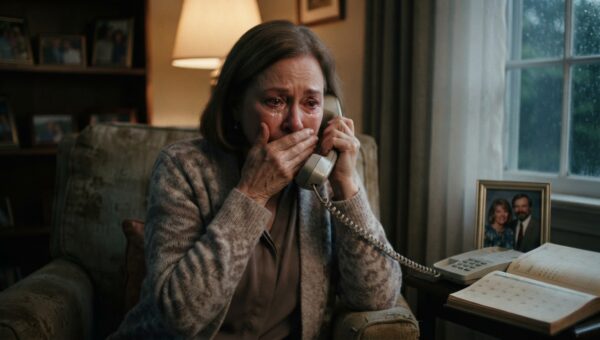
“Don’t give me that calm crap!” he roared, and I could hear the faint, frantic rattle of porcelain in the background, probably Margaret dropping her demitasse spoon because her hands were shaking too hard to hold it. “She won a fifty-thousand-dollar Cartier necklace at a charity auction, and her card declined right in front of everyone! The girl at the register tried three times. Three times, Olivia! The machine just kept flashing that stupid red light while the whole committee stood there watching!”
I looked down at my own hand. The skin around my left ring finger was slightly paler than the rest of my skin, a neat, pale band where a heavy platinum setting had lived for five long years.
“I heard you the first time,” I said. “Though I’m surprised she didn’t have her own plastic for a fifty-thousand-dollar trinket. Weren’t the charity auctions always supposed to be about the children?”
“You know damn well she doesn’t carry balances on her personal cards,” Brandon snapped, his breathing heavy and wet in the tiny speaker. “You set up the family accounts. You managed the routing numbers. The black card was tied straight to your operating holdings. The clerk said the account was closed. Just like that. Closed!”
“It wasn’t closed by mistake,” I said.
For five years, my marriage to Brandon had operated like a silent utility company. I paid the bills, I funded the galas, I kept the books balanced while Brandon spent his afternoons talking about real estate investments that never quite materialized and Margaret spent her mornings planning luncheon menus that required three different forks. I had told myself it was just the cost of being part of a family that had roots in the older part of Oakwood, people who supposedly knew how to behave in rooms with high ceilings and oil portraits of men who looked like they smelled of stale tobacco.
I remember the first year we were married, sitting in Margaret’s formal dining room while she picked at a wedge of cantaloupe and explained to me how the local historical society handled its benefactors.
“We simply don’t discuss ledgers at the table, Olivia,” she had told me, her voice dropping into that smooth, glacial register that made you feel like you were six years old and standing in wet socks. “It lacks a certain neighborhood grace.”
Back then, I had nodded and reached for my water glass, my fingers still stained with machine oil from the workshop where I spent sixty hours a week getting my apparel distribution business off the ground. I had thought grace meant keeping my mouth shut while they spent my earnings on imported boxwood hedges and country club dues. I had spent four years believing that if I just signed enough checks, if I just kept the balance high enough, they would eventually stop looking at my shoes when I walked into the foyer.
The divorce papers had taken four months to push through the county courts, mostly because Brandon fought tooth and nail over the equity in the commercial warehouse on Springboro Pike, insisting that his last name on the marriage license somehow entitled him to the brick walls I had bought before we ever met. But yesterday afternoon, the final stamp went down. The judge’s signature was dry. The supplementary credit cards, the ones with Margaret’s name embossed in gold leaf right under mine, had been flagged for deactivation the moment the digital copy of the decree hit my lawyer’s inbox at 4:00 PM.
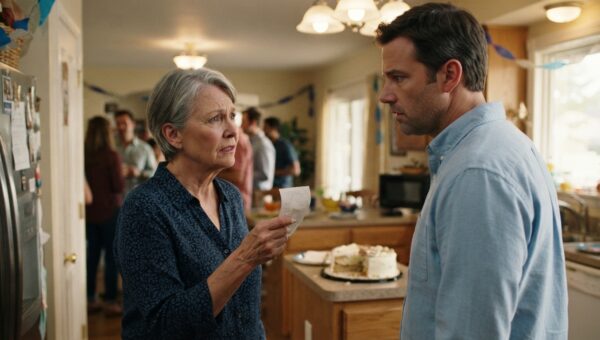
“You need to call them,” Brandon hissed through the phone, his tone dropping from a shout to that ugly, wheedling register he used whenever he needed me to bail him out of a bad car deal or a forgotten tax payment. “You need to call the fraud department right now and tell them it was an administrative error. Mother is sitting in her kitchen right now and she won’t even touch her tea. Her name is ruined in this town, Olivia. Do you understand what this does to us?”
“There is no error, Brandon,” I said. I picked up my espresso cup again, though the coffee had gone cold. “The account is dead. Just like our marriage.”
“Stop talking like a lawyer for five seconds and listen to me!” He was shouting again now, losing whatever thin veneer of control he usually wore like a cheap suit. “That necklace is already in her possession. They let her sign the ledger slip because they assumed it was a system glitch. If we don’t wire those funds by noon, they’re going to involve the board. Do you want my mother hauled through the local papers over a fifty-thousand-dollar piece of jewelry?”
“I don’t want anything, Brandon,” I told him, and for the first time since I met him, my chest felt entirely empty of lead. “That’s the beauty of it. I genuinely, completely don’t care.”
There was a long, jagged silence on the line. The kind of silence where you could almost hear the gears grinding in his head as he tried to find a lever that had worked every other time for the last five years. He was waiting for the sigh. He was waiting for that familiar, tired little concession where I would rub my temples, reach for my laptop, and quietly transfer the funds to make the noise stop.
“You’re bluffing,” he whispered. It didn’t sound angry now; it sounded small, like a boy who had dropped his toy down a storm drain and couldn’t figure out why it didn’t float back up. “You can’t just cut us off. We have commitments. Margaret has the garden club luncheon on Thursday and the country club board dinner next week. How is she supposed to pay her dues?”
“That sounds like a conversation for Margaret and her bank,” I said.
“You bitch,” he muttered. It wasn’t even a roar anymore. It was just a wet, flat insult dropped into the receiver like a stone in a well. “You sat in our house for five years acting like one of us, and the second you get your name off the deeds, you turn into a cold-blooded, “
“I was never one of you, Brandon,” I interrupted. My voice was very quiet now, almost conversational. “I was the one paying the electric bill while your mother told her friends my family was in the dry-goods business.”
I didn’t wait for him to answer. I didn’t wait for him to start up about the lawyers or the social registry or the shame of it all. I simply reached out with my thumb and tapped the red circle on the glass screen.
The phone went dark instantly.
The penthouse was quiet again. The espresso in the white cup was completely cold now, a dark skin forming over the surface like thin ice on a puddle. I carried the cup over to the sink, rinsed it under the tap until the porcelain was clean and white, and set it upside down on the wire rack to dry.
My tablet buzzed once on the counter. Another notification from the bank. A small, routine alert about a monthly software subscription for my warehouse inventory system, the kind of expense that actually mattered, processed from an account that belonged to me and nobody else.
I walked over to the floor-to-ceiling window and pressed my palm against the cool glass, looking down three floors toward the street where a delivery truck was double-parked by the curb, its hazard lights blinking in the pale morning glare. Down there, people were moving fast, carrying boxes, shouting across pavement, living real lives that didn’t depend on a black card or a charity auction.
I reached into my pocket, found Brandon’s name in the contacts list, and pressed block. Then I did the same for Margaret. Then for the landline at the Hawthorne estate on Ridgeway Road.
The screen stayed dark and clear in my hand. For the first time in five years, nobody was calling to tell me what I owed them. There was only the hum of the refrigerator, the distant rumble of the Third Street delivery trucks, and the heavy, solid silence of the rooms behind me.