Eleven years. That was how long I stood in the corner of every family gathering, holding my tongue while Darrell corrected the way I spoke, the way I dressed, and the way I spent the meager paycheck I earned working the front desk down at the county records office.
Lenora watched all of it. She sat in her floral-print wingback chair with her lap blanket pulled up to her chest, her sharp gray eyes tracking every small slight, every time Darrell waved away my opinion as if it were lint on his sleeve.
Back then, I thought she was just an old woman lost in her own quiet thoughts, knitting endless scarves that smelled faintly of lavender and stale peppermint. I did not know she was keeping a ledger in her head.
When her hips finally went out three years ago and the doctors said she could not live alone anymore, Darrell and his sisters did not hold a family meeting to discuss who would take her in. They held a meeting to discuss how cheaply they could park her in a Medicaid facility on the south side of town so her modest house could be sold off to fund Kendra’s new kitchen remodel and Marlo’s credit card debt. I was the one who packed a duffel bag, moved into the spare room down the hall, and spent the next thirty-six months learning the exact schedule of her insulin injections, the precise angle to prop her pillows so her lungs wouldn’t rattle, and how to spoon pureed soup past lips that had stopped smiling years ago.
For eight months after they lowered her casket into the red clay behind St. Jude’s, Darrell, Kendra, and Marlo treated me like a criminal who had picked a corpse’s pockets. They called me at all hours of the night. They cornered me in the grocery store parking lot. They even drove out to the house twice a week just to bang on the front screen door and demand I sign over the deed to the property before probate closed. They had convinced themselves that I had slipped some fraudulent papers under a medicated, dying woman’s nose while her faculties were gone.
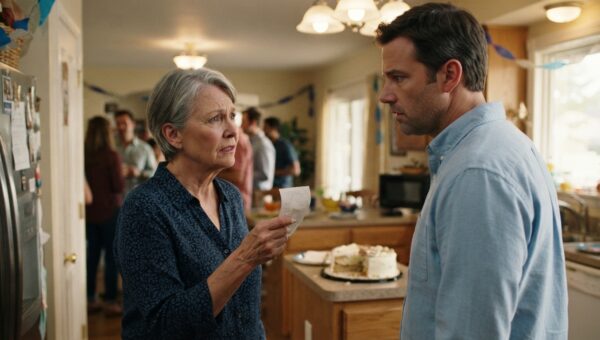
Last Sunday afternoon, all four of them piled out of Darrell’s pickup truck and marched up the front steps without knocking. There was Darrell, his two sisters Kendra and Marlo, and Marlo’s husband Keith, who mostly just stood around to nod at whatever mean thing the women said.
They didn’t even wait to be invited into the kitchen. Darrell walked straight to the walnut sideboard, reached past the framed photo of Lenora’s garden, and pulled the crystal decanter of Kentucky bourbon down from the shelf.
He poured two fingers of the expensive amber liquid into a heavy glass tumbler without even looking in my direction, let alone offering me a drop of my own mother-in-law’s liquor.
“You took advantage of a dying woman,” Darrell said, swirling the bourbon and taking a slow, defiant sip that stained his upper lip.
I kept my hand resting flat against the cool laminate edge of the kitchen counter and didn’t answer him. I didn’t need to. I had spent eight months listening to the exact same tired accusations, the same bitter threats about contesting the will, the same ugly whispers that I was nothing more than a low-class opportunist who had trapped an old lady in her dotage.
“We talked to a lawyer this morning, Audrey,” Marlo chimed in, crossing her arms tightly across her chest and leaning her hip against the refrigerator like she owned the place. “You can’t just isolate an eighty-two-year-old woman for three years, cut off her own flesh and blood, and walk away with eighty-seven thousand dollars in savings, a paid-off house, and a Buick. It’s illegal. It’s straight-up theft.”
“She didn’t even know what year it was by the end,” Kendra added, her voice climbing into that shrill, grating register it always hit whenever she didn’t get her way at Christmas dinner. “She didn’t know us. She probably thought you were the nurse from the agency half the time.”
Darrell set his glass down on the counter with a sharp clink that made the spoon in the sugar bowl jump. “Sign the quitclaim deed, Audrey. Hand over the keys to the Buick. If you do it right now before we call the sheriff back out here, we might not press charges for elder exploitation. But you’ve got about ten seconds to decide.”
I didn’t blink. I walked over to the kitchen drawer where I kept the junk mail, rubber bands, and old coupons. I slid the drawer open, reached all the way to the back past a rusted pair of poultry shears, and pulled out the small black thumb drive Lenora had handed me six months before her heart finally gave out.
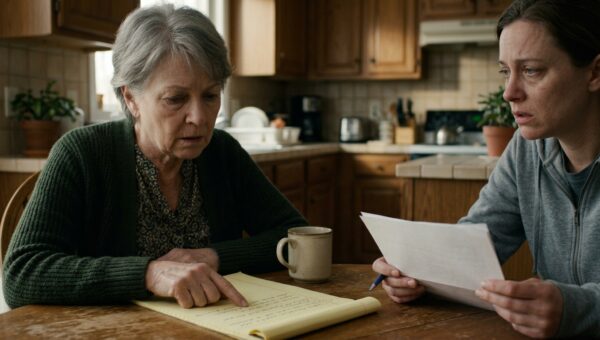
Lenora had made that video in total secrecy with Mr. Charles Henderson, the family’s longtime estate attorney, sitting right across this very kitchen table. She had been fully lucid, wearing her favorite blue sweater, and speaking with the steady, unshakeable clarity of a woman who had spent fifty years balancing a dry-goods ledger to the exact penny.
I walked over to the counter where Darrell’s laptop sat open to some online banking tab he was checking behind my back. I pushed his mouse aside, plugged the little plastic drive into the USB port, and clicked the media player icon.
The built-in speakers of the laptop gave a soft, dry pop. Then Lenora’s voice filled the small kitchen, steady, raspy, and unmistakably alive.
“If you are watching this, Darrell, Kendra, and Marlo, it means I am finally in the ground and you have descended on my house like crows on a roadkill,” Lenora’s recorded voice said from the small screen, her image sharp and unyielding against the white-painted cabinets.
Darrell froze mid-reach toward his bourbon glass, his fingers hovering half an inch above the crystal rim. The color drained out of his face so fast his skin took on the grayish tint of skim milk. Kendra let out a short, sharp gasp and took half a step backward until the back of her legs hit the kitchen table.
“Mom,” Darrell muttered, his voice dropping an octave as he stared dumbly at the screen. “What is this?”
On the video, Lenora shifted slightly in her chair, looking directly into the lens of Mr. Henderson’s handheld camera with an expression of profound, bone-deep exhaustion.
“I am leaving everything to Audrey because for eleven years I watched my son treat her like a hired maid and an ATM machine,” Lenora’s voice stated, ringing off the tile backsplash. “I watched you take every dollar she made at the county office to pay off your stupid truck repairs and your bar tabs, Darrell. I watched you belittle her every time she spoke at Sunday dinner while she sat there and took it because she thought that’s what a wife was supposed to do.”
“Turn that off,” Darrell hissed, lunging forward with his hand outstretched toward the keyboard.
I didn’t move an inch. I just looked him dead in the eye, my hand resting over the escape key so he couldn’t touch it. “Keep watching, Darrell. Your mother isn’t done talking yet.”
The video continued, Lenora’s gaze never wavering from the lens.
“And don’t you dare stand there and pretend you didn’t know what was happening to me either,” the recording continued, shifting its target toward the two sisters standing by the refrigerator. “Kendra, Marlo, you haven’t set foot in this house for longer than twenty minutes at a stretch in four years unless you needed a fifteen-thousand-dollar check for a down payment or a luxury vacation to Myrtle Beach. You didn’t change a single diaper, you didn’t empty a single bedpan, and you didn’t buy a single bottle of the expensive blood pressure medication my doctor prescribed when my kidneys started failing.”
Marlo opened her mouth, but no sound came out. Her jaw worked twice like a fish out of water, her face turning a blotchy, mottled red.
“Mr. Henderson has my full medical evaluation right here in his safe,” Lenora’s voice went on, calm and relentless. “Certified by a board-certified neurologist the exact morning this video was recorded six months ago. I am of sound mind, sound judgment, and utter clarity. I am giving my home, my car, and every cent in my savings account to Audrey because she is the only person in this family who ever looked at me like I was a human being instead of an expiring annuity.”
The screen flickered slightly as Lenora reached out a frail, blue-veined hand to tap the lens of the camera to stop the recording. But the silence that settled over the kitchen was heavier and louder than any video file could ever be.
Nobody said a word for ten full seconds. Outside, a blue jay squawked from the oak tree by the driveway, the sound sharp against the heavy air. Darrell was still staring at the glowing screen, his hand trembling slightly where it rested against the edge of the counter. The ice in his untouched bourbon glass had stopped melting.
“She… she wasn’t right in the head at the end,” Darrell finally managed to choke out, his voice cracking on the last word. He looked around the room at his sisters as if pleading for someone to back up a lie they all knew was dead on arrival. “The medication. The morphine drip at the hospice center. It made her paranoid. It made her turn against her own blood.”
“Mr. Henderson recorded the neurological assessment the same morning, Darrell,” I said quietly, my voice sounding stranger to my own ears than it had in years. “The papers are filed down at the county courthouse. The estate is settled. Probate closed two months ago. Every single penny of that eighty-seven thousand dollars is in an account with only my name on it.”
“You manipulated her,” Kendra shrieked suddenly, breaking out of her frozen shock and lunging toward the counter with her fingernails clawing the air. “You poisoned her against us! You were whispering in her ear every single day while we were busy working real lives!”
I didn’t flinch. I reached into the pocket of my cardigan and pulled out two manila envelopes I had prepared the night before, sliding them across the laminate surface right past Darrell’s untouched glass of bourbon.
“What is that?” Keith asked from the doorway, speaking for the first time all afternoon.
“Those are copies of the divorce petition,” I said, looking straight at Darrell, who looked smaller now than he had in eleven years of marriage. “And the formal notice of eviction for the primary residence. You have forty-eight hours to get your clothes and your tools out of the guest shed, Darrell. If you aren’t gone by Tuesday evening, the sheriff will be the one helping you pack.”
Darrell stared down at the manila envelope bearing his name written in my neat, steady cursive. He looked at the papers, then up at Lenora’s framed portrait hanging by the pantry, and finally down at his expensive leather shoes. All the bluster, all the arrogant certainty that had carried him through the front door twenty minutes ago, had completely evaporated. He looked like an old, tired man who had finally realized he was standing on the edge of a cliff he had dug himself.
“Audrey, come on,” Darrell muttered, his voice dropping to a pathetic, wheedling tone that made my stomach turn. “We’ve been married eleven years. You can’t just throw me out over an old lady’s grudge. We can talk about this. We can go down to the diner and talk it out like adults.”
“I spent eleven years talking to you, Darrell,” I said, my voice as flat and hard as the kitchen floor. “And for the last three, your mother did too. Now get out of my house.”
Marlo grabbed her husband’s arm, her face twisted in pure, unadulterated venom. “Come on, Keith. Let’s go. This house is full of poison anyway. Let the gold digger keep her trash.”
They didn’t slam the front door on their way out, they didn’t have the stomach for it anymore. They just hurried down the hallway in a ragged, silent cluster, their boots scuffing against the linoleum I had scrubbed with my own hands every Tuesday morning. The heavy front door clicked shut behind them with a soft, final latch.
I stood alone in the quiet kitchen for a long time. The afternoon sun had shifted, casting long, golden bars across the hardwood floor where the dust motes danced in the still air. I walked over to the counter, picked up Darrell’s abandoned glass of bourbon, and poured it straight down the stainless-steel drain, watching the dark amber liquid swirl away into the dark pipes below.
Then I pulled out a kitchen chair, sat down at the wooden table Lenora had sat at for decades, and looked over at the small framed recipe card stuck to the side of the refrigerator with a magnetic peach. It was in Lenora’s sloping, hurried handwriting for her old-fashioned Sunday peach cobbler.
For the first time in eleven years, the house was completely, perfectly quiet. I closed my eyes, took a long, deep breath that didn’t taste like old medicine or stale bourbon, and realized for the very first time that I was finally home.