The smell of lemon oil and dry cedar always stays in the back of my throat whenever I think about that kitchen. For eight solid months, Darrell and his three sisters called me every name in the book. They said I worked my way into an old woman’s good graces with a casserole dish and a smile. They told the neighbors down on County Road that I was a parasite.
They even got the local pastor to look at me sideways after church three Sundays in a row. I took it all because I knew what was coming. I knew what Lenora had left behind in that walnut drawer between the spare dish towels and the rubber bands.
When Lenora fell down the back steps three winters ago and broke her hip, nobody came. Darrell was too busy with his landscaping business that never seemed to turn a profit, and his sisters were too busy living their busy little lives two towns over. I was the one who packed a bag, left my part-time bookkeeping job at the feed store, and moved into the guest room. I changed her bandages. I spooned broth into her mouth when she was too weak to lift a spoon. I listened to her tell the same story about the 1974 flood four times an afternoon without ever letting on that I had heard it before.
That was my life for thirty-six months. Not a vacation. Not a grift. Just thirty-six months of laundry, bedpans, and the steady tick of the grandfather clock in the hall.
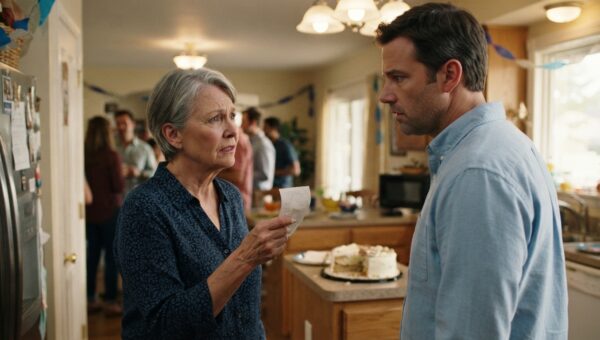
Last Sunday afternoon, all four of them showed up at once. They didn’t call first. They just parked their trucks and SUVs all over the gravel drive like they owned the place. Darrell walked through the back door first, smelling faintly of stale cigarette smoke and cheap cologne. His sisters, Brenda, Linda, and Carol, crowded in right behind him, bringing the cold autumn wind into the warm house. They didn’t take off their coats. They didn’t ask how I was holding up. Darrell walked straight to the liquor cabinet in the corner, grabbed Lenora’s good Kentucky bourbon, and poured two fingers into a heavy crystal tumbler without offering a drop to anyone else in the room.
“You took advantage of a dying woman,” Darrell said, turning around with the glass in his hand and his face flushed red. “We all know what you were doing while she was medicated. Mom wasn’t in her right mind those last six months.”
I didn’t answer right away. I just kept my hand resting on the edge of the laminate counter, feeling the little groove where the Formica had chipped away back in the nineties. Brenda crossed her arms over her puffy vest and shook her head, looking at the ceiling like she had a saint for a brother. Linda muttered something about probate court and hiring a real lawyer who wasn’t afraid of a fight. They had their speeches ready. They had practiced them in some parking lot before driving over.
“We’re filing on Tuesday,” Darrell said, taking a slow sip of the bourbon that wasn’t his to drink. “The house gets split four ways. The savings account gets divided. And you get out by the end of the week.”
I didn’t yell. I didn’t cry. I just pulled open the small drawer beneath the silverware tray, reached past the rubber bands, and pulled out the little black thumb drive Lenora had handed me six months before she passed.
I walked over to the old laptop sitting on the kitchen desk and slid the plastic stick into the side port. The little green light blinked twice before steadying.
“What is that?” Carol asked, her voice pitching up just a fraction. “What are you doing?”
I clicked the mouse twice on the video file labeled with today’s date and Lenora’s full name. The speakers on the old machine crackled softly before her voice filled the room. It wasn’t the frail, rattling whisper she had in her final week. It was the sharp, clear voice of a woman who had run a household of five ungrateful children for forty years and hadn’t forgotten a single detail.
“If you are hearing this,” Lenora’s recorded voice said from the small speakers, “it means my children finally showed up after I was gone to try and take what isn’t theirs.”
Darrell froze halfway through lifting his glass to his mouth. The amber liquid sloshed over the rim and hit the linoleum, but he didn’t look down at it. Brenda dropped her arms from her chest. The kitchen went so quiet you could hear the refrigerator compressor humming in the corner.
“I am leaving everything to Audrey because for eleven years I watched my son bleed her dry,” Lenora’s voice continued, steady and unyielding. “I watched Darrell take every dollar she made at that feed store to pay off debts he swore were business loans. I watched him spend her inheritance from her daddy on a truck he smashed up three weeks later. And when I broke my hip, none of you even bothered to check if I had clean sheets. You called once a month to ask if the roof was paid off yet.”
Brenda looked like she had swallowed a lemon. “Mom didn’t say that,” she whispered, taking half a step toward the desk before stopping dead. “She wasn’t well. Audrey must have coached her or something.”
“Shut up, Brenda,” Darrell hissed, his face draining of whatever color it usually held.
Lenora kept talking on the screen. She listed the exact dates Darrell had come to her asking for bailouts, down to the penny. She named the $14,200 he took in 2018 under the guise of buying farm equipment that never arrived. She detailed how Linda and Carol hadn’t visited for Thanksgiving in four years because they didn’t want to be bothered driving fifty miles out into the county. She laid out the whole ugly architecture of their family greed in plain, unvarnished English.
“Mr. Harrison and I spent three hours going over my sound mind and my final wishes,” the recording went on. “The house, the car, and the eighty-seven thousand dollars in the credit union belong to Audrey and nobody else. If any of my children step foot on this property after I am gone, Audrey has my full permission to call the sheriff and have them hauled off for trespassing.”
The screen flickered as the video ended and the file went black. The reflection of the overhead fluorescent light sat right in the middle of the dark monitor. Nobody moved. Nobody breathed. The silence in that kitchen was heavy and thick, filled with the ghost of a woman who had finally told the truth out loud.
Darrell set the glass down so hard on the counter that the crystal cracked right up the side. “You manipulated her,” he choked out, his voice shaking with a rage that had nowhere to go. “You whispered in her ear while she was sick. You stole our inheritance.”
“She was sharper than you ever were, Darrell,” I said, and my own voice sounded stranger to me than Lenora’s did. “She knew every dime you stole from me. And she knew you wouldn’t give me the time of day if I didn’t have a paycheck coming in.”
Linda started crying, but it wasn’t the crying of someone who was sad. It was the ugly, furious weeping of someone who just realized the gravy train had derailed for good. “We’re your family,” she sobbed out toward the empty screen. “We’re her blood.”
“Blood didn’t wash her sheets when she couldn’t get out of bed,” I said, stepping around the table and standing right in front of Darrell. “Blood didn’t sit up with her at three in the morning when the pain medicine wore off. You haven’t cared about this house except for what you could sell off to pay your back taxes.”
Darrell lunged forward a half step like he was going to grab the laptop off the desk, but I didn’t flinch. I just reached down and pulled the thumb drive out of the side port, dropping it right into my apron pocket.
“Get out,” I said.
“Audrey, come on,” Darrell said, his tone shifting instantly from fury to that pathetic, wheedling whine he used whenever the bank threatened to repossess his trailer. “We can talk about this. We’re married. What’s mine is yours, right? That’s what you always said.”
“What’s yours is three months behind on your truck payment and a storage unit full of junk you haven’t looked at since the Clinton administration,” I told him. “And you’re going to need somewhere to sleep tonight because I am changing the locks before dark.”
Brenda and Carol were already heading for the back door, muttering under their breath about lawyers and courts and how crazy the whole family had become. They didn’t look back once. Darrell stood there for another five seconds, his jaw working like he wanted to chew glass, trying to find some leverage that wasn’t there anymore. When he saw the look on my face, he finally turned and followed his sisters out into the yard, slamming the screen door so hard the glass rattled in its wooden frame.
I watched through the small window over the sink as all four of them climbed back into their vehicles. The gravel crunched under their tires in that particular hollow way I had listened to for three long years. They didn’t wave. They didn’t look back at the porch. They just kicked up a cloud of white dust and tore down the drive toward the highway, disappearing into the late afternoon haze.
When the dust settled, the yard was entirely empty. The sun was dropping low behind the pecan trees at the edge of the pasture, throwing long, crooked shadows across the grass. I walked out onto the back porch, letting the screen door shut softly behind me without a slam. The air smelled like damp pine needles and wood smoke from someone burning brush three properties over.
I reached into my pocket and pulled out the small brass house key Lenora had given me the day she signed the papers with Mr. Harrison. It felt cool and heavy against my palm, worn smooth around the edges from years of being carried in the bottom of her apron pocket. For the first time in eleven years, nobody was asking me for money. Nobody was telling me how to spend my time or where I couldn’t go. The house behind me was quiet, solid, and entirely mine. I stood there on the top step, closed my fingers around the little brass key, and took my first real breath in a very long time.