I still keep the 1987 church ledger in the bottom drawer of my oak roll-top desk, tucked right beneath a bundle of old hymnals and a box of dull No. 2 pencils. The cover is faded blue cardboard, soft around the corners from thirty-six years of thumbs turning the pages, and the spine smells faintly of dry basement air and old paper.
Most people would throw out an old account book from an era when groceries cost a fraction of what they do now, but I cannot bring myself to do it. That book holds the exact tally of every wool sweater, every pair of waterproof boots, and every heavy-duty parka bought with parish donations during the coldest winter our town had seen in decades. It also holds the quiet beginning of a story I never expected to see come full circle.
Back in December of 1987, the wind off the northern plains didn’t just blow; it felt like it went right through your ribs, carrying ice crystals that stung your cheeks until they went numb. I was forty-two back then, teaching remedial English at the high school and spending my weekends sorting donated winter gear in the drafty basement of First Methodist. We ran our little drive out of folding tables and cardboard boxes, matching names from the school counselor’s list with whatever coats our congregation could spare.
Most kids got something decent, though a few had to settle for garments that were a little too large or a little too worn at the cuffs. We did the best we could with what the town gave us, week in and week out, praying the heat bills wouldn’t outpace the collection plate.
That was the year Marcus Vance walked into my classroom during third period, shivering so hard his teeth clicked together like loose gravel in a tin can. He was fourteen, painfully thin, and wearing a frayed gray sweater with holes at the elbows that wouldn’t have stopped a summer breeze, let alone a sub-zero blizzard. The other kids kept their distance, not out of cruelty so much as the instinctive teenage fear of anything that looked too fragile to touch. I remember watching him huddle over his wooden desk, rubbing his bare blue hands together beneath the metal edge to catch whatever little warmth the radiator managed to push up through the rusty pipes.
“Marcus,” I said after the bell rang and the hallway cleared out, keeping my voice low so the other stragglers wouldn’t look. “Did you forget your coat at home today?”
He didn’t look up from his desk, staring hard at a smudge of ink on the wood. “It got ruined,” he muttered, his voice barely carrying over the hum of the heater. “My dad had to throw it out.”
I knew about his father, or rather, I knew what the whispers in the teacher’s lounge said about the house down by the rail yards. There was drinking involved, and missed rent checks, and a social worker who visited just often enough to make everyone nervous. Marcus was three meals away from foster care and everyone in town knew it, which somehow made it worse because nobody was actually doing anything about it. He was just another quiet kid slipping through the cracks of a school system that was stretched too thin to catch him.
“Stay right here for a minute,” I told him, grabbing my leather purse off the corner of the grading table.
I didn’t ask permission from the principal, and I didn’t wait for committee approval. I drove straight down to JCPenney during my forty-minute prep period, the snow blowing sideways across the asphalt and frosting my windshield faster than the wipers could clear it. I bypassed the clearance racks and went straight for the heavy winter gear, picking out a solid navy-blue parka with a quilted lining and a thick hood that looked like it could stop a block of ice. It cost forty-seven dollars, which was a good chunk of my grocery money for the week, but looking at the price tag didn’t bother me nearly as much as the thought of that boy walking home in the dark.
When I got back to the school, the hallways were quiet except for the squeak of the janitor’s mop bucket down near the gymnasium. I called Marcus out to the hallway by my classroom door, handing over the brown paper bag without making a big speech about charity or hard times. He pulled the parka out, stared at the dark blue fabric as if it were made of spun gold, and then looked right at me with eyes that were too old for a fourteen-year-old face.
“You don’t have to wear this if you don’t like it,” I said, feeling suddenly awkward. “I can exchange it for a different color.”
He shook his head slowly, gripping the heavy nylon in his thin fists. “Why’d you do this, Mrs. Gable?”
“Because you’re worth keeping warm, son,” I said, smoothing down the collar. “Nobody should have to freeze just because life got complicated.”
He put the coat on right then, zipping it all the way up to his chin, and for the first time all winter I watched his shoulders drop an inch as the shiver finally left his frame. That coat stayed with him through high school graduation, through the years he worked odd jobs around the county, and eventually out into the wider world after his mother passed away and he left town to make something of himself. I didn’t see him for nearly thirty years, though I heard rumors through church circles about how he had gotten into construction management and was doing well for himself over near Amarillo. Life moves fast when you’re busy grading papers and planning the next church bake sale, and memories tend to settle like dust on old furniture.
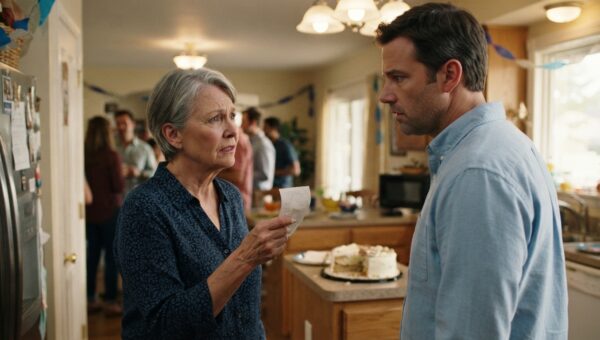
Then came last Tuesday morning, bright and clear with that crisp autumn snap in the air that makes your lungs feel clean. I was sitting at my old desk in the church basement, sorting through the new shipment of winter coats for our annual drive, when the heavy oak door creaked open. Footsteps echoed on the concrete floor, slow and deliberate, coming down the steps past the bulletin board covered in faded flyers. A tall man in a dark canvas jacket walked into the light, carrying a thick manila envelope in one hand and a travel mug in the other. He had silver at his temples and lines around his eyes, but the moment he smiled, I knew the shape of his mouth instantly.
“Mrs. Gable,” he said, stopping a few feet away from my folding table.
I set down a pile of children’s mittens and peered up over my reading glasses, trying to bridge the gap between the fourteen-year-old boy in the frayed gray sweater and the grown man standing before me. “Can I help you, young man? If you’re dropping off donations, the bins are right by the, “
He didn’t let me finish. Instead, he laid the manila envelope right on top of my neat stacks of thermal underwear, tapping the thick paper with one finger.
“Thirty-six years ago,” Marcus said softly, his voice a little rougher than it used to be, “you bought me a forty-seven-dollar parka from JCPenney. You told me I was worthy of warmth. I didn’t have anybody telling me things like that back then, Mrs. Gable. My old man was drinking himself into an early grave, and I honestly thought I was invisible to the rest of the world.”
The silence in the basement felt heavy, filled only with the distant hum of the furnace kicking on upstairs. I could feel my throat tighten up, and I reached out to touch the corner of the envelope just to anchor myself to the moment.
“You were a good student, Marcus,” I managed to say, though my voice sounded thin even to my own ears. “You just needed a little help getting through a rough patch.”
“It wasn’t just a rough patch,” he said, stepping closer and resting both hands on the edge of the table. “I was on the verge of being put in foster care, and that coat, and those words… they kept me from giving up. I kept that coat until the seams literally fell apart during my second year of community college. I still remember the exact feel of that nylon.”
Before I could answer, he pulled the flap of the envelope open and slid a cashier’s check across the metal table toward my coffee mug. I looked down at the numbers written in neat, deliberate blue ink, and my breath caught in my chest. Eight hundred dollars. Not eighty, not eight hundred in loose change, but eight hundred solid dollars meant for our parish fund.
“Take it,” he said before I could push it back. “I’m not dropping off a donation, Mrs. Gable. I’m paying it forward, with interest.”
“Marcus, this is far too much money for an old church drive,” I said, shaking my head and trying to slide the check back toward him. “You earned this. You worked hard for everything you have.”
He reached across the table and placed his hand right over mine, stopping the paper in its tracks. “My name is Marcus Vance, and I’ve spent thirty years remembering how it feels to walk into a school half-frozen and terrified. You didn’t just give me a coat that day. You gave me my dignity back.”
I couldn’t look away from his eyes, seeing the exact same kid who had stood in my third-period classroom shivering by the radiator, only now he was strong enough to carry someone else through the storm.
The next hour passed in a blur of quiet conversation as we sat on the metal folding chairs, drinking lukewarm coffee from paper cups and talking about the way the town had changed over the decades. He told me about his construction business, how he finally bought a home with a big front porch, and how he had come back to town to help out at the local high school where my granddaughter Lily was now enrolled as a junior. When he mentioned Lily’s name, my eyebrows went up in surprise because the world has a funny way of spinning smaller the longer you live in it.
“Lily talks about her English teacher who pushes her to read poetry,” Marcus smiled, leaning back against the metal shelving unit. “Turns out she inherited your stubborn streak.”
We didn’t leave the check in the general parish fund. Instead, we spent the afternoon walking over to the high school principal’s office to talk about how eight hundred dollars could do the most good right where it was needed most. The school cafeteria balance was sitting in the red for dozens of families who were struggling to keep up with rising utility bills and winter heating costs, leaving kids to go through the line wondering if their parents had managed to pay off the weekly debt. Marcus laid out his plan with the quiet authority of a man who knew exactly what hunger felt like when the winter wind rattled the windows.
“We’re going to clear the board,” Marcus told the principal, sliding his check across the polished oak desk. “Every single negative balance, wiped clean today. And we’re going to set up a permanent coat-and-meal pantry right here in the front hallway so no kid ever has to sit through third period shaking from the cold.”
The principal looked from the check to Marcus, and then over at me with absolute astonishment, realizing that this wasn’t just a random donation from an alumnus, but a full circle moment thirty-six years in the making.
By the end of the week, the school board officially launched the Marcus and Evelyn Warmth Drive, backed by the seed money Marcus had brought through the church doors. The cafeteria balance was permanently reset to zero, feeding dozens of stressed families without penalty and taking a massive weight off parents who were working two jobs just to keep the lights on. Marcus became a regular fixture around the school hallways, mentoring kids who reminded him of himself and dropping by my classroom on Friday afternoons to check in on Lily and share a cup of coffee.
Yesterday afternoon, I stood by the second-floor window of the high school building, watching the crisp autumn air stir the dry leaves across the asphalt playground. Down below, Lily was running toward the entrance with her backpack swinging over one shoulder, her cheeks pink from the wind, wearing a thick wool scarf I had knitted for her birthday last month. Right beside the front doors, a brand-new chrome rack sat filled with rows of heavy winter coats in navy blue, charcoal gray, and bright forest green, all lined up and ready for the first hard freeze of the year.
Marcus was standing near the doorway, holding a clipboard and talking to the head custodian about where to set up the new boot boxes for the incoming students. He looked up toward the second-floor window, catching my eye through the clean glass, and gave me a slow, knowing nod that needed no translation at all. I raised my coffee mug in a silent toast, feeling the afternoon sun warm against the glass, and for the first time in a very long time, I didn’t feel the chill of 1987 at all.