The notification on my phone at 4:12 PM was just a reminder about a routine car insurance payment, but looking down at the screen made my stomach drop anyway because my granddaughter Lily had not called me from the driveway like she always did. Instead, the front door rattled off its hinges, and Lily burst into our kitchen with her backpack swinging wildly by a single strap.
Her face was flushed, and her eyes were bright with what looked like terrifyingly fragile tears. She dropped her books right onto the linoleum and stood there catching her breath, her chest heaving under her pink zip-up hoodie. I stood up from the wooden table, my hand still gripping my mug of lukewarm chicory coffee, honestly ready for some crisis about a lost science project or a playground scrap.
“Gram, you are not going to believe this,” Lily gasped, her voice shaking as she tried to wipe her nose with her sleeve. “Nobody had to pay for lunch today. Not a single kid. Principal Miller got on the loudspeaker right before the bell and told us some man paid off the whole school cafeteria debt. Four thousand two hundred dollars. All of it gone. Just like that.” I stared at her, my hand freezing halfway down to the table. Four thousand two hundred dollars is the kind of money local school boards fight over for months, let alone something a stranger covers on a Tuesday afternoon.
Before I could even ask what on earth she meant, my landline on the wall began to ring, piercing the quiet kitchen with a shrill, demanding tone that made us both jump.
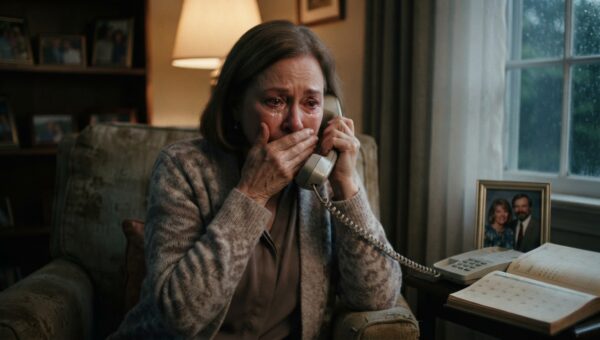
Principal Miller was on the other end before I even finished saying hello, his voice tight and breathless in a way that sounded entirely unlike the steady, mild-mannered administrator I had known for years. He didn’t waste time on pleasantries or check-ins about Lily. “Evelyn,” he said, and I could hear rustling paper in the background like he was shuffling through official documents. “I need you to come down to the administrative office right now. The anonymous donor who cleared the lunch debt left something else behind. It was delivered directly to my desk by hand, and it has your name written across the front in block letters.” My fingers tightened around the receiver until my knuckles turned white.
I asked him what kind of sick joke he was playing at this time of day, but he just cut me off with a quiet, shaky breath. “It’s not a joke, Evelyn. He left an envelope, eight hundred dollars cash, and a note. For the winter coat you bought me in 1987 at JCPenney. I was 9. My mother couldn’t afford one. You paid $47. I never forgot.”
My hands started trembling so badly I almost dropped the phone right onto the floorboards. 1987. Back then, my husband and I barely had two nickels to rub together, but every single winter without fail, I loaded up the trunk of our station wagon with cheap heavy coats from the church charity drive downtown. Dozens of them. Navy blue, hunter green, bright red with slick nylon lining that rustled when the kids walked. Principal Miller paused for a long second, the silence stretching across the phone line until I could hear the faint hum of the school copy machine in the background. “He asked me to read you one thing,” Principal Miller whispered, his voice dropping an octave. “I became a teacher because of you.
I work at this school. I see your granddaughter every day. I never said anything because I didn’t know how to tell you I’m also the boy you saved from the…”
The line went dead silent except for the harsh electronic beep of an incoming call waiting, but Principal Miller didn’t hang up. He just stopped talking right there in the middle of the sentence. I stood in the middle of my kitchen, the smell of damp pine straw drifting in through the open window from the yard, and my brain simply refused to process the words. “Principal Miller?” I managed to get out, my voice cracking down the middle. “Principal Miller, what did he say? Who is it?” But the line clicked, and the dial tone buzzed in my ear like an angry hornet. I slowly lowered the phone back onto its cradle, my chest feeling tight and hollow all at once. Lily was watching me from the kitchen table, her small hands folded tightly in her lap, sensing the sudden terror in the air. “Gram? Who was that? What’s wrong?”
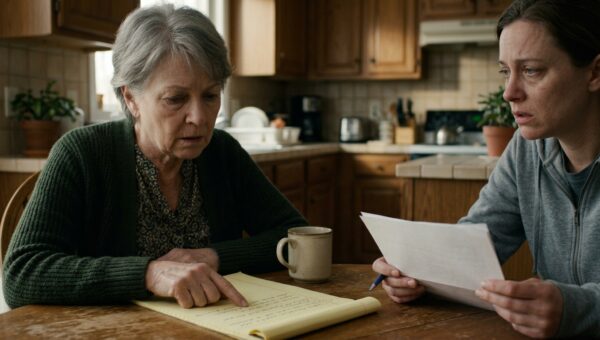
I didn’t answer her right away because I couldn’t find my voice. I walked over to the old roll-top desk in the corner of the living room, fumbling with the brass key that stuck in the lock every time the humidity rose. I pulled out the bottom drawer, shoving aside stacks of old seed catalogs, church bulletins, and bundles of yellowed hymnals until my fingers brushed against a heavy cardboard shoe box. Inside sat my 1987 church ledger, bound in cracked blue vinyl with my maiden name written on the inside cover in faded blue ink. I flipped the stiff pages, the dry paper crackling like dead leaves, until I found the entry for December fourteenth. There it was, written in my own looping cursive: *JCPenney downtown. Four navy parkas, size 10. Total $188.00.* Beside it, I had jotted a tiny, hurried note to myself in the margin: *The little boy with the bruised knuckles and the torn sweater. Paid forty-seven dollars out of grocery envelope. Told him he’d be somebody one day.*
Thirty-seven years had passed since that afternoon in the bustling department store aisle, thirty-seven years of raising kids, burying my husband, working part-time at the hardware store register, and watching the world change into something fast and hard. I looked down at the faded ink in the ledger, then back at Lily, who was standing beside me now with a look of pure confusion on her face. “Get your coat, Lily,” I said, my voice finally steadying into something cold and resolute. “We’re going back to the school.” The drive took less than eight minutes, but every red light on Main Street felt like a deliberate insult. The sun was dipping low behind the water tower on the edge of town, casting long, bruised shadows across the asphalt as I pulled my old Buick into the empty teachers’ parking lot right beside the brick gymnasium wall.
The school was mostly quiet when we walked through the double glass doors, the afternoon janitor already dragging a heavy gray mop down the main corridor and leaving a sharp smell of pine cleaner in the air. Principal Miller was waiting for us by his office door, looking nervous and holding a plain manila envelope in his hand like it might bite him. He didn’t say a word as we approached; he just gave me a solemn nod, turned on his heel, and motioned for us to follow him down the junior wing toward the science classrooms at the very end of the hall. The doors were all closed, except for room 214, where a single square of warm golden light spilled out onto the waxed floor tiles. A hand-painted sign beside the door read *MR. ALBRIGHT – 5TH GRADE SCIENCE*, and underneath it, a taped-up poster of the solar system was peeling slightly at the corners.
Principal Miller stopped right outside the threshold, tapped softly on the wood twice, and pushed the door open just enough for us to see inside. “He’s waiting for you inside, Evelyn,” Principal Miller said quietly, refusing to step through the door himself. “Take all the time you need.” I pushed the door the rest of the way open, my boots making a soft scuffing sound against the linoleum. At the front of the room, standing beside a heavy oak demonstration table covered in glass beakers and jars of colored water, was a tall man in his mid-forties with thinning salt-and-pepper hair and gentle, tired eyes behind wire-rimmed glasses. He was wearing a faded plaid button-down shirt with the sleeves rolled up to his elbows, exposing forearms that bore the faint, pale lines of old scars. When he saw me standing there in the doorway with Lily clutching my hand, he swallowed hard, his Adam’s apple bobbing sharply against his collar.
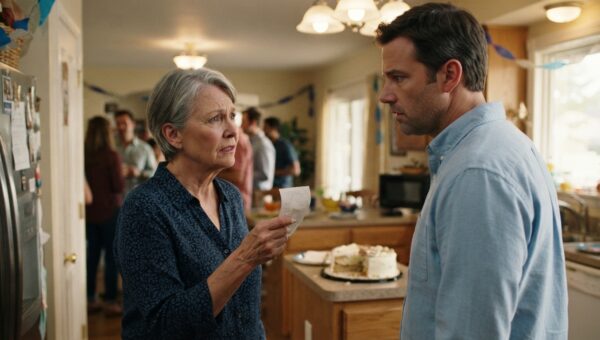
Marcus Albright didn’t smile, and neither did I. We just stood there fifty feet apart in the quiet, dusty room while the wall clock ticked off the seconds with a rhythmic, heavy thud. “You kept the ledger,” Marcus finally said, his voice low and raspy, sounding like a man who hadn’t spoken out loud for hours. I let go of Lily’s hand and took two slow steps forward into the room, my eyes locked on his face as the decades suddenly collapsed into a single, breathless moment. “I keep everything, Marcus,” I whispered, the name tumbling out of my mouth before I even consciously remembered how I knew it. “I remember the coat. And I remember the way you wouldn’t look me in the eye until I bought you that hot chocolate at the lunch counter.” A single tear finally broke free and tracked down the side of his nose, but he didn’t reach up to wipe it away. He just pulled open the top drawer of his desk, reached deep into the back, and laid something small and flat right in the center of the wooden surface.
It was a frayed, yellowed cardboard JCPenney price tag attached to a tiny swatch of dark navy nylon, preserved inside a clear plastic sleeve like a holy relic. Beside it sat the rest of the note, handwritten in the very same careful, upright block letters I had seen in Principal Miller’s office. Marcus walked slowly around the desk, picked up the paper, and read the final words out loud so the quiet room seemed to vibrate with them. “…the boy you saved from the freezing cold, and from believing I didn’t matter to this world.” I stopped walking right in front of him, my chest aching with a heavy, overwhelming warmth that felt like standing too close to a roaring winter hearth after hours in the snow. “You didn’t have to pay off the whole school’s debt, Marcus,” I choked out, my voice breaking entirely. “That must have cost you nearly everything.” He shook his head slowly, looking down at Lily for a brief second before bringing his eyes back to mine with absolute, unwavering clarity.
“Every child deserves a full stomach, Evelyn, just like you told me every child deserves dignity when the world is too cold to care,” Marcus said, his voice steadying now as he handed me the envelope containing the eight hundred dollars cash. “My mother was gone by spring, and social services put me in three different foster homes before I turned twelve. That navy coat was the only thing I owned that winter that didn’t smell like mildew or belong to someone else. You looked at me like I was a person who mattered. You told me I had the kind of mind that would build bridges one day.” He smiled then, a tired, beautiful smile that finally chased away the ghost of the terrified nine-year-old boy shivering in the department store aisle. “I didn’t build bridges, but I became a teacher. And every time I look at a kid in my room who’s sitting a little too quietly or wearing shoes with holes in the soles, I try to give them a piece of what you gave me.”
Lily looked up between the two of us, finally understanding the invisible thread that had connected our lives across thirty-seven years without either of us ever knowing it was there. I took the eight hundred dollars, not as a repayment of a debt, but as something far more sacred, and I placed my hand over Marcus’s rough, scarred forearm. “We’re going to take this money, and we’re going to start a brand new permanent coat drive right here at this school, Marcus,” I told him, my voice firm and clear in the quiet classroom. “You and me and Lily. And we’re going to make sure no kid in this county ever has to wonder if someone noticed they were cold.” Marcus nodded, his eyes shining in the golden afternoon light as he reached out and gently pulled Lily and me both into a tight, grounding embrace that felt like coming home after a very long journey.