The laundry basket was sitting by the back door because I always check the pockets of David’s heavy winter coats before they go into the wash at the change of the season. After sixteen years of marriage, you learn that leaving a foil gum wrapper or a stray ink pen in a wool pocket means a ruined load and an afternoon of scrubbing blue stains out of the drum.
This coat was his favorite, a heavy charcoal wool he had worn through sixteen bitter winters of commuting to the grain elevator office. I slid my hand deep into the right pocket, expecting the usual lint and maybe a crumpled gas receipt, but my middle finger caught on something snagged in the torn corner of the inner lining.
I pulled it out and held it up to the kitchen light. It was a small brass key, old enough that the metal had gone dull and dark around the ridges, with a narrow shank and a tiny brass tag dangling from a rusted jump ring. Stamped into the brass in uneven, hammered numbers was a single designation. Unit 38.
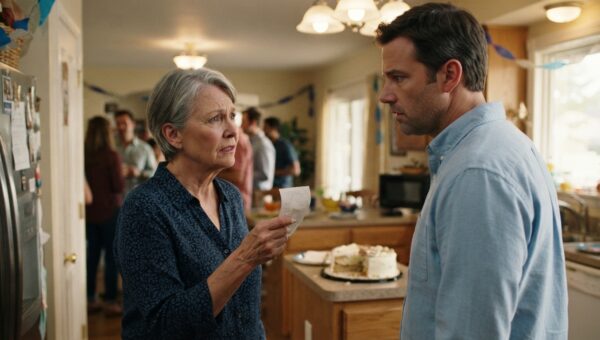
David came into the kitchen five minutes later holding his coffee mug, his graying hair still slightly damp from his shower. I didn’t say anything right away. I just laid the key on the laminate counter right beside his favorite blue mug, the one with the chipped rim.
“Found this in your coat lining,” I said. My voice sounded flat, even to me. “Looks like it goes to a padlock.”
David stopped halfway to the kitchen table. He looked down at the brass key, and for just a fraction of a second, his eyes went wide in a way I had never seen in all our years together. It wasn’t the look of a man trying to remember an errand; it was the look of a man who had just dropped a glass on a hardwood floor and knew it was already shattered before it hit. Then the mask slid back into place, smooth and practiced as an old habit.
“Must be from my old apartment downtown,” he said, taking a sip of his coffee without looking at me. “From back before we got married. I must have shoved it in the lining years ago and forgot all about it.”
I stood there by the sink and looked at him. We had been married for sixteen years, and in all that time, David had never once lived in an apartment that used small brass padlocks on individual doors. His old place on 4th Street had a digital keypad and an intercom.
“We’ve been married sixteen years, David,” I said, keeping my tone level. “And your old place didn’t use keys like that.”
“Well, maybe it was the storage locker behind the hardware store,” he muttered, turning toward the hallway. “Honestly, Clara, I don’t even remember. Toss it in the junk drawer and let’s get moving or we’ll be late for the dinner at my sister’s.”
He walked out of the room, but the casual shrug didn’t reach his shoulders. I watched the way his left hand gripped the coffee mug a little too tight, his knuckles going white beneath the skin.
Two hours later, after dropping him off at his sister’s house under the excuse of a sudden migraine, I didn’t go home. I sat in the idling sedan in the gravel parking lot of the county library and pulled up my phone. I searched local storage facilities within a twenty-mile radius, writing down addresses on the back of an old grocery receipt with a stubby pencil I found in the glove box. There were four places. The first two were modern climate-controlled complexes with electronic gates and digital logs where a brass padlock would be completely useless.
The third one was out past the old rail yards, a weathered place called Prairie View Storage with chain-link fences topped by rusted barbed wire and rows of gray tin lockers that looked like they hadn’t been painted since the eighties.
The office smelled like damp cardboard and stale cigarette smoke. The manager was an elderly man who didn’t look up from his crossword puzzle until I laid a twenty-dollar bill on the counter beside his elbow.
“Unit 38,” I said, repeating the number from the tag. “My husband lost his key. I need a spare cut or help opening it. We’ve been renting it for years and he forgot the number.”
The old man squinted at me over the top of his reading glasses, his rheumy eyes scanning my face with a dull kind of suspicion. He didn’t ask for identification or a signature. People out here don’t bother with formalities when cash is on the table. He reached into a dented metal filing cabinet behind him and pulled out a heavy cardboard ledger, running a yellowed fingernail down a greasy column of names and numbers.
“Unit 38,” he mumbled, licking his thumb to turn a page. “Leased out on a cash rollover every six months. Name on file is Marcus Cole. Paid up through the end of next month.”
Marcus Cole. David’s lifelong best friend and the silent partner in their grain brokerage firm. Marcus, who came over for Sunday pot roast every month, who helped us frame the back deck, and who always brought a cheap bottle of red wine he never drank.
“That’s right,” I lied, my throat feeling dry as sandpaper. “Marcus has been having some health trouble. He asked me to check on a few boxes he left in there.”
The old man grunted, reached into a wooden box of spare keys, and tossed a heavy iron master key onto the counter. “Don’t break the latch. Nobody’s been down that row in months.”
The gravel crunched loudly beneath my boots as I walked down row C, past rows of identical gray doors with faded red stencils. Unit 38 was near the very back, where the chain-link fence met a thick overgrown line of sumac and dry thistle. The padlock hanging from the hasp was an old brass Master lock with scratches across the face.
My hand shook so badly the key rattled against the iron loop twice before I managed to guide it into the cylinder. It turned with a heavy, protesting click, and the metal door swung outward with a long, dry screech that sounded entirely too loud in the quiet afternoon.
I reached inside and flicked the plastic toggle of a battery-powered wall sconce hanging from a nail.
The light washed over a space that made the air catch in my throat. It wasn’t boxes of old college textbooks or spare furniture. It was a bedroom. A small twin bed sat against the back wall, covered in a faded floral quilt that looked like something out of my grandmother’s guest room. Beside it stood a white wooden nightstand holding a small ceramic lamp with no bulb and a paperback book with yellowed pages.
Against the right wall, a tall metal garment rack held a row of dresses and cardigans. I stepped closer, my boots clicking against the bare concrete floor, and reached out to touch the sleeve of a blue wool coat hanging near the front. It was my size. Exactly my size. Not just roughly, but down to the custom sleeve length I always had to alter because my arms are shorter than average. Beside the coats were three pairs of shoes neatly lined up on a plastic mat: two pairs of loafers and a pair of winter boots with the same faux-fur trim I had worn every winter since I was thirty.
Then I looked at the wall above the bed.
Someone had pinned dozens of photographs to the unpainted drywall using rusty pushpins. Photos of a woman with dark auburn hair cut into a blunt bob, wearing a green coat, laughing in front of the county courthouse. Photos of her sitting on a park bench, reading a book, walking down Main Street with a grocery bag in her arms.
I stared at the face in the photographs, and for a terrifying second, I thought I was looking into a mirror. The same high cheekbones. The same small mole just beneath the left corner of her jaw. The same deep-set brown eyes that looked back at me every morning when I washed my face.
Except I had never been to the county courthouse in green wool, and I had never worn that coat in my life.
My heart hammered against my ribs like a trapped bird, but my feet felt glued to the concrete. I backed away toward the open door, my eyes scanning the desk in the corner. On top of the wooden surface sat a thick manila folder held open by a heavy brass paperweight. I stepped forward, reached out with trembling fingers, and pulled the top document loose.
It was a lease agreement, dated November 2013. The monthly rental rate was one hundred and seventy-five dollars, paid in cash every thirty days without fail for eleven straight years. Totaled up in my head with the cold clarity of a ledger, it came to twenty-three thousand one hundred dollars spent on a concrete box to keep an empty room alive.
The signature at the bottom of the lease wasn’t David’s. It was signed in sharp, angular strokes by Marcus Cole.
Beneath the lease was a single clipping from the local newspaper, yellowed at the edges and dated October 14, 2013. The headline read: POLICE STILL SEARCHING FOR MISSING LOCAL WOMAN. Below it was a picture of the woman with the auburn hair, smiling out from the newsprint. Her name was Clara Vance.
I stood there in the dim light of the storage unit for nine full minutes.
My brain refused to move forward, looping instead over sixteen years of quiet dinners, anniversary cards, and David’s steady, comforting hand on my shoulder whenever my mother’s health failed. He hadn’t just married me because he loved me. He had found me because I looked like the ghost he kept locked behind a rusted padlock twelve miles out of town. And Marcus had signed the lease, but David had paid the rent every single month, withdrawing cash in small increments so I would never see it on our joint statements.
The silence inside the unit felt thick, smelling faintly of mothballs and old dust.
I pulled my phone from my coat pocket. My thumb hovered over the screen, steady now with a strange, cold resolve that felt nothing like fear. I dialed three digits and pressed the speaker to my ear.
“State Police dispatch,” a calm voice answered. “What is your emergency?”
“My name is Clara Cole, Clara… Clara Vance,” I started, then caught myself, my voice hitching before I leveled it out. “My name is Clara Peterson. I’m at Prairie View Storage off Route 9. Unit 38. You need to send investigators here right now. I found a missing person’s shrine, and my husband has been paying the rent on it for eleven years.”
Detective Miller arrived forty minutes later in an unmarked gray sedan, his breath pluming white in the freezing dusk. He didn’t look like the television detectives; he looked tired, wearing a worn leather jacket with the cuffs frayed and a paper cup of lukewarm coffee in his hand. He stepped into Unit 38, took one look at the pinned photographs on the wall, and let out a long, low whistle through his teeth.
“Well,” Miller said, shining his heavy metal flashlight across the floral quilt. “I’ll be damned. We closed this active file down to a cold cold-case back in fourteen. Marcus Cole was our primary person of interest from day one, but we never found a body, and his alibi held up just enough to keep us off his back.”
“David paid the rent,” I said, standing just outside the open door with my arms crossed tight over my chest. “Twenty-three thousand one hundred dollars over eleven years. Every month like clockwork. Marcus signed the paper, but David funded it.”
Miller turned to me, his eyes sharp in the flashlight beam. “You’re David Peterson’s wife? The woman he married back in two thousand and eight?”
“Sixteen years ago,” I said. “And I look just like her because that’s why he married me.”
Miller didn’t offer any comforting platitudes. He didn’t tell me it was going to be alright or that I misunderstood. He just nodded slowly, pulled a pair of latex gloves from his pocket, and snapped them onto his large, calloused hands.
“Let’s see what else is in here,” he muttered, walking over to the metal desk.
He didn’t have to look long. Using a small penknife, he popped the latch on an old iron lockbox tucked underneath the twin mattress. Inside sat Clara Vance’s original driver’s license, her leather-bound personal journal with the cover warped from dampness, and a heavy silver wristwatch with the crystal cracked right across the face and the hands frozen permanently at 11:42. Etched on the back of the watch case was a single set of initials: M.C.
“Marcus’s watch,” Miller said, holding it up by the strap without touching the face. “And her diary. This changes everything we thought we knew about that night.”
We were still standing in the open doorway when headlights swept across the gravel driveway outside. A dark sedan bounced down the uneven lane between the storage lockers and pulled to a halt ten feet from our vehicles. The engine cut off, and the door swung open before the headlights died.
David stepped out into the cold air, his coat unbuttoned, his face pale and twisted into an expression of frantic panic I had never seen on him before.
“Clara?” he called out, his voice cracking slightly as he hurried toward us. “Thank God. Your sister called me, she said you never made it to dinner, and I tracked your phone, what on earth are you doing out here in this godforsaken place?”
He stopped dead in his tracks five feet away as he saw Detective Miller standing in the doorway of Unit 38 holding the iron lockbox.
David’s gaze darted from Miller to me, and for a second, his mouth opened and closed like a fish out of water. The confident, dependable husband of sixteen years evaporated right there in the gravel dust, leaving only a scared, cornered man.
“Miller,” David breathed, his voice dropping to a harsh whisper. “What is this? What’s going on here?”
“We just found Clara Vance’s belongings, David,” Miller said, stepping out of the unit and letting the heavy metal door bang shut behind him. “And Marcus’s watch. Looks like you’ve been keeping a very expensive museum open for a long time.”
“I didn’t touch her!” David yelled, his voice suddenly rising high and frantic, cracking in the cold air. “It was Marcus! Marcus lost his head when she threatened to go to the bank examiner about the embezzled accounts in thirteen! I just helped him clean up the mess so he wouldn’t drag us both down! I kept the room because I couldn’t let him destroy the only piece of her left, “
He stopped abruptly, his chest heaving, his eyes darting back to me. The confession hung in the freezing air between us, sharp and undeniable as a gunshot.
“You helped him,” I whispered, the words feeling heavy and dead in my mouth. “She threatened to expose your books, Marcus killed her, and you helped him hide the body and set up this shrine.”
“Clara, listen to me,” David pleaded, taking a step forward with his hands raised, his fingers trembling. “I protected us. I built a life with you. You have to understand, when I met you at the bookstore, you looked so much like her it felt like a second chance, “
“Don’t you ever say my name again,” I said.
Detective Miller didn’t wait for David to finish. He stepped forward, grabbed David’s right arm with practiced efficiency, and forced him down against the hood of the sedan, snapping the steel cuffs onto his wrists with a sharp, metallic click. David didn’t fight back. He just slumped forward against the cold metal, his forehead resting against the frost-covered paint, staring down at the gravel as Miller read him his rights.
An hour later, sitting in the back of a warm patrol car while crime scene techs swarmed the facility with floodlights, Detective Miller handed me a sealed plastic evidence bag containing my car keys and my handbag.
“We’ve got Marcus in custody at his home across town,” Miller said through the rolled-down window. “And your husband just traded the location of Clara’s remains up in Marcus’s timber lot for a shot at avoiding life without parole. It’s over, Mrs. Peterson. You’re safe.”
“My name isn’t Peterson,” I said, looking out at the flashing red and blue lights reflecting off the wet tin roofs. “It’s Clara.”
Three days later, the house was quiet. The joint bank accounts had already been frozen by court order, and my lawyer had filed for an immediate emergency annulment based on fraud and criminal conspiracy. The police had removed every box, every photo, and every stitch of clothing from Unit 38, leaving the concrete box completely bare.
I stood in the upstairs bathroom of our home with a pair of sharp stainless-steel kitchen shears in my right hand.
I looked at my reflection in the medicine cabinet mirror. For sixteen years, I had kept my hair long and pinned back in the exact style David liked, wearing the green wool coats and the soft cardigans he bought me for every birthday and Christmas. Every choice I had made about how I looked, how I dressed, and how I carried myself had been gently shaped by a man who was loving a ghost through my skin.
I gathered my dark auburn hair into a tight fist at the base of my neck, right above my collar, and brought the blades down.
The sound of shearing hair was loud in the small, tiled room. Clumps of heavy hair fell into the porcelain sink like dark autumn leaves, hitting the white surface with soft, dry thuds. I cut it shorter and shorter until the weight of it was gone from my shoulders, leaving a sharp, modern crop that looked nothing like the woman in the faded photographs pinned to the storage unit wall.
When I was finished, I swept the dark locks off the floor into a neat pile and threw them straight into the kitchen trash can. I walked back to the bathroom mirror, looked straight into my own eyes without a trace of hesitation, and turned on the faucet to wash my face.