PART 1
The wicker laundry basket sat right in the middle of our worn kitchen linoleum, holding three pairs of beige socks with the toes darned twice, an old hairbrush with two missing teeth, and a small stack of faded photographs from our anniversary trip up to Door County. My son David stood by the pantry with a roll of brown packing tape tucked neatly under his arm.
His face had that tight, reasonable look it always wore when he had decided on a course of action and expected no argument from anyone.
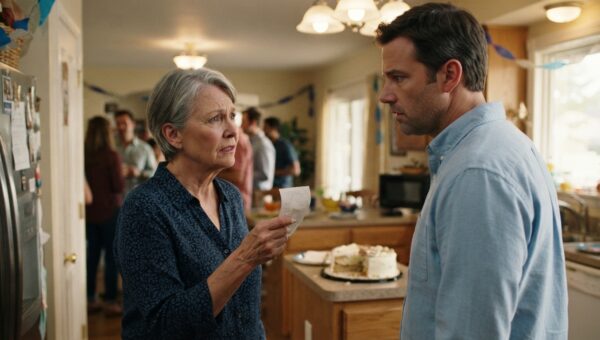
“We found a very nice room at Oakridge,” David said, dropping his voice into that smooth, patient register people use when they are explaining something complicated to a child or a patient. “They have three meals a day served in the main dining hall, a nurse on duty around the clock, and a sunny courtyard with bird feeders. It is time, Mama. You cannot keep managing this house by yourself.”
I did not answer right away. I sat at the laminate table with a blue plastic cup of lukewarm water between my hands, watching my thumb trace the wet rim. For three years, since the stroke took most of Arthur’s coordination and left his speech tangled into thick, heavy knots, my world had shrunk to these four walls, the hallway rug, and the small bedroom where my husband slept under a blue patchwork quilt.
“The stairs are getting dangerous,” Sarah chimed in from the doorway. She was David’s wife, wearing a lavender cardigan that smelled faintly of dry cleaning and peppermint. She held a stack of empty cardboard boxes, her eyes carefully avoiding Arthur’s empty chair by the radiator. “And your memory, Margaret. Well, you forgot the casserole in the oven last Tuesday. The smoke detector went off for twenty minutes before the neighbors finally called.”
“I was helping Arthur with his afternoon stretches,” I said quietly, keeping my eyes on the blue plastic cup. “The timer was ticking, but I didn’t hear it over the radio.”
“That is exactly what we mean,” David said, stepping closer and dropping the tape onto the table with a dull thud. “You are seventy-six years old. You are looking after Arthur in a house that is falling apart, and frankly, you are starting to lose track of things yourself.
We talked to the estate attorney yesterday. Your thirty thousand in savings will cover a year at Oakridge, and we can list the house in the spring to pay for the rest.”
Thirty thousand dollars. That was the money we had set aside from the sale of Arthur’s machine shop back when he retired, kept in a separate account at the credit union on Fifth Street for emergencies. They had already figured out how to spend it. They had already calculated the exact cost of my absence.
David walked over to the sideboard and picked up our framed wedding portrait from 1972, running his thumb over the glass. “It is the safest choice for both of you. Arthur will get professional nursing care, and you can finally get some rest. You have earned it, Mama.”
“And Arthur?” I asked. My throat felt dry, like swallowing coarse meal. “Where does Arthur go?”
David hesitated for half a second, his gaze flickering toward the hallway before coming back to me. “There is a specialized wing at Oakridge for assisted living residents with mobility issues. They have aides to help him. It is better than this house, Margaret. Look around. You are exhausted.”
I looked around the kitchen. The yellow walls were scuffed near the back door where Arthur used to bump his walker before his legs gave out entirely. The calendar on the wall was turned to July, but the little square for today had a neat, precise circle drawn around it in blue ink, followed by four lines of tiny numbers and times written in my own hand.
“I am not exhausted,” I said, though my voice sounded thin even to my own ears. “I am just busy.”
Sarah sighed, a soft, sympathetic sound that annoyed me more than shouting would have. “Denial is a very common stage, the social worker at the clinic told us. We already have the movers coming on Monday morning. Just pack what fits in two suitcases, Mama. We will handle the rest.”
PART 2
Sunday dinner was supposed to be a farewell gathering, though nobody called it that. David and Sarah had brought a roasted chicken from the grocery store deli in a plastic container that was already cooling on the counter, along with a paper bag of rolls and a tub of potato salad.
Arthur sat at the end of the table in his wheelchair, wearing his plaid flannel shirt buttoned crookedly at the collar. He didn’t say much anymore; most of his words got stuck behind his teeth, turning into low, frustrated grunts. But he knew what was happening. I could see it in the way his cloudy blue eyes kept darting toward the front door, tracking our movements with a quiet, panicked vigilance.
The six of us sat around the table in the fading evening light. David talked about the real estate market, explaining to his teenage daughter, Chloe, how selling our house would help pay for her college fund in four years. Chloe was fourteen, scrolling through her phone under the edge of the table while pretending to listen.
“Grandma’s house has good bones,” David said, carving a dry chicken breast with the electric knife we rarely used. “Once we update the kitchen and put in new carpets, we should clear at least two hundred thousand after the mortgage is settled.”
“And what about me?” Arthur muttered suddenly, his voice thick and gravelly from the back of his throat. He pointed a trembling, stiff-fingered hand toward the living room rug. “Where… where…”
“You are going to a wonderful place, Dad,” David said quickly, not looking up from the chicken platter. “A place with doctors right down the hall. You won’t have to worry about Mama trying to lift you out of bed anymore.”
Arthur made a low, rattling sound in his chest and dropped his hand into his lap. His head sank toward his chest.
I reached out across the oilcloth tablecloth and covered his gnarled hand with mine. His skin felt like old parchment, cold and dry. For three years, since the stroke robbed him of his independence, every single day had been built around the exact rhythm of his body. I knew the precise hour his muscles would start to cramp in his left calf. I knew how many milligrams of his medication he needed so his body stayed steady. I knew the exact angle to lift him by his belt loops so his bad knee wouldn’t buckle.
Nobody else knew. David came by once every two weeks for twenty minutes, brought a bag of groceries, checked the mail, and told me I looked tired. Sarah called on Tuesdays to ask if I needed anything from the pharmacy, then changed the subject to her garden club. They saw an old woman forgetting where she put her glasses, and they assumed the rest of the machinery had stopped turning entirely.
“Thirty thousand dollars,” David repeated, as if trying to reassure himself more than us. “It will cover the intake fee and the first six months. After that, we can apply for the state subsidy.”
“It’s not enough,” I said.
David paused with the carving fork in his hand. He looked across the table at me, a polite, indulgent smile forming at the corners of his mouth. “Mama, we checked the rates. Thirty thousand is plenty for the transition period. We aren’t letting you spend your last dime on a private room when Oakridge has government-backed beds available.”
“The money in the credit union isn’t for the home,” I said, my voice rising just enough to cut through the hum of the refrigerator.
David let out a short, dry breath through his nose. “Then what is it for? You don’t travel. You haven’t bought a new coat since Dad got sick. That money is sitting there doing nothing while you’re burning dinners and losing track of your medication.”
Before I could answer, little seven-year-old Lily, David’s youngest, looked up from her paper plate of potato salad. She had a smudge of yellow mustard on her cheek and a piece of chicken skin dangling from her fork.
“Grandma doesn’t forget medicine, Daddy,” Lily piped up in her clear, high-pitched child’s voice. “She gives Grandpa his shots every morning and every night. She never forgets that.”
PART 3
The kitchen went entirely still.
The hum of the refrigerator seemed to double in volume, vibrating through the floorboards under my slippers. David’s hand froze with the carving fork halfway to the platter. Sarah stopped buttering her roll, the yellow plastic knife hovering an inch above the bread. Chloe looked up from her phone, blinking as if she had just woken up from a nap.
David slowly lowered the fork to the table. He looked at his daughter, then back at me, his forehead wrinkling into hard, suspicious lines. “What shots, Lily? What is she talking about?”
Lily pointed her fork directly at me, entirely unaware of the sudden ice in the room. “The little bottles in the fridge. The ones with the tiny needles. Grandma does them on his belly every day at breakfast and before the cartoons come on.”
David turned his head slowly toward me. His mouth opened slightly, then closed. “Insulin?” he asked, his voice dropping into a flat, dangerous whisper. “Dad doesn’t have diabetes.”
“He has type two, David,” I said, my hand still resting over Arthur’s cold fingers. “It started six months after his stroke. The doctor at the clinic prescribed a twice-daily regimen. If I miss a dose, his sugar spikes, his kidneys start to fail, and he goes into a coma within forty-eight hours.”
Sarah dropped her butter knife. It hit the laminate table with a sharp clatter that made Lily jump. “Wait a minute,” Sarah said, her voice rising in sudden, panicky disbelief. “You’ve been giving him insulin? Who monitors his blood sugar? Who calculates the units?”
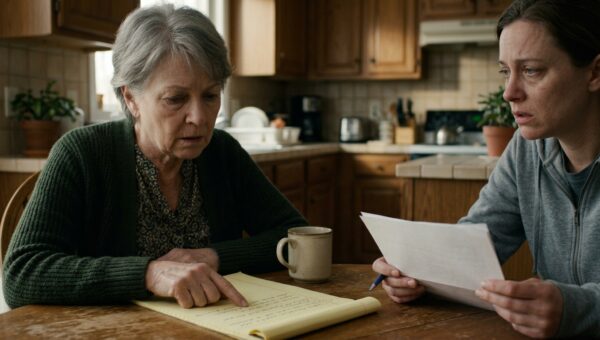
“I do,” I said. “Every morning at six and every evening at eight. I use the digital meter on the counter. I keep a log in the blue notebook by the telephone.”
David stood up so fast his wooden chair scraped loudly against the linoleum. He walked over to the kitchen counter, shoved aside the box of packing tape, and yanked open the small refrigerator door. He stared at the door shelf for five seconds, his hand hovering over the small carton of insulin vials and the plastic box of sterile syringes I kept tucked behind the creamer.
Then he pulled out a small black leather notebook with dog-eared pages, flipped it open, and stared down at columns of numbers written in my neat, precise cursive, tracking blood glucose readings, carbohydrate grams, and insulin dosages down to the half-unit for the last nine hundred days.
He slowly closed the notebook. He didn’t look like an efficient son managing his mother’s affairs anymore. He looked like a man who had just walked off a cliff and only now realized there was no ground beneath him.
“If you go to Oakridge,” David whispered, staring at the notebook in his hand, his voice shaking with a sudden, ugly realization. “If you go to the home… then who’s been…”
“Nobody,” I said, standing up from my chair. My knees gave a faint, familiar pop, but I didn’t lean on the table for support. “The aides at Oakridge don’t do individualized sliding-scale injections for stroke patients unless you pay an extra twelve hundred a month for private nursing care. And thirty thousand dollars wouldn’t have covered four months of that.”
David stood frozen by the refrigerator, the black notebook dangling from his fingers. “You were paying for his private nursing hours out of your own savings?”
“I was paying for the medication and the supplies that Medicare didn’t cover,” I said, looking straight into his eyes. “And the rest of that thirty thousand was sitting there because I knew that the day you and Sarah finally decided I was too old to live in my own house, you would try to strip every last cent we had to pay for my room, leaving Arthur in a facility that doesn’t even know how to time his meals.”
Sarah stood up, her face flushed red, her hands trembling as she grabbed the back of her chair. “Why didn’t you tell us? You let us sit here and talk about selling the house! You let us pack your boxes!”
“You didn’t ask,” I said simply. “You didn’t ask how he was eating. You didn’t ask how he was walking. You didn’t ask why his blood pressure machine was sitting on the sideboard. You only asked if I was ready to leave.”
ENDING
The house was so quiet we could hear the distant hum of traffic on Route 4 coming through the closed kitchen window. David looked down at the black notebook in his hand, then across the table at his father, who was staring blankly at the empty potato salad bowl.
David didn’t say anything about the movers coming on Monday morning. He didn’t mention Oakridge again, or the real estate agent, or the college fund. He just set the black notebook down very gently next to the tape dispenser, walked out the back door without his jacket, and sat down on the top step of the wooden porch in the dark.
I watched him through the screen door for a moment, his shoulders slightly hunched under his blue shirt, his hands empty. Then I turned back to the table, picked up Arthur’s fork, and helped him finish his roll before it got cold.