PART 1
The linoleum in Mama’s kitchen had a small burn mark near the stove where she dropped a skillet of bacon grease back in nineteen ninety-four, and after she passed away, that burn mark was the first thing my eyes found. Her house smelled of old Pine-Sol and dried peppermint, the scent she carried on her sweaters even when she wasn’t baking.
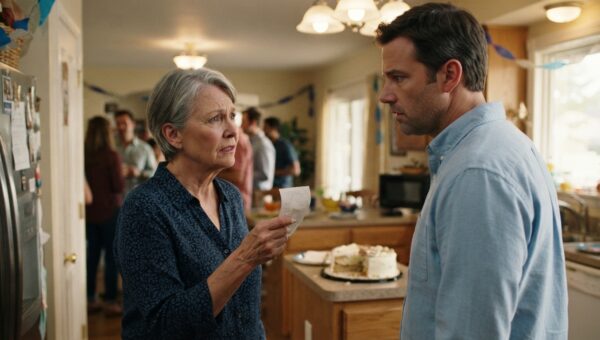
My brother Russell was standing by the kitchen table with a black Hefty bag in his hand, already tossing out expired cans of creamed corn and boxes of saltines that had gone stale during the winter.
“We need to clear this place out by the weekend,” Russell said, not looking up as he shoved three jars of pickled beets into the garbage. “The realtor is coming Monday morning to put the sign in the yard. We can’t be tripping over forty years of junk when people come to look at the floors.”
I didn’t answer right away. I was standing by the pantry, my fingers resting on the white wooden shelf where Mama kept her baking supplies. Behind a sack of unbleached flour sat the old yellow metal tin with the faded painted daisies on the lid, the one she had used since I was twelve years old. For as long as I could remember, whenever Russell or I asked her for extra grocery money for school pictures or new shoes, she would tap the lid of that tin with her knuckle and say the same thing.
“Touch anything else in this house if you have to,” Mama would tell us, her voice sharp as a tack, “but you leave that flour tin alone. That is for the winter when the heat goes out.”
Russell reached out, grabbed the tin by its side, and gave it a shake. A dry, muffled rustle came from inside, followed by a light puff of white dust that escaped under the lid and settled on the dark wood of the shelf.
“Probably just recipes and old coupons,” Russell muttered, setting it down on the counter with a hollow clatter. “Mama loved keeping receipts from nineteen eighty-five like they were gold bars. Toss it in the bin, Linda. We have twenty boxes to pack before dark.”
I reached out and pulled the tin toward me. It felt heavier than an empty canister should feel. I slipped my thumbnail under the stiff metal edge and popped the lid off.
A cloud of fine flour dust drifted up into the afternoon light, smelling of old wheat and time. Inside, beneath a layer of white powder, sat a thick stack of banded currency wrapped in greaseproof paper, along with a folded piece of lined notebook paper covered in Mama’s cramped, precise handwriting.
I pulled the paper out first. The ink was slightly faded blue ballpoint.
Fairly, I’m sorry, Linda, it began, using the old nickname she had given me when I was little because I was always quiet and fair-haired. If you are reading this, Wayne took everything else, but he never found the flour tin.
My heart gave a heavy, slow thud against my ribs. Wayne was our stepfather, the man Mama had married six years after our father died in the delivery-truck accident on Route 9.
“What’d you find?” Russell asked, pausing with another Hefty bag halfway open. “More of her sewing scraps?”
I didn’t tell him about the money yet. I didn’t tell him about the note.
I tucked the folded paper into the pocket of my cardigan and pulled the stack of banded bills out of the flour.
I peeled back the greaseproof paper. Underneath sat neat rows of fifty and hundred-dollar bills, crisp and old-fashioned. When I counted them right there on the kitchen counter while Russell went back to clearing out the junk drawer, the total came to eighteen thousand, nine hundred and forty dollars.
PART 2
Russell dropped a handful of plastic forks into the trash bag and looked over his shoulder. He saw the bills fanned out on the laminate counter between us, and his eyebrows went up, his mouth opening in a dry, disbelieving half-smile.
“Where’d she get that?” he asked, taking a step closer. He reached out a hand as if to touch the hundred-dollar bills, but I pulled the stack back toward my chest. “Is that cash? Mama had nearly twenty grand sitting in an old baking tin?”
“She didn’t have twenty grand in ninety-nine when the roof leaked,” I said, my voice dropping into a flat, hard register. “Remember? We had to borrow five hundred from Uncle Ray just to patch the shingles over your bedroom because Mama said her accounts were cleaned out by the hospital bills from Wayne’s back surgery.”
Russell shrugged, his shoulders lifting under his plaid shirt. “Well, people squirrel money away. You know how the old generation is. They don’t trust banks after the crash. Put it in the estate pile, Linda. The realtor said we split everything fifty-fifty after expenses.”
“It’s not estate money, Russell,” I said, holding up the folded piece of lined paper. “Read what she wrote. She says Wayne took everything else.”
Russell waved a hand dismissively. “Wayne’s been dead for three years, Linda. You’re digging up old things. Wayne was a good enough stepfather. He took us to the lake, didn’t he? He bought us those bikes when we turned fourteen.”
“He bought them with what?” I asked, looking straight into Russell’s eyes. “Do you remember the delivery-truck accident on Route 9 when I was seventeen? The one that left me in a fiberglass hip cast for four months?”
Russell frowned, shifting his weight from one foot to the other. “Of course I remember. You stayed in the spare room with that metal frame over the bed for half a school year.”
“And do you remember what Mama told us happened to the seventy-thousand-dollar settlement check from the trucking company?” I asked, my fingers tightening around the paper in my pocket. “She told us every single cent went to pay the county hospital bills and the orthopedic surgeon in Indianapolis. She told us we didn’t have a dime left over for college because my body cost too much to fix.”
Russell stared at me for a second, then let out a dry, uncomfortable laugh. “Well, it did cost a lot. Medical care is highway robbery. Everybody knows that.”
“Except Wayne didn’t pay the hospital,” I said, my voice barely above a whisper. “Look at the rest of this note.”
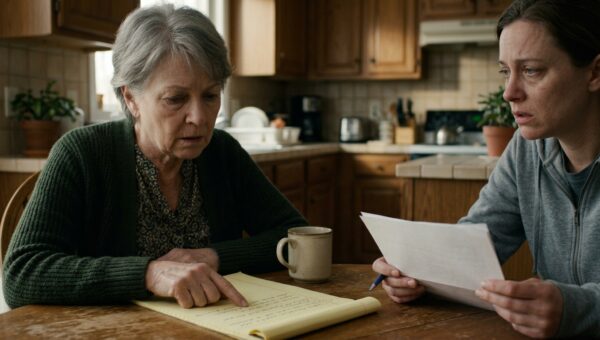
I unfolded the paper and read the second paragraph aloud to the empty kitchen.
Wayne took the settlement check from my drawer while I was at the physical therapy clinic with Linda in ninety-eight, Mama had written in her shaky, stubborn hand. He said he was putting it in a high-yield CD for our retirement. By the time I found out he had put it into his own secret account and gambled it away at the riverboat in Evansville, there was nothing left to sue for without losing the house. I made him pay back every dollar he could scrape together over ten years, five hundred at a time, hidden right here where he was too lazy to look.
The kitchen was so quiet we could hear the refrigerator compressor humming in the corner. Russell stopped smiling. He looked down at the stack of bills on the counter, then back at me, his face turning pale around the edges.
“That’s…” Russell swallowed hard. “That’s impossible. Wayne was always so quiet. He sat in that recliner every night watching the news. He didn’t gamble.”
“He gambled,” I said. “And Mama spent ten years hiding eighteen thousand, nine hundred and forty dollars in a flour tin so the man who stole my college fund wouldn’t spend a single nickel of it before she died.”
PART 3
By five o’clock that afternoon, Russell had gone home to his wife in Greenwood, claiming he had dinner plans and didn’t want to get mixed up in old family history that couldn’t be fixed anyway. He told me to lock the back door when I left and put the key under the ceramic flowerpot by the hose.
I didn’t lock up and I didn’t go home. I got into my sedan with the flour dust still streaking the sleeves of my cardigan, put the brown paper bag containing the eighteen thousand, nine hundred and forty dollars on the passenger seat, and drove straight down to First County Bank on Main Street.
The parking lot was nearly empty except for two cars by the drive-through lane. Inside, the carpet was the same navy blue it had been when Mama opened her savings account back when the town still had a textile mill. The teller on duty was a young woman named Chloe whom I had gone to church with when she was in the youth choir.
Chloe looked up from her computer terminal as I laid the brown paper bag on the counter and slid the stack of banded bills out onto the marble slab.
“I need to deposit this into a separate trust account,” I told her, my voice remarkably steady. “And I need to pull every bank record associated with a joint account held by Arthur Wayne Miller and Helen Miller between nineteen ninety-five and two thousand and five.”
Chloe blinked, looking at the old-fashioned fifty-dollar bills with their small portraits. “Mrs. Miller… these are pretty old notes. Some of these series haven’t been in circulation for years.”
“They were stored in a dry place,” I said. “Can you run the microfilms for Wayne Miller’s accounts? I have the probate letters right here.”
It took forty minutes. Chloe disappeared into the glass-walled back office twice, talking in low tones to the branch manager, an older man named Mr. Henderson who had known my father before the truck accident on Route 9.
When Mr. Henderson finally walked out to the counter, he wasn’t holding deposit slips. He was holding a thick manila folder with yellowing tabs marked Miller Estate – Archive.
“Your mother came in here once a year, Linda,” Mr. Henderson said quietly, resting his forearms on the glass partition. “She never made a withdrawal from that secondary safety deposit box she rented back in ninety-nine. But I remember when Wayne tried to clear out the joint checking account after the settlement funds cleared. Your mother raised holy hell right at this counter. She couldn’t stop him from taking the first lump sum because his name was on the signature card as power of attorney, but she made sure every subsequent payment he forced out of him went directly into cash notes she could bring home herself.”
“He stole my future,” I said, looking down at the marble counter. “And she spent ten years getting a fraction of it back one fifty-dollar bill at a time.”
Mr. Henderson slid the manila folder across the counter toward me. Inside were the certified copies of the bank transfers, the withdrawal slips signed in Wayne’s spiky, hurried handwriting, and a signed affidavit from Mama dated 2004 detailing every dollar he had siphoned from the household while she worked thirty hours a week at the dry cleaner’s.
“Your brother didn’t know?” Mr. Henderson asked softly.
“Russell didn’t want to know,” I said. “It’s easier to pretend the floor is clean if you sweep the dirt under the rug.”
ENDING
The sun had dropped below the courthouse dome by the time I walked back out to my car. The evening air smelled of damp asphalt and coming rain.
I set the brown paper bag on the passenger seat next to my purse. I didn’t feel triumphant, and I didn’t feel like celebrating a victory over a dead man who had lived out his days in a vinyl recliner watching the evening news. The eighteen thousand, nine hundred and forty dollars wouldn’t bring back the years I spent working night shifts at the diner to pay for my community college credits. It wouldn’t give back the hips that still ached whenever a cold front rolled in off the river.
When I pulled into my driveway on Maple Street, the porch light was on, casting a small, warm circle over the welcome mat. I took the flour tin out of my tote bag, set it on the kitchen counter next to the kettle, and wiped the remaining white dust off the lid with a damp sponge.
I left the eighteen thousand, nine hundred and forty dollars in the bank under a new account in my own name, but I kept the tin right where Mama had left it.
I filled the kettle, struck a wooden match against the box, and waited for the blue flame to catch under the burner.