PART 1
The heavy wool of my husband Paul’s winter coat always smelled faintly of cedar and dry cleaning, a comforting scent that had anchored our sixteenth winter together in the house we bought on Maple Street. Paul had tossed it over the oak armchair by the front door on a Tuesday evening when the wind off the lake rattled the storm windows.
When I picked it up to hang it in the hall closet, a heavy clink hit the hardwood floor with a sharp, metallic ring.
I bent down and picked it up. It was a small brass key, old-fashioned and unpolished, with a jagged edge. Stamped neatly into the flat head of the brass was a set of numbers and letters: Unit 38.
When I asked Paul about it over dinner while we were eating leftover pot roast, he didn’t look up from his plate immediately. He pushed a potato around in the gravy, his hand steady, before giving me a half-smile that didn’t reach his eyes.
“Must be from my old apartment downtown,” he said, his voice entirely too casual. “The one on Oak Street. I think I had a storage locker in the basement before we got married.”
“You haven’t lived in that building for seventeen years, Paul,” I said, setting my fork down on the edge of the stoneware. “And the management company tore down those basement lockers when they renovated in two thousand and eight.”
He blinked then, a micro-second hesitation that I would have missed if I hadn’t known the rhythm of his breathing after sixteen years of sharing a pillow.
He reached for his water glass, took a slow sip, and shrugged. “Well, memory plays tricks. Might be from an old toolbox at the garage. Don’t worry about it.”
He dropped the key into the ceramic catchall dish by the sink the next morning before leaving for his job at the county water department, but the small weight of it stayed in my mind. By Thursday afternoon, I couldn’t shake the nagging grit of doubt. Paul had never kept old keys. He was meticulous, throwing away expired coupons, old receipts, and broken tools with ruthless efficiency. An orphaned brass key labeled Unit 38 did not fit his habits.
I drove out to the industrial park on the west side of town where three different self-storage facilities sat back to back against the railroad tracks. The first two places had digital keypads and electronic cards, not physical brass keys. The third facility, Safe Harbor Storage, was an older cinder-block building with rows of green metal roll-up doors rusted at the bottom edges from winter salt.
The office smelled of damp cardboard and cheap coffee. The manager, a tired-looking woman with gray hair pinned up in a clip, looked over my shoulder as I laid the brass key on her counter.
“Recognize this lock pattern?” I asked.
She squinted at the stamped numbers. “Row C. Old building in the back. Built back in ninety-four. We replaced most of those cylinders with digital pads two years ago, but Unit 38 still has the original Yale deadlock because the renter refused the upgrade.”
“Who’s the renter?” I asked, my fingers curling into the edge of the laminate counter.
The manager tapped her keyboard, her fingernails clicking against the plastic keys. “Paul Miller,” she said without looking up. “Paid monthly by automatic check since June of two thousand and fifteen. Eleven years.”
PART 2
I stood in the narrow gravel alleyway behind Row C while the wind stirred up dry autumn leaves against the base of the green metal doors.
The manager had walked back with me, her boots crunching on the gravel, her hand holding a master ring of keys just in case the old brass one jammed in the cylinder.
It didn’t jam. It turned with a heavy, oiled click that echoed off the cinder blocks. The manager pulled the heavy door upward, and a smell rolled out into the cold air that made my stomach drop instantly. It wasn’t the smell of mildew or old tires or boxes of tax forms. It smelled like lavender laundry detergent and stale peppermint, the exact scent of the hand lotion Paul always bought me at the pharmacy for my birthday.
“You need a minute?” the manager asked, her eyes softening as she looked at my face.
“I’m fine,” I whispered, though my knees felt hollow.
I stepped past the threshold into the dim rectangle of the unit. There was no bare concrete floor or dusty furniture. Someone had laid down cheap gray carpet tiles over the concrete. Against the back wall stood a narrow twin bed made up with a pale yellow quilt dotted with small white daisies. Beside the bed was a nightstand with a small ceramic lamp, a box of tissues, and a paperback book with a cracked spine.
In the corner, a metal clothing rack held a dozen plastic hangers. I walked slowly toward them, my hand brushing the fabric of the garments hanging there. A navy blue cardigan with mother-of-pearl buttons. A pair of gray wool slacks. Three cotton blouses in sizes that matched mine down to the quarter-inch. On the floor beneath the rack sat two pairs of walking shoes and a pair of fuzzy winter slippers.
On the small desk underneath a battery-operated wall clock sat a stack of spiral notebooks and a manila folder labeled with a rental agreement. I pulled the folder open with trembling fingers. The name at the top of the lease wasn’t Paul’s, and it wasn’t mine. It was a name I recognized instantly from a framed photograph that had sat on my grandmother’s mantelpiece for twenty years before she passed away.
Clara Vance. My mother’s younger sister, my Aunt Clara, who the family had whispered about at Thanksgiving back in the nineties before she supposedly packed up and moved out to California to start a new life.
A rental fee of one hundred and seventy-five dollars a month, paid faithfully every single month for eleven years. Totaled up in my head with the cold clarity of an accountant, it came to twenty-three thousand, one hundred dollars siphoned out of our joint checking account over more than a decade while Paul told me we needed to watch our pennies for retirement.
I stood there in the quiet bunker for nine minutes, staring at the empty yellow quilt on the twin bed and the framed portrait of my grandmother resting face-down on the nightstand. Then I walked back out to my car, pulled my phone from my purse, and dialed the local sheriff’s department.
PART 3
The deputy who met me at the storage facility was a young man named Henderson whose name tag looked too big for his shirt pocket. He listened to my statement, looked at the lease agreement with Aunt Clara’s name on it, and then walked into the unit with his flashlight beam bouncing off the daisy-quilted bed.
“Mrs. Miller,” he said, stepping back out into the gravel alley and clearing his throat. “You’re saying this woman is your aunt?”
“My mother’s sister,” I said, my arms crossed tightly over my chest against the chill. “My family told me she moved to Sacramento in nineteen-ninety-nine after a bitter falling out over property. Nobody had heard from her in decades. My grandfather took her name off the family bible. We thought she was gone.”
“Well, she wasn’t in Sacramento,” Henderson said, holding up a manila envelope he’d pulled from the desk drawer inside the unit. “According to these medical transport receipts from three weeks ago, she’s been living in a care facility down in Bloomington for early-stage dementia. But she hasn’t been paying for her room out of pocket. Look at the return address on these checks.”
He handed me a folded receipt. The issuing bank was the same credit union where Paul and I held our mortgage. The signature on the bottom of the check was Paul’s neat, precise cursive.
“Why would my husband rent a storage unit to house his aunt’s clothes and keep her hidden from me for eleven years?” I asked, and my voice didn’t shake anymore. It had gone cold and flat, like winter iron.
“That’s something you’ll have to ask him,” Henderson said quietly. “Though I should tell you, looking at the date on these medical intake forms, she was admitted to Bloomington Memory Care the day after your husband visited that facility for a consultation. He didn’t just store her clothes, Mrs. Miller. He’s been maintaining a secret apartment for her right here in town until her health failed last month, and nobody in your family had a clue.”
I drove home with the heater blasting full force against my windshield, but I couldn’t get warm. When I pulled into the driveway at six o’clock, Paul’s sedan was parked by the garage. The kitchen light was on, casting a warm yellow square across the frost-covered grass.
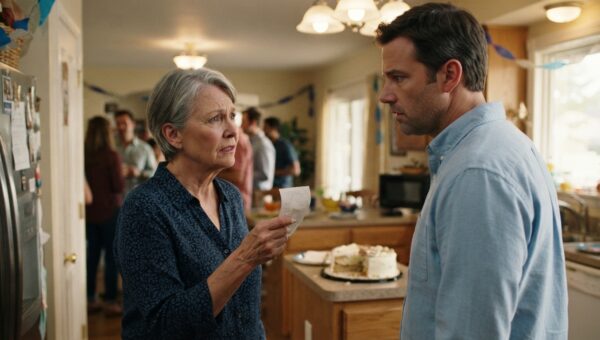
When I opened the back door, Paul was standing by the stove stirring a pot of canned soup. He looked over his shoulder, his face relaxing into that familiar, easy smile he wore when he thought dinner was ready and the world was turning on its usual axis.
“Hey,” he said, turning down the burner. “You’re late. I got worried. Where were you?”
I didn’t take off my coat. I reached into my canvas bag, pulled out the manila folder containing the storage lease and the medical transport receipts, and laid them directly on the clean white tile of the kitchen counter.
Paul’s hand froze over the soup spoon. The smile didn’t fade all at once; it just cracked, the edges crumbling away until his face looked gray and old under the fluorescent light.
“Unit 38, Paul,” I said, and the silence in the kitchen felt heavier than the winter air outside. “Care to tell me why you’ve been paying rent on Aunt Clara’s clothes for eleven years while telling me she was three thousand miles away?”
He didn’t reach for an excuse. He didn’t tell me he was fixing up an old apartment or helping a friend. He pulled out one of the wooden kitchen chairs, sat down heavily, and stared at the linoleum floor between his boots.
“Your father cut her out of the will before he died,” Paul whispered, his voice cracking on the words. “And your mother swore she’d never speak her name again after Clara took the blame for that embezzlement at the family lumber yard back in ninety-eight. But she was innocent, Sarah. The uncle who did it pinned it on her and skipped town. Clara had nowhere to go, no job, no references, and she was sleeping in her car behind the diner when I found her.”
“So you rented a storage unit,” I said, my voice dropping to a harsh whisper. “For eleven years?”
“She wouldn’t take charity,” Paul said, looking up at me with red-rimmed eyes. “She was too proud. She wanted a place that was hers, even if it was just four cinder-block walls and a bed where she could keep her mother’s quilts and her old books. When her memory started failing last month, I had to move her into the facility down south. But I couldn’t bring myself to clear out her things. That was her home, Sarah. The only home she had left.”
ENDING
The house was completely silent except for the low hum of the refrigerator in the corner. I stood by the kitchen table, my car keys still clutched in my hand, looking at the man I had trusted with every breath of my adult life. He wasn’t a monster, and he wasn’t a criminal running from the law. He was just a man who had carried a secret burden for eleven years because he couldn’t bear to let an old woman disappear entirely from the world.
I walked past him without another word, went down the hall, and opened the hall closet. I took his heavy winter coat off the wooden hanger and checked the pocket.
The brass key was gone, left behind on the counter in Unit 38 where the deputy had laid it.
I hung his coat back up, closed the closet door, and walked into the living room to turn on the lamp by the window as the first cold stars came out over Maple Street.