PART 1
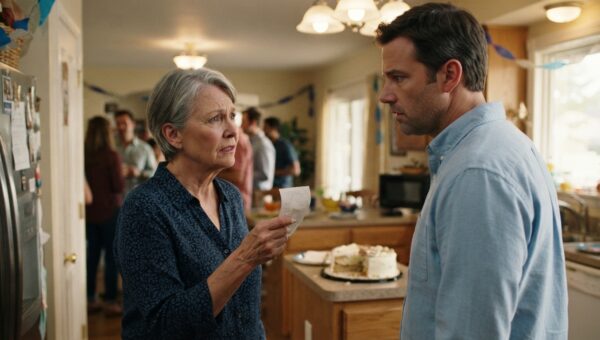
I wasn’t going to say anything at the potluck. Eat my potato casserole, keep my mouth shut, and walk out to the car. That was my plan when I pulled into the Fellowship Hall parking lot at five on a Friday.
Then Pastor Williams stood up by the coffee urn and read the quarterly report from a blue plastic folder.
“Our church benevolence fund helped fourteen families keep the lights on this year,” he said, smiling out at the two hundred and ten people packed into the room folding chairs. “Through your faithful tithes, the Lord provides.”
My hand went up before I even thought about it.
The room went quiet so fast you could hear the hum of the refrigerator in the kitchenette.
Pastor Williams blinked behind his wire-rimmed glasses, his thumb holding his place on the white paper.
“Helen?” he asked, tilting his head. “Did you have a question about the budget?”
“I have a statement,” I said, staying seated because my knees felt weak. “Why wasn’t my family one of them?”
A few people in the front row turned around in their folding chairs. My husband Earl was sitting right beside me, his hand trembling slightly on his knee. He hadn’t wanted to come tonight. He stayed home four days out of seven now, yellow-eyed and short of breath from the cirrhosis that was slowly killing him.
“Helen, this isn’t the time or the place,” Pastor Williams said, his voice dropping into that smooth ministerial tone meant to calm down upset parishioners.
“When is the time, Pastor?” I asked, my voice rising over the noise of the fluorescent lights. “Earl is on the transplant waiting list at University Hospital.
The coordinator told us we need three hundred and eighty-seven thousand dollars in escrow or verified insurance coverage before they’ll even schedule the operation. We applied to the church benevolence fund in April. We were denied in three days.”
“The fund has strict guidelines,” the pastor said, his chin lifting a fraction of an inch. “We prioritize temporary hardships. Job loss. Car repairs. Major medical needs of that scale require institutional resources beyond our modest deaconal pool.”
“You told me the fund was completely empty,” I said, standing up now so the whole room could see the flour on my apron and the worn cuffs of my cardigan. “You told me there wasn’t a single dollar left to spare when I sat in your office three weeks ago.”
Earl tugged on my sleeve, his fingers cold and dry. “Helen, stop. Let’s just go home. Please.”
“No, Earl,” I said, looking down at him. “I’m tired of going home.”
Pastor Williams set the blue folder down on the metal table. His face had gone a tight, pale pink. “Helen, if you are going to make a scene about board decisions, we can discuss this in private on Monday morning.”
“I don’t think Monday will work,” I said.
I reached into my canvas tote bag and pulled out four pages of heavy white paper stapled together in the corner. I didn’t need to look at them because I had spent the last two nights staring at the numbers until my eyes burned.
“I have the statements here,” I said, holding the papers up so the room could see. “From First National Bank. My cousin Brenda works in commercial auditing. She helped me pull the public ledger for the benevolence account since January.”
The pastor took two steps off the low wooden stage, his hand raised. “Helen. You have no right to look at private church accounts.”
“It’s not private,” I said clearly. “Not when it’s funded by Sunday offerings from people who think their money is buying medicine for the sick. The benevolence account took in one hundred and twelve thousand dollars this year.
And according to these deposit slips and wire receipts, ninety-four thousand of it went to one single vendor.”
The room was so still you could hear the gravel crunching in the parking lot outside.
“A vendor named the Shelbyville Aesthetic and Laser Clinic,” I read from the paper. “Owned by Dr. Marcus Vance. Who happens to be married to Pastor Williams’s stepdaughter.”
PART 2
The silence after those words was heavier than anything I had ever felt in that church.
Pastor Williams stood frozen at the edge of the stage, his mouth slightly open, the ministerial smile completely gone. Several people in the middle rows turned around to stare at him, their expressions shifting from polite confusion to slow realization.
“Helen,” the pastor said, his voice losing its smooth ring and dropping into something thin and rough. “You need to come with me to the vestry right now. We are not airing congregational business in front of—”
“You aired it when you told everyone you helped fourteen families while my husband was dying of liver failure because you needed the cash to pay for your daughter’s face-lifts and laser treatments,” I said.
Earl finally stood up, his breathing ragged, leaning his weight against the back of his folding chair. “Helen, let’s go. We’re done here.”
He was shaking. I could see the cold sweat on his forehead. I put my arm around his waist, feeling how thin he had become under his plaid shirt, and walked him down the aisle between the rows of chairs. Nobody reached out to stop us. Nobody looked us in the eye. People leaned away from us as we passed, pressing their knees against the metal frames of their seats to give us room, as if our ruin were something catching.
We drove home in the dark. Neither of us said a word.
When we got to the house on Maple Street, Earl sat in his recliner in the living room without turning on the lamp. He just stared out the front window at the streetlamp across the road. I went into the kitchen, filled a glass of water, and swallowed two aspirin for the throbbing behind my eyes.
The phone started ringing at eight-fifteen.
I let it ring three times before I picked up the receiver.
“Helen,” a woman’s voice said. It was Brenda from the bank, sounding breathless. “Are you watching your front window?”
“No,” I said, looking out into the dark hallway. “Why?”
“Pastor Williams just left the parsonage with two members of the church elders board,” Brenda said fast. “They went straight to the bank’s night drop box. I think they’re trying to pull the physical paper records from the archive bin before Monday morning audit.”
“They can’t,” I said. “The archive bin requires a two-key supervisor override after six p.m.”
“Well, they’re arguing with night security right now,” Brenda said. “Helen, you need to call the sheriff. What you pulled today was public record because it’s tied to our municipal utility pass-through trust, but if they destroy the physical deposit slips at the branch tonight, you won’t have the ink signatures.”
I hung up the phone without saying goodbye.
I looked back into the living room. Earl was leaning his head against the back of the chair, his eyes closed. He looked so small in the dim light, a man who had worked thirty-two years at the grain elevator without ever missing a Sunday service or asking the town for a dime.
I didn’t call the sheriff. I walked to the coat rack, pulled my brown wool coat off the peg, and went out to the garage.
PART 3
The gravel at the First National Bank branch on Main Street was damp with evening dew. When I pulled my old sedan around the side of the brick building, Pastor Williams’s gray sedan was parked right across two visitor spaces near the night deposit chute.
The pastor was standing by the stainless steel door, his shirtsleeves rolled up to his elbows, talking frantically to a young security guard in a blue uniform. One of the elder board members, a retired contractor named Dale who had known Earl since grade school, was holding a large plastic flashlight.
I cut my engine and stepped out into the cold air.
“It won’t open, Pastor,” the security guard was saying, his hands up. “I told you. I don’t have the second key. Only the branch manager has the second key, and she’s out of town until Monday.”
“We are members of the church finance committee,” Pastor Williams said, his voice sharp and ragged. “This is an administrative emergency regarding church property.”
“It’s church property that’s currently being audited,” I said, walking across the asphalt.
The three men spun around. Pastor Williams took a step toward me, his face pale in the light of the security lamp.
“Helen,” he said, trying to force a calm note back into his voice. “What are you doing here? This is completely inappropriate.”
“You’re trying to destroy deposit slips that prove where ninety-four thousand dollars of benevolence money went,” I said, stopping ten feet away from them. “Brenda called me from inside the bank. She’s watching you on the security monitors right now.”
Dale, the elder board member, dropped the flashlight down toward the ground. He looked from the pastor to me, his heavy jaw working slowly. “Pastor… what is she talking about? What clinic?”
“She is delusional,” Pastor Williams snapped, his face flushing dark red. “She’s under immense stress because of her husband’s illness. She’s imagining things to hurt the church.”
“I’m not imagining the wire receipts with your stepdaughter’s signature as the clinic manager,” I said. “And I’m not imagining the fact that while my husband was sitting on a waiting list to stay alive, you were paying for cosmetic laser treatments in Shelbyville.”
Pastor Williams took a threatening step forward, his hands clenched into fists at his sides. “You have no proof that will hold up anywhere. The bishop will back me up before he lets a bitter woman destroy forty years of ministry over a personal grudge.”
“I don’t need the bishop,” a new voice said from the shadows near the drive-through lane.
We all turned. A tall man in a dark jacket was walking toward us, holding a leather briefcase. It was Mr. Henderson, the chairman of the bank’s board of directors, who lived three houses down from us on Maple Street.
Mr. Henderson stopped under the light, looking at Pastor Williams with a cold, flat expression.
“I was at the potluck tonight, Pastor,” Mr. Henderson said quietly. “I heard what Helen read. And twenty minutes ago, my daughter called me from the auditing department. We already secured the digital ledger and locked down the physical archive drawers from the main terminal. You aren’t getting into that box tonight.”
Pastor Williams stared at the banker, his mouth moving once or twice without any sound coming out. Then he looked at Dale, who was slowly backing away toward his truck with his hands in his pockets.
“This is a private matter between the church and its members,” the pastor whispered, his voice finally breaking.
“No,” Mr. Henderson said. “It’s bank fraud and tax evasion. And by morning, the state synod and the county prosecutor are going to have every single page.”
ENDING
The investigation took three weeks.
The state synod removed Pastor Williams from the pulpit by the following Tuesday, and the clinic in Shelbyville closed its doors two months later when the state attorney general froze their accounts under suspicion of wire fraud involving multiple nonprofit accounts across three counties.
The church board held an emergency meeting and voted unanimously to reallocate the remaining benevolence funds. They didn’t give us the whole three hundred and eighty-seven thousand dollars at once, but last Thursday, the hospital coordinator called.
Earl’s name moved from the inactive waiting list to the active slot.
We didn’t celebrate with a party or a trip. On Saturday morning, I walked out to the garden behind the garage to check on my tomato plants. The frost was starting to edge the leaves in white, but the late fruit was still holding on, small and red against the dry vines.
Earl came out the back door, wearing his heavy gray sweater, walking slow with his hand on the wooden railing. He didn’t say anything about the hospital, and he didn’t mention the pastor. He just stood beside me in the cold air, looking down at the dirt.
“We need to clear out those dead vines before the snow comes,” he said, his voice stronger than it had been in months.
“We will,” I said.
I reached down, broke off a dry tomato leaf, and dropped it into my apron pocket.