PART 1
The refrigerator in Mom’s mobile home had a loose seal on the bottom corner that let the kitchen air leak in, leaving frost clinging to the wire racks like stubborn wool. When I visited last Christmas, I reached inside to grab a carton of half-and-half for my coffee and found nothing except a three-week-old container of milk that had gone sour and two dented cans of creamed corn.
Mom was eighty-four then, sitting in her floral armchair with a fleece blanket pulled up to her chin even though the propane heater was ticking softly in the corner. She looked thin, her shoulders bowed under her cardigan like empty coat hangers. When I helped her stand to walk to the bathroom, I could feel the sharp ridge of her spine through her clothes. She had lost eighteen pounds since my previous visit in July.
My sister Brenda was supposed to be handling everything. After Dad died six years ago, Brenda had stepped in with her usual organized efficiency, taking over Mom’s paperwork, setting up the direct deposits, and managing the monthly budget from her office across town. Mom’s survivor pension was two thousand one hundred dollars a month, clear and steady from the utility company where Dad had worked thirty-five years. Between that and Social Security, Mom should have had enough to keep the pantry stocked with fresh groceries, pay the modest lot rent on the mobile home, and afford her blood pressure medication without counting nickels.
Instead, Mom was living on canned soup and toast, wearing the same three faded polyester outfits rotation after rotation, while Brenda lived in a four-bedroom house with an in-ground pool in Lake Worth.
I send her two hundred dollars out of my own pocket every month, I told Brenda over the phone three days after I got back home. Mom’s fridge was practically empty, Brenda. She’s wasting away in that place. What are you doing with the pension?
Brenda’s voice came through the receiver with the smooth, practiced irritation of someone dealing with a troublesome child. Prices have gone up, Chloe. Property taxes on the park went through the roof, and the medical copays are killing us. You don’t see the bills because you only show up once a year with your opinions.
I hung up the phone, but her words didn’t settle right. I knew what lot rent cost in that park because I had checked it when Dad passed. It hadn’t changed in three years.
On a Tuesday morning in January, I drove straight to the First National Bank branch where Mom’s accounts were held. I parked my sedan in the gravel lot, smoothing down the front of my wool coat, and walked inside. The linoleum was scuffed from winter boots, and the air smelled of floor wax and wet wool.
I waited behind an elderly man depositing a social security check until the teller, a young woman with a neat gold name tag reading Sarah, looked up and asked how she could help.
I need to check on the account status for Helen Miller, I said, sliding my ID and Mom’s power of attorney document across the counter. I’m her younger daughter, Chloe.
Sarah took the papers, scanned them into the terminal, and started typing. After a few seconds, her fingers stopped moving. She looked up at the computer screen, then down at my ID, and finally across the counter at my face.
Her expression had changed from polite retail cheer to something tight and careful.
Mrs. Miller, Sarah said, lowering her voice so the man behind me wouldn’t overhear. Your mother’s pension doesn’t stay in her personal checking account. It goes to a linked sweep account every single month.
My hands curled into fists inside my pockets. A linked account? Whose name is on it?
Sarah hesitated, tapping a fingernail against the edge of the wood. It goes directly to an account held by Brenda Miller. Your sister. It’s been set up that way for six years.
PART 2
The bank lobby seemed to tilt slightly, the low hum of the fluorescent lights turning into a buzzing sound in my ears. Six years. Seventy-two months of twenty-one hundred dollars hitting an account I had never known existed.
How much has been transferred? I asked, my voice barely carrying over the counter partition.
Sarah looked down at her screen, her lips pressing into a thin line. I shouldn’t give out itemized balances without a court order, but looking at the recurring monthly automatic transfer of two thousand one hundred dollars since January of two thousand twenty… She did a quick mental calculation, her eyes darting across the monitor. That’s approximately one hundred and fifty-one thousand, two hundred dollars total over six years.
One hundred and fifty-one thousand, two hundred dollars. Stolen from an eighty-four-year-old woman living on canned corn in a drafty mobile home.
Does my mother withdraw from that account? I asked, though I already knew the answer.
No, Sarah said gently. There are no debit card transactions or ATM withdrawals from the linked account. The funds are swept into a mortgage escrow and commercial loan payment service for a residential property in Lake Worth.
Lake Worth. Brenda’s three hundred and forty thousand dollar suburban house with the manicured lawn and the stone pillars by the driveway.
I didn’t say goodbye to Sarah. I turned around, walked out the glass doors into the cold winter air, and got into my car. I sat in the driver’s seat with my hands shaking so violently I couldn’t get the key into the ignition on the first try. The steering wheel felt cold against my palms.
I pulled my phone from my coat pocket and dialed Brenda’s cell number. She picked up on the second ring, sounding rushed, like she was standing in the middle of a grocery store aisle or a boutique.
Chloe, I’m in the middle of something, Brenda snapped before I could speak. What is it now?
How much is your monthly mortgage payment, Brenda? I asked.
There was a sharp silence on the other end of the line. When Brenda spoke again, the polished annoyance had vanished, replaced by a sudden, thin ice. Where did you get that number?
I’m sitting in the parking lot of First National, I said, my voice dropping into a register that made my own throat hurt. I just saw the routing. Two thousand one hundred dollars a month straight from Mom’s pension into your mortgage escrow. For six years. One hundred and fifty-one thousand dollars.
Mom doesn’t need that money, Brenda shouted, her voice breaking through the speaker with sudden, ugly panic. She barely goes anywhere! She sits in that chair all day watching game shows. What is she going to do with cash, buy gold bars? My mortgage went up three hundred dollars last year, and inflation is through the roof. I’m the one who drives her to the doctor. I’m the one who answers the phone when the plumber calls.
She barely EATS, Brenda! I screamed, slamming my hand against the steering wheel. Her fridge had sour milk and canned corn last month! She lost eighteen pounds because you stole her grocery money to pay for your granite countertops!
Don’t you dare talk to me about sacrifice, Brenda hissed. You live two hours away and send a measly two hundred dollars like you’re buying an indulgence at church. If I hadn’t taken control of the books, Dad’s pension would have been wasted on medical junk years ago. I’m keeping it in the family.
You’re keeping it in your own name, I said.
Before she could answer, I pressed the red end call button, cutting her off in the middle of a sentence. My chest felt tight, constricted by a rage so cold it made my fingers numb. I didn’t go back home. I put the car in drive and headed straight for the county courthouse on Main Street to file the emergency paperwork with Adult Protective Services.
PART 3
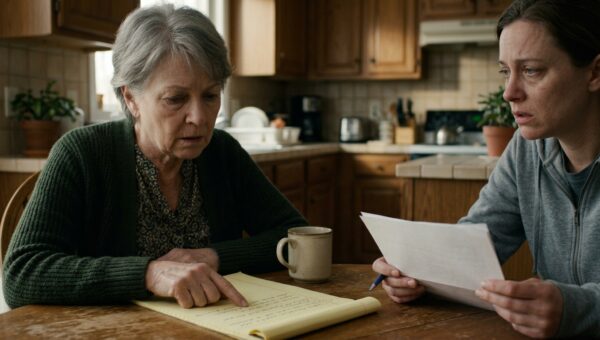
The intake worker at the county office was a patient woman named Mrs. Gable who smelled of peppermint tea and wore a heavy wool sweater. She listened to me for forty minutes without interrupting, her ballpoint pen moving steadily across a yellow legal pad as I laid out the bank statements, the power of attorney documents, and the dates of my visit to Mom’s mobile home.
An elder financial exploitation case of this scale requires immediate escalation, Mrs. Gable said when I finally finished. She slid a multi-page carbon copy form across the desk toward me. We can freeze the linked account through a probate court injunction within forty-eight hours, and we’ll send a caseworker out to perform an independent welfare check on your mother by tomorrow morning.
What happens to Brenda? I asked, watching the tip of her pen.
The state prosecutor’s office handles criminal financial abuse once our protective audit is complete, Mrs. Gable said plainly. Given the amount over one hundred and fifty thousand dollars this falls well into grand larceny and elder abuse felony tiers. Your sister will have to account for every dollar of that pension before a judge.
The wheels of the county moved with bureaucratic slowness, but they moved. By Thursday afternoon, a state-appointed health worker named Dave stood inside Mom’s mobile home with a clipboard and a camera, documenting the empty refrigerator, the lack of fresh food, and the inadequate heating in the bedroom.
When Brenda tried to access the account on Friday morning to make her mortgage payment, the transaction was blocked by the court order. Within three hours, Brenda’s attorney had filed an emergency motion claiming the funds were a voluntary familial contribution, but the judge took one look at the photos of Mom’s pantry and the bank records showing zero disbursements for grocery or medical care and denied the motion outright.
I drove down to Lake Worth on Saturday morning to bring Mom back to my house until the legal dust settled.
When I unlocked the front door of her mobile home, Brenda was already there. She had let herself in with her spare key and was standing by the small kitchen table stuffing a cardboard box with framed photographs and old knickknacks.
You did this, Brenda said, her face red and swollen, her hair unbrushed. She pointed a shaking finger at me. You ruined everything over a few cans of corn. The bank is auditing my accounts. The mortgage company sent a default notice because the automatic transfer bounced.
You stole one hundred and fifty-one thousand dollars from an eighty-four-year-old woman, I said, stepping past her into the tiny hallway. You’re lucky you’re packing boxes instead of packing a prison bag.
She’s my mother too! Brenda cried, her voice cracking into a desperate whine. How am I supposed to pay the property taxes on that house now? You’ve destroyed my life!
You destroyed hers first, I said.
I walked past her into Mom’s bedroom, where Mom was sitting on the edge of the mattress wearing her fleece blanket like a shawl, watching us with wide, confused eyes. I knelt down in front of her, took her frail, paper-thin hands in mine, and smiled as best as I could.
Come on, Mom, I whispered. Let’s go home with me. I have some fresh milk in the fridge.
ENDING
Mom moved into the small spare bedroom at the end of my hallway, the room where my daughter used to sleep when she was little.
The legal process took nine months. Brenda eventually agreed to a court-ordered lien against her house to repay the stolen pension funds, though the lawyers took a large bite out of what was recovered, and the rest was placed into a restricted trust controlled by a court-appointed administrator to ensure Mom’s care. Brenda’s husband moved out six weeks after the bank started foreclosure proceedings on the Lake Worth property, and Brenda moved into a small, two-bedroom apartment on the other side of town where there was no in-ground pool and no stone pillars by the driveway.
I never called Brenda again, and she never called me.
On a Tuesday afternoon in September, eight months after we brought Mom home, I walked into the kitchen carrying a bag of groceries. The refrigerator hummed quietly in the corner, the seal tight and cold.
Mom was sitting at the kitchen table with a small paring knife, peeling an apple into one long, unbroken red ribbon, the way she used to do when I was a kid. A bowl of fresh fruit sat in the center of the table beside a carton of milk that hadn’t even been opened yet.
She looked up as I set the grocery bags down on the counter, her eyes clearer and brighter than they had been in years, carrying the quiet weight of someone who finally had enough room to breathe.