The smell of damp wool and floor wax always takes me right back to the basement of St. Jude’s. That was where we stacked the cardboard boxes every November, sorting through donated mittens that smelled like mothballs and heavy winter coats that people had outgrown or left behind in their closets. I spent twenty-four years down there on Tuesday mornings, sorting the zippers and checking the linings before the church doors opened at nine.
You do not think about what sticks in a child’s head when you hand them something to keep the wind out. You just hand it over, tell them to pull the hood tight, and reach for the next hanger.
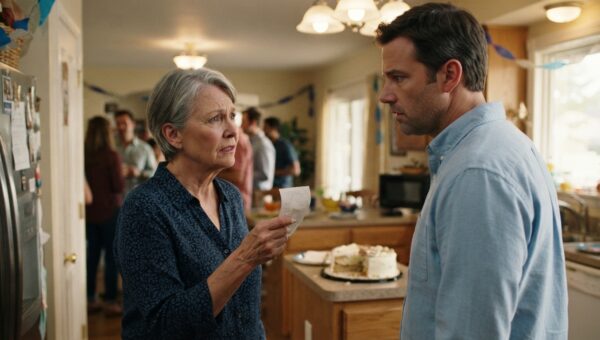
My granddaughter Lily came through the front door at three-fifteen on a Tuesday, her small green backpack swinging from one shoulder and her face smudged with a streak of blue dry-erase marker. She dropped her bag on the laminate floor so hard the metal zipper clattered against the baseboard. I was standing at the counter wiping down a water ring from the kettle, and I saw right away that her eyes were red. Not the kind of red you get from a playground scrape where the nurse hands you an ice pack and you forget about it by the third period. This was the red of a kid who had been holding her breath for six hours and finally let it out the second she crossed the threshold.
“Grandma,” she said, her voice shaking in that thin, tight way children get when they are trying not to cry all over again. “Nobody has to pay for lunch tomorrow. Or next week. Or ever again this year.”
I stopped with the dish towel in my hand. I told her to slow down and hang her coat up, but my own chest tightened up a little because school lunch accounts were always a mess around the holidays. The district had sent home three yellow notices that month alone about balances and payment plans.
“A man came to the office right after the bell,” Lily said, her hands twisting the hem of her cardigan until the wool looked fuzzy. “He didn’t say who he was to us kids, but Principal Vance told the teachers. He paid four thousand two hundred dollars. For every single kid who owed money. Even the ones whose parents haven’t paid since October. He just wrote a check and walked out.”
Four thousand two hundred dollars is a lot of money in a small town like ours, where the lumber mill closed down back when my oldest was in middle school and the grocery store survives mostly on canned goods and lottery tickets. Nobody writes checks like that unless they are selling off a timber lot or inheriting something they did not earn.
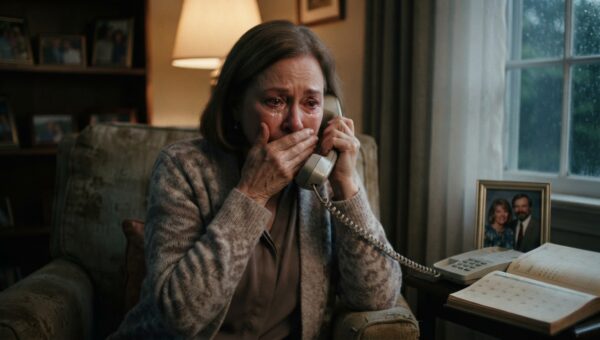
Before I could ask her who had seen him, the landline on the wall began to chirp. That phone has a sharp, grating ring because the spring inside the bell has been loose since nineteen-ninety-five, and it always makes me jump when it goes off after three in the afternoon. I wiped my hands on my apron and lifted the receiver.
“Evelyn,” Principal Janice Vance said. Her voice was thin and raspy, the way it always got when she had been dealing with school board meetings or septic tank leaks in the home economics wing. “I need you to come down here. Not tomorrow. Right now.”
“Janice, if Lily left her gym shoes in the bleachers again, she can walk back and get them herself,” I said, trying to make light of it because my throat felt dry.
“It is not about shoes,” Janice said, and I could hear the papers rustling on her desk through the receiver. “The man who cleared the lunch debt. He left something for you specifically. An envelope. Eight hundred dollars cash, and a note.”
I didn’t move. The refrigerator hummed against the quiet of the kitchen, and outside a blue jay landed on the bird feeder, making the plastic tray swing back and forth.
“Me?” I asked.
“He said you would know,” Janice continued, her voice dropping an octave the way it does when she is reading something hard. “He asked me to read you one line before you got in your car. *For the winter coat you bought me in 1987 at JCPenney. I was 9. My mother couldn’t afford one. You paid $47. I never forgot.*”
The room seemed to tilt just an inch. Nineteen eighty-seven was the year my husband had his hip surgery, the year we were living off savings and three boxes of saltine crackers a week, and yet I was down at St. Jude’s every single Tuesday because the church furnace had gone out and the parishoners were bringing in bags of frozen bread. I bought coats every year. Dozens of them. Red ones, blue ones, cheap nylon parkas with slippery linings that made a swishing sound when the boys ran across the asphalt.
“Janice,” I whispered, and my hand started to shake so badly I had to switch the receiver to my other ear. “Who is it?”
“He’s still here,” Janice said softly. “He’s sitting in room fourteen grading science quizzes. He asked me to read you one more thing from the bottom of the page. *I became a teacher because of you. I work at this school. I see your granddaughter every day. I never said anything because I didn’t know how to tell you I’m also the boy you saved from the, *”
She stopped. The line went completely dead of words, save for the faint scratching sound of her breathing on the other end.
“From the what, Janice?” I asked.
“The rest is crossed out,” she said. “In heavy black ink. But he’s waiting in fourteen, Evelyn. Take your car and drive down here.”
Three weeks earlier, I had cleaned out the attic and found an old ledger from the church drive, pages yellowed around the staples where I used to write down sizes in clumsy blue ink: *Boys 8, Navy blue, corduroy collar, $47.* I remembered that particular coat because it was the last one left on the rack at the JCPenney down on Route 9 before the snowstorm hit us on a Thursday night. A little boy with red, chapped knuckles and a flannel shirt that was three sizes too thin had been standing by the display window, staring at the mannequins like they were made of glass. I had asked him his name, but he only shook his head and pulled his sleeves down over his hands.
I hung up the phone without saying goodbye to Janice. I didn’t bother with my winter boots; I just shoved my feet into my old leather loafers by the back door and grabbed my keys off the brass hook. Lily was standing by the table, her eyes wide with questions she didn’t know how to ask.
“Get your jacket, honey,” I told her, my voice sharper than I meant it to be. “We’re going back to school.”
The drive down Maple Street took four minutes, though every red light seemed to linger twice as long as usual. The elementary school was a low, yellow-brick building built in the fifties, smelling permanently of floor wax and old radiator iron. When I walked through the double doors, the hallway was quiet except for the muffled sound of a vacuum cleaner running in the gymnasium down the corridor.
Janice Vance was waiting by her office door with a white business envelope in her hand. Her face was pale, and she didn’t smile when she saw me coming. She just handed me the paper without a word.
“He’s in fourteen,” she said, nodding toward the north wing where the fifth and sixth graders stayed. “Go on down. The door’s open.”
I walked down the green-tiled hall. My loafers made a hollow clicking sound against the floor that seemed too loud for the empty afternoon. Room fourteen had a small square window in the wooden door, and through it I could see rows of empty desk chairs stacked neatly on top of maple tables. A man was sitting at the teacher’s desk near the chalkboard, his back to the door, bent over a stack of blue folders with a red pen in his hand. He wore a gray tweed sport coat with patches on the elbows, and his hair was thinning at the crown in a way that reminded me of my brother Jim.
I pushed the door open. It gave a dry little squeak that made him look up.
He turned around slowly, the red pen still held between two fingers. He wasn’t a boy anymore, of course. He was a grown man in his late forties with deep lines around his eyes and a quiet, steady look that didn’t belong to the scared nine-year-old I remembered from the department store aisle. But the shape of his jaw and the way his ears sat close to his head, that didn’t change.
“Mrs. Abbott,” he said. His voice was lower than I expected, but it had that same slight hitch at the end of every sentence.
I didn’t walk all the way into the room. I stood right there on the threshold with my purse strap twisted around my thumb. “Tommy Miller?” I asked.
He set the red pen down on the desk. He didn’t smile, but his shoulders dropped an inch, as if he had been carrying something heavy and finally set it on the floor.
“Tommy was a long time ago,” he said, standing up and smoothing down the front of his gray trousers. “Mr. Miller to the kids. But to you, I suppose I’m still just the kid who didn’t know how to zip his own jacket.”
I looked down at the envelope in my hand, then back up at him. “You paid the lunch debt for the whole school, Tommy.”
“It needed doing,” he said simply. He walked over to the side bookshelf where a row of science encyclopedias sat between two bookends made of petrified wood. “When you’ve spent thirty years watching kids come to school with nothing in their lunch pails except a piece of white bread and a napkin, you start keeping track of things. I got a small bonus from the state last month for the science program. It was more than I ever thought I’d see at one time. I didn’t need a new car. I didn’t need anything.”
“And the eight hundred dollars?” I asked.
“That’s for the church drive,” he said, looking straight at me with eyes that were the exact same pale blue as they were on that snowy Thursday in nineteen-eighty-seven. “For the coats. You bought mine for forty-seven dollars with your own grocery money because my mother was sitting in the truck with the heater broken and the gas gauge on empty. You told me the cold doesn’t get to keep people down if they’ve got something warm to wear.”
I felt a sudden, sharp ache behind my eyes. I had forgotten those words. I said a lot of things to a lot of kids over forty years of volunteering, but that one came back to me now like a coin dropped down a well.
“I didn’t know where you went,” I said, my voice dropping until it barely crossed the empty room. “Your mother moved us out of that trailer park by spring. The landlord said everyone was gone before the ground thawed.”
“We went to my uncle’s place in Tennessee,” Tommy said, leaning back against the edge of his desk and crossing his arms. “We didn’t have much there either, but he had a wood stove. Every time I put that navy parka on to walk to the bus stop, I checked the inside pocket. You had slipped a five-dollar bill inside the lining with a note that said *for wool socks.* My mother cried when she found it. She didn’t want to take charity, but she took it because she didn’t have a choice. And I kept the tag.”
He reached into his breast pocket and pulled out a small, worn piece of white cardstock, folded over twice and yellowed around the edges with age. He laid it flat on the corner of the wooden desk. It was the original price tag from the JCPenney coat, the little cardboard square with the punched hole and the red ink numbers stamped by the register: *47.00.*
“You kept that?” I asked.
“Through college,” he said. “Through my first year teaching in that terrible little school down by the river. Whenever I thought about giving up and going back to working the loading dock like my cousins, I’d pull that tag out of my wallet and look at the price. Forty-seven dollars. That’s all it took to keep someone from disappearing.”
I walked the rest of the way into the room and set my purse down on the front desk. My hands weren’t shaking anymore, but the weight of it all, the thirty-eight years of church basements, the boxes of mittens, the children whose names I had long since stopped remembering, seemed to settle right down into my bones.
“Your sentence was crossed out,” I said quietly. “Janice said you couldn’t finish it.”
Tommy looked down at the floor for a long moment, his thumb tracing the edge of the cardboard tag. “I started to write *the boy you saved from the cold*,” he said, his voice dropping until it was almost a whisper. “And then I realized that wasn’t quite right. It wasn’t just the frostbite, Mrs. Abbott. It was the other thing. The part where you look around a room full of people and realize nobody in the world even knows your name.”
He looked back up, and for a second he looked like that nine-year-old boy again, standing by the glass window with his red hands shoved deep into his pockets.
“You saved me from believing nobody cared,” he said.
I didn’t know what to say to that. In a town like ours, people don’t talk about things like salvation or grace over a school lunch bill. We talk about the weather, and the price of beef at the piggly wiggly, and whether the county is ever going to pave the back road by the creek. But standing there in room fourteen with the smell of floor wax and old paper, I knew that some things don’t stay in the church basement. They follow you down the hall, year after year, until one day they come back and sit at the desk right next to yours.
“Well,” I said, clearing my throat and reaching out to touch the corner of the JCPenney tag with the tip of my finger. “Forty-seven dollars was a lot of money back then, Tommy. I had to skip buying myself those wool slippers I wanted.”
A slow, tired smile spread across his face, the first real one I’d seen all afternoon. “I’ll buy you the slippers now, Mrs. Abbott. With interest.”
“You’ll do no such thing,” I told him, picking up the white envelope with the eight hundred dollars inside. “We’re going to take this money down to St. Jude’s on Thursday morning, and we’re going to buy twenty-four coats. And you’re going to help me check the zippers.”
“I wouldn’t miss it,” he said.
We walked out of the classroom together down the long green hallway where the janitor was still pushing his broom across the rubber tiles. Lily was waiting by the front office doors, sitting on the wooden bench with her knees pulled up to her chest, watching the dust motes drift through the afternoon sunlight coming through the high windows. When she saw us coming, she stood up and smoothed her skirt down, looking back and forth between the two of us with those sharp, curious eyes that missed nothing.
“Everything’s paid for, Grandma,” she said.
“I know it is, honey,” I told her, taking her small warm hand in mine. “Mr. Miller and I have business to take care of.”
We walked out past the brick wall where the old bulletin board showed a faded construction-paper turkey from November, out into the cool air of the parking lot where the trees were beginning to drop their last dry leaves onto the asphalt. The sun was dipping low behind the water tower, turning the sky the color of old brass. Tommy stayed on the steps for a minute, watching us go, with his hands tucked deep into the pockets of his gray tweed coat. He didn’t wave, and neither did I. We just stood there for a second in the quiet, knowing exactly what forty-seven dollars can buy when a person has nowhere else to go.