I balanced our family checkbook every month for thirty-six years. Every receipt, every grocery slip, every utility stub from the local power company, every deposited paycheck, every single entry written down in dark blue ink with a fine-point Pilot pen. My mother taught me how to keep a ledger before I even learned how to drive. She told me that a woman who keeps her own accounts keeps her own life, and I took that to heart.
Through mortgage rate hikes, two cars that died on the interstate, braces for our daughter, and thirty-six years of quiet autumns, that ledger never lied to me.
Then, last Tuesday, one number didn’t make sense.
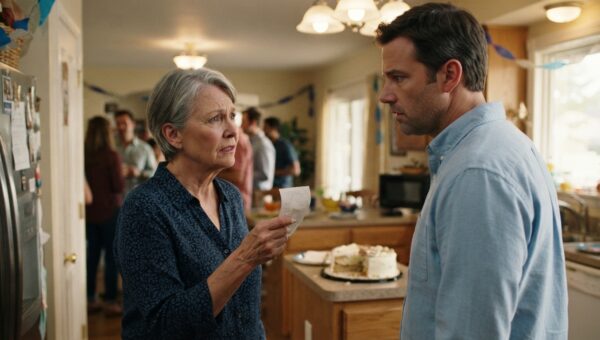
It was mid-afternoon, the house was empty except for the hum of the refrigerator, and the sunlight was cutting across the dining room table in long dusty stripes. I was checking the quarterly digital statements against my paper log, reconciling the small automatic fees that always seem to creep in when you aren’t looking. A streaming service we barely used. A lawn care subscription from two summers ago. Then my eyes hit a line item that stopped my thumb cold on the page. An $800 automatic transfer leaving our primary checking account on the fifteenth of every month.
I blinked. I took off my reading glasses, cleaned the lenses on the edge of my cardigan, and put them back on. The line was still there.
Eighty hundred dollars. On the fifteenth.
I don’t even know why I remember this part, but a bluejay was screaming at something outside in the oak tree, making a sharp, frantic racket that went right through my skull. Arthur was still down at the hardware warehouse taking inventory, three miles away, completely unaware that the floor under my feet had just dropped four feet. I went to the bottom shelf of the linen closet where we keep the cardboard banker boxes. I pulled out eight years of old bank statements, dust flying off the cardboard tabs, my fingers moving too fast to be steady.
I sat on the hardwood floor with my legs tucked to one side, spreading the statements out like tarot cards.
January 2017. February 2017. March 2017.
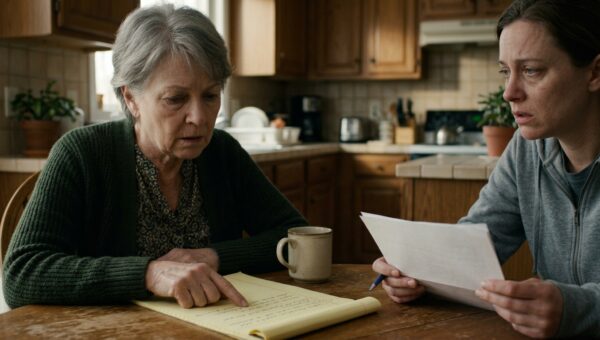
There it was. Every single month, without fail. $800 on the fifteenth. I didn’t need a calculator, but I grabbed one anyway because my brain refused to do simple math.
I punched it in. Twelve months a year, for eight years. Nearly $77,000 had quietly disappeared from our savings while I was busy balancing grocery totals down to the dime.
The money wasn’t going to a mutual fund. It wasn’t going into our retirement account or a college fund for our grown children. It was going into an account with only one name on it. My husband Arthur’s name. No joint owner. No memo line. No explanation.
I sat there on the floor until my knees went stiff. I didn’t cry. You don’t cry when you’re in shock; you just go cold all over, like you stepped outside into a January blizzard in your house slippers. Thirty-six years of marriage. Thirty-six years of sharing coffee every morning at six o’clock, of talking about the weather and the garden and what we were having for Sunday pot roast. And all the while, my husband had been siphoning money behind my back into a secret account.
I didn’t call him. I knew if I called him while he was at work, his voice would sound normal, and that would have made me sick to my stomach.
The next morning, I put on my good walking shoes and my wool coat, grabbed my leather handbag, and drove down to the First National branch on Elm Street. The air outside was sharp and smelled like wet pavement. I didn’t have an appointment, but I knew Evelyn Vance, the branch manager. We served on the library committee together for twelve years. She knows me as well as anyone in this town does.
The fluorescent lights in the lobby hummed with that dry, thin sound that always made my teeth itch. Evelyn looked up from her desk as I walked through the gate, her reading glasses pushed up into her gray hair.
“Helen,” she said, smiling that polite, small-town banker smile. “What brings you in today? You look like you’ve seen a ghost.”
I didn’t smile back. I laid my driver’s license, our original marriage certificate from 1988, and the stack of printed statements right on the smooth wooden surface of her desk.
“Evelyn,” I said, and my voice sounded like dry paper scraping together. “I need to look at account ending in four-four-zero-nine. My husband’s name is on it. I am his wife, and I have every legal right to see where our money has been going for the last eight years.”
Evelyn looked down at the marriage certificate, then up at my face. She didn’t ask questions. She knows my handwriting from every deposit slip I ever filled out at her window. She turned her computer screen away from the glass partition, typed three quick keystrokes with her left hand, and stared at the monitor for a long, quiet second.
“Helen,” she said softly. “Are you sure you want me to turn this around?”
“Turn it,” I told her.
She slowly rotated the heavy flat-screen monitor toward me across the mahogany.
I leaned in, my hands flat against the cold edge of her desk. I expected to see a fat balance. I expected to see stocks, or a vacation home, or gambling debts, or maybe, and this thought made my chest seize up, another woman’s name attached somewhere down the footer.
Instead, I saw a balance of $214.32.
I stared at the number, my brow furrowed so hard my forehead ached. Two hundred and fourteen dollars. Not thousands. Not a secret hoard. A checking account that sat nearly empty month after month.
“Evelyn,” I whispered, my throat tight. “Where does the eight hundred go? Every month on the fifteenth. Where is it going?”
Evelyn clicked her mouse twice, bringing up a subsidiary ledger attached to the routing number. She pointed a manicured finger at the bottom of the screen.
“It goes out the same day it comes in, Helen,” she said gently. “Ten minutes after Arthur’s transfer clears, an automated ACH disbursement pulls the exact eight hundred dollars out and sends it to an institutional routing number in Crestview. Cedar Grove Care Residence.”
The name hit me like a splash of cold well water. Cedar Grove. That was the memory care facility out on the county line, past the old grain elevators where the highway narrows down to two lanes.
“Cedar Grove?” I repeated, and the word felt heavy and foreign on my tongue. “Why would Arthur be sending money to Cedar Grove?”
Evelyn looked down at her hands, folding them neatly over her keyboard. She didn’t look at me anymore. “Helen, I shouldn’t say anything, but… Arthur has been personally listed as the secondary contact on their patient registry since late 2017. The primary name on the room is Thomas Vance.”
Thomas.
The blood rushed out of my ears, leaving a high, thin ringing sound. Thomas Vance was Arthur’s older brother. The same Thomas who had packed a battered brown suitcase one afternoon back in the fall of 1994, slammed the front door of our old house so hard the hallway mirror cracked, and walked out of our lives forever. There was a bitter falling out over land, over pride, over old family secrets that nobody in Arthur’s family ever talked about without lowering their voices to a hiss. Arthur swore to me back then that he didn’t have a brother anymore. He told me Thomas had moved out west, that he was gone, that we were never speaking his name again.
And now here was a ledger showing eight years of secret payments keeping Thomas alive in a memory care bed thirty miles away.
I thanked Evelyn, picked up my marriage certificate, and walked out of the bank without another word. The midday sun was bright, but I couldn’t feel its warmth. I didn’t drive home. Instead, I pointed my sedan toward the county line, my hands locked at ten and two on the steering wheel, my mind spinning through thirty-six years of memories trying to find the cracks where I should have noticed.
Cedar Grove Care Residence looked less like a hospital and more like an old brick motel that had been converted into offices. The parking lot was gravel and half-empty. Inside, the air smelled faintly of floor wax, boiled cabbage, and old wool. A young woman at the front desk with a plastic name tag reading *Chloe* looked up as I walked in, her fingers resting on a plastic keyboard.
“Can I help you, ma’am?” she asked.
“I’m Helen Vance,” I said, keeping my voice level. “I’m looking for Thomas Vance.”
Chloe blinked, looking down at her screen. “Oh. Room 114 down the south hall. Are you family?”
“I’m his sister-in-law,” I said. It was the first time I had ever said those words out loud in nearly thirty years.
Room 114 was at the very end of the hall, past a common room where a television was playing a game show to an empty circle of armchairs. The door was half-open. I pushed it gently with my fingertips.
A man was sitting in a padded vinyl armchair by the window, staring out at a patch of brown grass and a chain-link fence. He was thin, his shoulders slumped forward under a plaid flannel shirt that looked two sizes too big for him. His hair was completely white and cut short, and his hands rested palms-up on his knees, trembling with a small, rhythmic tremor.
I stood in the doorway for a long time, watching him breathe. He didn’t look like the angry ghost Arthur had described back in 1994. He just looked old. Small. Forgotten.
A nurse with a cart full of small plastic medicine cups walked past me, paused, and looked in. “Are you visiting Mr. Vance?” she asked kindly. “He doesn’t get many visitors. Just his brother. Arthur comes every Thursday evening like clockwork.”
“Every Thursday?” I asked, my voice barely audible.
“Rain or shine,” she said, adjusting her glasses. “Arrives around six. Sits with him for an hour. Doesn’t say much, just helps him eat his pudding or sits by the window. A good man, your husband. You don’t see family loyalty like that anymore.”
She walked away, her rubber-soled shoes squeaking softly against the linoleum.
I didn’t go into the room. I stood in the hallway for three more minutes, watching Thomas turn his head slowly toward the window, and then I turned around and walked back out to my car. The entire drive home, my hands didn’t shake once. By the time I pulled into our gravel driveway, the shock had burned away, leaving behind a cold, hard knot of realization.
Arthur was home early. His old gray pickup was parked by the side of the garage, the engine ticking as it cooled in the shade.
I walked through the back door into the kitchen. The smell of coffee grounds and old paper hung in the air. Arthur was standing by the kitchen counter, wearing his canvas work jacket, unzipping it as I pushed the door open. He looked tired. Not just ordinary end-of-the-day tired, but the kind of bone-deep fatigue that comes from carrying something heavy up a very long hill for eight years without ever putting it down.
He looked up, and the moment his eyes met mine, his hands froze on his zipper. He didn’t ask how my day was. He didn’t ask why I wasn’t sitting in my usual spot by the bay window. He just looked at the thick folder of bank statements in my left hand.
“You went to the bank,” he said. It wasn’t a question. His voice was flat, devoid of fight, almost like he had been rehearsing this exact conversation every Tuesday for nearly a decade.
I walked over to the kitchen table, laid the eight-year folder down square in the middle, and pulled out the printout from Cedar Grove with Thomas’s patient ID clearly stamped across the top.
“Thirty-six years, Arthur,” I said, and my voice was so quiet it sounded like someone else speaking across the room. “Every single month, I balanced the books. Every penny accounted for. And all the while, you were siphoning eight hundred dollars every month into a ghost account.”
Arthur lowered his head. He didn’t try to step toward me. He pulled out one of the wooden kitchen chairs and sat down heavily, resting his forearms on the table and burying his face in his rough, calloused hands.
“I’m sorry, Helen,” he muttered into his palms. “God, I am so sorry.”
“Who is paying for him?” I asked, my voice rising just a fraction. “Why didn’t you tell me? Did you think I was a monster? Did you think I would let your own brother starve in a county ward?”
Arthur looked up then, and his eyes were red, wet at the corners. “You didn’t know Thomas, Helen. You remember how he left. You remember the things he said about us, about my father’s farm, about how he swore he’d never take a dime from this side of the family. When he got the diagnosis eight years ago, early-onset vascular dementia, the doctors called it, he had nothing. No pension, no savings, no wife, no home. The state was going to put him in a Medicaid facility down in the valley, a place with bars on the windows.”
He swallowed hard, his throat working visibly under his wrinkled collar.
“I couldn’t let him end up like that,” Arthur whispered. “He’s my brother. For all his faults, he’s the only blood I have left from back home. But I knew your pride, Helen. I knew how hard we worked for every acre of this place, how carefully we saved for our own retirement. If I had come to you and said, *We need to pay eight hundred dollars a month to keep Thomas comfortable*, you would have said no out of principle. Or worse… you would have agreed out of pity, and you would have resented every single dollar we spent on a man who cursed us out on his way out the door.”
“So you lied to me,” I said. “For eight years, you carried a secret debt behind my back.”
“I didn’t touch our retirement,” Arthur said, his voice cracking slightly as he leaned forward. “Look at my tax folders from the last eight years. Look in the bottom drawer of my desk. I picked up second-hand drafting and freelance consulting work for the county engineering office. Thirty hours a month, nights and weekends, drawing up drainage maps and culvert specs. That eight hundred dollars never touched our household money, Helen. I earned every cent of it on the side so I wouldn’t have to shortchange you by a single dime.”
I stared at him across the table. The ledger sat between us, open to last Tuesday’s page where the numbers balanced down to the exact decimal point.
“You worked nights,” I said slowly, remembering how he used to sit at the kitchen desk until midnight with his green ledger pad, rubbing his eyes while I watched television in the other room. “For eight years, I thought your eyes were just getting bad from the television. I thought you were just getting old.”
“I was getting old,” Arthur said softly. “And I was scared. Every single month, I was terrified you’d look at the statements too closely. But I was more terrified of letting my brother rot away in that state hospital, and even more terrified that telling you would break something between us that could never be glued back together.”
We sat there in the quiet kitchen for a long time. The refrigerator hummed, clicked off, and hummed again. The afternoon light shifted across the wood grain, turning from gold to a deep, flat gray as the sun dropped behind the neighbor’s barn.
I didn’t yell. I didn’t throw the coffee mug that was sitting near his elbow. I walked over to the counter, picked up a clean glass of tap water, and took a slow sip. My hands didn’t shake. Thirty-six years of marriage doesn’t shatter just because a man is a fool out of misplaced loyalty and shame. But it does change. It demands a new kind of ledger.
I walked back to the table, pulled out the chair directly across from him, and sat down.
“The secret account stops tomorrow,” I said, my voice firm and clear.
Arthur flinched slightly, nodding once. “I know. I’ll close it.”
“We aren’t closing it,” I corrected him. “We’re moving his care into our joint budget. Transparently. Every month, right alongside the electric bill and the property taxes.”
Arthur looked up, his mouth parting in surprise. “Helen, you don’t have to, “
“Shut up, Arthur,” I said, though there was no heat in it. “You’ve been carrying this boulder up the hill by yourself for eight years, and look what it’s done to your hands. You look ten years older than you did when we planted the garden out back.”
I slid the Cedar Grove brochure across the table toward him.
“We are going to go visit him together on Thursday,” I said. “Both of us. And you are going to stop pretending you don’t have a brother, and I am going to stop pretending that your past isn’t part of my house.”
Arthur stared at the brochure, and then, for the first time since we were young, I saw my husband put his face in his hands and truly break down, not with shouting or anger, but with the quiet, shaking shoulders of a man who had finally been relieved of a weight he was never meant to carry alone.
The worn, thirty-six-year-old family ledger still rested open on the kitchen table where the afternoon shadows caught the crisp white paper. I picked up my fine-point Pilot pen, turned the page to the new month, and began to write the entry for the care facility by hand, while Arthur reached across the table, took the pen from my fingers for a second, and signed his name right beside mine.