PART 1
My mother kept a high school yearbook hidden in the bottom of her cedar dresser, tucked beneath old wool sweaters that smelled of mothballs and lavender. I only found it the Tuesday after she passed away, when my sister and I were clearing out the small brick house on Maple Street where we grew up.
It was a 1974 edition from a high school three counties over, bound in faded blue cloth with the school crest stamped in tarnished gold.
I sat on the edge of my mother’s old twin bed, wiping dust from the cover, and began turning the heavy pages filled with black-and-white portraits of teenagers who had grown old or gone away.
On the back flyleaf, someone had written in dark blue ink with a heavy hand.
To Margaret. I will find you again. I promise. Love, James.
I didn’t know any James. My father’s name was Robert, and they had been married for forty-one years until his stroke took him back in twelve. I flipped back toward the front of the book, scanning the senior class photos until I found the name printed beneath a clean-cut boy with dark hair and a serious stare. James Fuller, class president. Next to his senior portrait, the caption read Most Likely to Succeed.
My sister was out in the hallway rattling cardboard boxes, so I pulled out my phone, typed the name into the search bar along with the name of the town, and waited while the screen loaded.
The first result wasn’t an obituary or a local business. It was a judicial directory listing for a retired circuit court judge in Savannah, seventy-one years old.
There was even a direct office phone number listed for his chambers or his private practice.
I looked at the yearbook page again, staring at the bold handwriting on the back leaf. Then I looked at the phone number on my glowing screen. My fingers hovered over the glass for a long second before I pressed dial.
PART 2
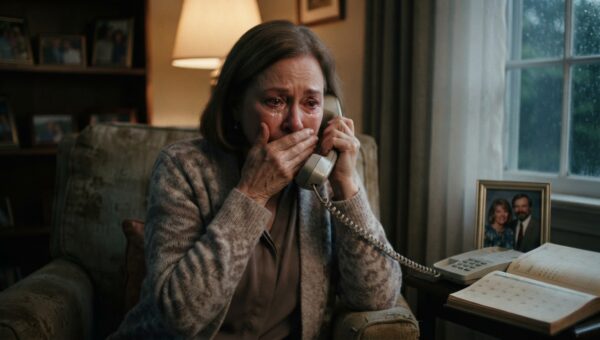
The phone rang four times. I expected a receptionist, an automated greeting, or a polite voice telling me the number was out of service.
Instead, a deep, raspy man’s voice picked up on the fourth ring. “Fuller.”
I froze. I hadn’t actually rehearsed what I was going to say. I just stared at the blue cover of my mother’s yearbook lying open on the chenille spread.
“Hello?” he said, his voice dropping slightly as he waited. “Who is this?”
Silence stretched between us for eight long seconds. I could hear the faint hum of an office air conditioner through his end of the line.
Then he spoke again, quieter this time, as if he were talking to an empty room.
“Margaret’s daughter.”
My breath caught in my throat. I stood up so fast the small bedside table wobbled. “How do you know who I am?”
I expected him to dodge, to ask what I was talking about, or to hang up. But he didn’t hesitate.
“Six hundred a month,” he said steadily. “For thirty-eight years. To a post office box in your mother’s maiden name. I never missed a payment. Because you’re my…”
He stopped himself. The line hissed with static and the distant sound of traffic.
“Your what?” I whispered, my hand shaking so hard I had to press the phone tighter against my ear. “What are you talking about?”
“Ask your aunt Clara,” the retired judge said, his voice hardening as if he were closing a docket. “Or check the records in the probate office in Grant County.
Your mother was a proud woman, Margaret. She wouldn’t take a dime from me after nineteen seventy-four, no matter what I offered. But she let me help pay for your college, and she let me keep the rest in trust until you turned twenty-one. After that, I sent what I could through the box because I knew what things cost.”
“You sent money?” I said, my chest tightening until it hurt to breathe. “To my mother? For thirty-eight years?”
“Every month,” he said. “Without fail. Now tell me why you’re calling me today. Is your mother…”
“She died last week,” I said, the words tasting like dry paper in my mouth.
Another long silence followed. This one felt heavier, loaded down by decades of distance and separate lives that had crossed only through postal money orders and stubborn pride.
“I see,” Judge Fuller said softly. “I’m sorry for your loss. She was… she was remarkable.”
“She hid this book in her cedar chest,” I told him, looking down at the faded blue binding. “With your name on the back.”
“She kept it,” he murmured, more to himself than to me. “I wondered if she did.”
PART 3
I hung up the phone without saying goodbye. My sister walked into the bedroom just then, carrying a stack of old photo albums under her arm, and stopped when she saw my face.
“Are you okay?” she asked, dropping the albums onto the bed. “You look like you’ve seen a ghost.”
“Where is Aunt Clara?” I asked.
“Downstairs in the kitchen, packing up the pantry.”
I didn’t answer. I walked out of the bedroom, down the narrow wooden stairs, and found my aunt Clara standing by the sink wrapping china tea cups in newspaper. Clara was seventy-eight, my mother’s older sister, with the same sharp eyes and straight posture that didn’t bend for anyone.
I set the blue yearbook down on the kitchen table right in front of her.
Clara looked at the cover. She didn’t gasp, and she didn’t look surprised. She just stopped wrapping the tea cup, set it down carefully on the counter, and wiped her hands on her floral apron.
“You found it,” Clara said quietly.
“Six hundred a month,” I said, my voice barely above a whisper. “For thirty-eight years. Judge James Fuller in Savannah. You knew about him.”
Clara pulled out one of the wooden kitchen chairs and sat down heavily. She folded her hands in her lap and looked up at me with tired, knowing eyes.
“Your mother loved him,” Clara said, her voice steady. “They were set to marry the summer after graduation. Then your grandfather got sick, the farm went under, and your mother’s family told her she had to stay put. James had a scholarship down south. He left. Your mother stayed. Two months later, she found out she was carrying you.”
“And Robert?” I asked, thinking of the man I had called Dad my entire life, the man who taught me how to fish and walked me down the aisle.
“Robert knew before they married,” Clara said gently. “He was a good man, your dad. He took your name, he raised you as his own, and he never asked a single question about the money that came in the mail every month. Your mother put every dollar of it into a separate account to pay for your master’s degree and your first house down payment. She never spent a cent of it on herself.”
I stood in the center of the quiet kitchen, looking at the faded blue yearbook and thinking about the mother I thought I knew. A woman who worked two jobs at the local dry cleaners, who patched our winter coats by hand, and who carried a secret across four decades without ever once letting the weight of it show on her face.
ENDING
We finished packing up the house by Sunday evening. The boxes filled the back of my SUV, stacked to the ceiling with old dishes, framed photographs, and winter clothes.
Before I closed the front door for the last time, I walked back into my mother’s bedroom. The cedar chest was empty now, its lid propped open to let the old wood breathe.
I reached into my coat pocket, pulled out the 1974 yearbook, and laid it flat on the bottom of the empty chest. I didn’t call the judge back, and I didn’t ask for the trust account records. Some things belong to the past they were built in.
I closed the lid, turned off the overhead light, and walked out to the car where my sister was waiting with the engine running.