PART 1
It rained three days, and on the fourth night I heard something shift heavy out behind the house, a sound like the ground letting out a breath. In the morning I went to look, and the old root cellar wasn’t willing to keep its secret anymore. If you grew up in the country like I did here in Virginia, you know a root cellar, a stone walled room dug back into the hillside where folks kept their potatoes and their canning before anybody had a deep freeze.
Ours came with the old home place, laid up with fieldstone by hands long gone, and I hadn’t used it for much but junk in years. Solid as the hill it sat in. My father stored his apples down there. His father before him.
That fourth night the saturated bank above it finally let go, slow, in the dark. I heard it more than felt it, that deep, wet, settling groan, and lay awake wondering what on the place had moved.
Come first light I walked down with a flashlight. The earth had shoved against the old stone and caved a whole section of the back wall inward, fieldstone tumbled across the dirt floor, cold air coming off the new gap. I climbed down in there to see how bad, and my light found the break in the wall. Behind the fallen stone the wall was double, laid up thick, with a space closed off inside it, back in the dark where the potatoes and the canning had sat a few feet off for a hundred years.
And set into that space, dry all this time, there was something wrapped and pushed to the back. I reached past the loose stone and lifted it out. And I backed toward the cellar steps with it in my hands, because even in the dim light of that caved in hole, I knew the size of it. It was a metal lockbox, heavy with years, painted the dark military green my uncle Arthur used on his tools back when Eisenhower was in the White House.
I carried it up to the kitchen table, wiping red clay off my boots before I stepped across the linoleum. My wife Sarah was pouring coffee, her eyes tired the way they had been since we had to sell off the lower forty to pay the back taxes on the tractor loan. She looked at the green box sitting between the sugar bowl and the salt shaker, its latch crusted with gray rust.
“Where did you dig that up?” she asked.
“The cellar,” I told her. “The back wall caved in during the storm. It was built into the double masonry behind the old bin.”
“Arthur’s?” she asked, naming the uncle who had lived in this house until he passed away back in ninety-four, the man who left me the deed with a handshake and a stack of unpaid bills.
“I don’t know,” I said. “Arthur never mentioned a second wall.”
I took an old flathead screwdriver from the drawer and jammed it into the rusty lip of the clasp. It took two hard pushes before the tin popped with a dry snap that made Sarah jump. Inside, protected by layers of oily flannel cloth, lay a leather ledger with cracked binding, a bundle of letters tied with faded twine, and a folded canvas pouch holding two hundred-dollar bills that looked crisp enough to spend tomorrow, except the series date printed in the corner was 1950.
Beneath those sat something smaller, wrapped in tissue paper: a heavy gold pocket watch with my grandfather’s initials engraved on the back, the very watch my father swore had been stolen out of his bureau drawer the winter my grandfather died back in sixty-two.
PART 2
I unfolded the top letter from the twine bundle. The paper was stiff, yellowed at the edges, written in my father’s sharp, careful cursive from the spring of sixty-two, right after the funeral.
Dear Arthur,
If the sheriff looks into the estate, tell him the watch was pawned in Roanoke to cover the seed bill. Do not let William find the ledger behind the root cellar stone. He has always been too honest for what needs doing on this place. If he knows we split the timber money between us before the probate judge even opened the will, he will never let it rest.
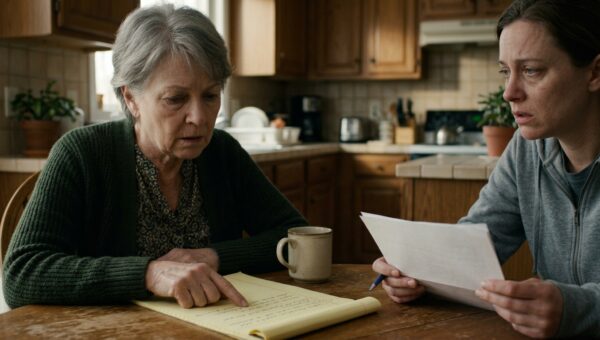
I sat there at the kitchen table, the coffee in my cup turning cold while I read it twice. My father, a man who had preached honesty from the porch swing every Sunday until his lungs gave out, had spent my entire childhood telling me the farm was poor, that we had to scrape for every nickel, that the reason we lost the east pasture was bad luck and dry summers.
“What does it say, William?” Sarah asked softly, standing behind my chair.
“It says my father lied,” I told her, my voice feeling thin in the quiet room. “Every year we worked ourselves half to death trying to pay off loans on land he had already sold the timber off of. He and Arthur took the cash, hid the paper behind the fieldstone, and left me holding a dry farm and a stack of debt.”
“That was sixty years ago,” Sarah said, though her hand came down on my shoulder, heavy and steady. “Arthur is gone. Your father is gone.”
“Yeah,” I said, looking at the gold pocket watch resting on the flannel. “And the bank is taking the house next Tuesday unless I come up with twelve thousand dollars for the drainage lien.”
I kept reading through the ledger. Page after page of timber sales, cattle tallies, and cash payouts marked down in pencil, signed by men from the lumber company down in Lynchburg who I only knew as names on old county maps. Halfway through the book, tucked between two blank leaves, was a folded receipt from the First National Bank of Staunton, dated November third, 1968.
It showed a deposit of fourteen thousand dollars. Not cash. A cashier’s check made out to my father, endorsed in his own hand, with a memo line written at the bottom: *For William’s college fund.*
I stared at those five words until the ink blurred.
I never went to college. My father sat me down at this very table the summer I turned eighteen and told me there wasn’t a red cent for school, that I needed to stay here and work the dirt if we wanted to keep the roof over our heads. I believed him. I thanked him for being honest with me about how hard times were. I spent the next forty years breaking my back on forty acres of clay while my father’s bank account sat somewhere across the mountain, untouched or buried in a name I had never heard of.
“Sarah,” I said, standing up so fast my chair scraped the floor. “Get my coat.”
“Where are you going?”
“To the courthouse,” I said, picking up the ledger and the bank receipt. “The county keeps the old property transfers in the basement archive. If that account existed in sixty-eight, the probate records from when my father passed in eighty-one should show where the balance went.”
PART 3
The county courthouse in Staunton smelled like old wool and wet umbrellas. The clerk on duty was a young woman named Brenda whose mother I had gone to school with, and she looked at my driver’s license with polite skepticism when I asked to pull the estate probate file for Arthur Vance and Thomas Vance.
“That’s forty-year-old records, Mr. Vance,” she said, tapping her keyboard. “They aren’t on the public portal. I have to go back to the microfiche room.”
“Take your time,” I told her, sitting on the wooden bench by the radiator.
It took her forty-five minutes. When she came back out through the swinging gate, she was carrying a dusty cardboard box with three manila folders inside. She set them on the counter and opened the top one.
“Your father’s estate was settled by attorney Miller back then,” she said, running a finger down a yellowed sheet of legal inventory. “Looks like the house and forty acres were transferred to you free and clear. But… wait.” She paused, turning the page toward the light. “There’s an addendum filed two weeks after the funeral. A separate trust account held at the Farmers and Merchants Bank in Waynesboro. Balance at the time of death was thirty-two thousand dollars.”
My heart gave a heavy thud against my ribs. “Who was the beneficiary?”
Brenda squinted at the small cursive signature at the bottom of the form. “It says… Arthur Vance as trustee for… well, it looks like it was assigned to a secondary holding, but there’s a release form signed by your cousin Ray back in ninety-five.”
“Ray?” I said. My cousin Ray, who had left for Ohio back in the seventies after he wrecked his daddy’s truck and never came back except for funerals. “Ray didn’t get this farm. I stayed here.”
“Not the farm,” Brenda said, pointing to the line. “The trust. When Arthur died in ninety-four, the remaining balance of the Waynesboro account was disbursed according to the original 1968 rider. It was set up for you, Mr. Vance. To be released when you turned sixty, or when the old house was sold.”
I stood there in the quiet hallway, the sound of the courthouse clock ticking against the wall.
My father hadn’t stolen my college fund to spend it on whiskey or fast cars. He had locked it away in a trust that required thirty years to mature, guarded by an old uncle who kept the secret behind a double wall of fieldstone because they both knew I was too proud to take a handout if I knew where it came from. They had watched me struggle, watched me sweat over every fence post and tractor repair, believing that hardship was the only way to make a man out of me, while the money sat in a bank forty miles away waiting for the day I turned sixty.
My birthday was last Thursday.
I didn’t say a word to Brenda. I thanked her, took the receipt and the bank reference number, and walked back out into the Virginia air.
ENDING
The drive home took forty minutes through the rolling hills where the fog was starting to settle in the hollows. When I pulled into the gravel drive, Sarah was standing on the porch holding a white envelope the mail carrier had dropped off an hour before.
I got out of the truck and walked up the steps.
“What’s that?” I asked, pointing to the paper in her hand.
“Notice from the bank,” she said quietly, her eyes searching my face. “They received a wire transfer this morning from an escrow account in Waynesboro. Twelve thousand, four hundred dollars. Paid in full. The drainage lien is cleared.”
I took the envelope from her fingers. Inside was a cashier’s receipt bearing my name, dated today, with a note typed at the bottom from the trust administrator: Account closed per original instructions. Maturity date reached.
We stood together on the porch for a long time, watching the sun drop behind the tree line where the old root cellar sat half-buried in the damp earth. The wall was still caved in, letting the cold air breathe out into the dark.
I reached into my pocket, pulled out my grandfather’s heavy gold pocket watch, and clicked the stem. The spring inside gave a sharp, clean tick, the first time I had heard it move since I was a boy standing beside my father’s knee.
“We’ve got work to do tomorrow,” I told Sarah, slipping the watch back into my vest. “We need to hire a mason to lay that stone back straight.”
“Are you going to seal up the hiding place?” she asked.
I looked down at the dark green tin sitting on the kitchen table through the screen door.
“No,” I said, putting my arm around her waist. “Some things need the air.”