The rain down here in Terrebonne Parish has a way of sounding like steady handfuls of gravel thrown against the window screen. I had the back door propped open just an inch to let the damp marsh air clear out the smell of bleach from the utility room, but all it did was bring in the smell of wet mud and rotting oak leaves.
My hands were pruned up from soaking whites in the basin, and my knees had that dull, familiar ache that always shows up before a front moves in from the Gulf.
Maya’s winter coat was hanging over the back of the kitchen chair where she left it on Monday night. It was a nice wool coat, camel-colored, the kind of thing she wore when she drove into Houma for her junior league meetings or went out to lunch with the girls from the parish guild. I only picked it up because she had dropped it on the floor near the back door, and nobody in our house leaves things lying around for the dog to sleep on. I went to hang it up in the hall closet, and my thumb caught on a heavy, wadded-up ball of paper buried deep in the right pocket.
You don’t go looking for trouble in your own kitchen, but habit is a hard thing to break after forty years of folding laundry.
I smoothed the paper out against my apron, pressing the creases flat with the heel of my hand against the laminate counter. It wasn’t a grocery list or a dry-cleaning tag. It was a cash register receipt from a twenty-four-hour pharmacy up past Thibodaux, exactly forty-one miles away from our back steps, timestamped at 3:14 on a Wednesday morning three weeks ago.
The items listed on it didn’t make any sense for a routine errand. There was a bottle of generic ibuprofen, a pack of mint gum, and a prescription refill under a strange doctor’s name for a heavy-duty sedative that doctors around here only hand out when somebody’s nerves are completely fried. Maya had told us she was spending that entire Tuesday night and Wednesday morning over at her mother’s house across town because her elderly mother was having dizzy spells and needed someone to sleep on the sofa.
I stood there by the washing machine with the damp towel still bunched in my left hand. I thought about the way Maya had looked at breakfast that morning when my son, Thomas, mentioned he needed to transfer some funds over to the credit union for the twins’ tuition accounts. She had dropped her toast face down on the ceramic plate and excused herself to the powder room, saying her stomach was acting up again from the humidity.
“You need to take a look at these statements, Arthur,” I told our family attorney the next morning over a cup of black coffee in his cramped office behind the courthouse. Arthur Vance had handled my husband’s small commercial fishing permits back before the heart attack took him, and he didn’t care much for fancy talk. He looked at the crumpled pharmacy receipt through his bifocals, turning it over twice to check the ink.
“Forty miles out at three in the morning,” Arthur said, tapping his yellow pencil against the edge of a green ledger. “And she told Thomas she was on Oak Street with her mother.”
“That’s what she said,” I told him, looking out the narrow window at the courthouse lawn where the live oaks were dripping in the drizzle. “She says a lot of things lately. Thomas is working sixty hours a week down at the shipyard, and he thinks the sun rises and sets wherever Maya happens to be standing. I want to know what’s sitting in their joint accounts, Arthur. Quietly. Before Thomas gets home from the early shift.”
Arthur didn’t ask me twice. He knew my voice when I used that particular tone, the one my late husband used to call my captain’s voice. He unlocked his bottom desk drawer, pulled out a standard consent form that Thomas had signed three years ago when we set up the family land trust, and told me to sit tight while he made some phone calls to the regional bank downtown.
The next forty-eight hours felt like waiting out a category three hurricane with the plywood already nailed down over the glass. Thomas came home for supper on Thursday smelling of hot zinc and diesel fuel, kissing the top of Maya’s head while she stood at the stove stirring a pot of red beans. She looked tired, the skin under her eyes dark and hollowed out like bruised fruit, but she smiled that quick, bright smile that always made Thomas think everything was fine in her little world.
“Mom’s been awful quiet today,” Thomas said, pulling out a chair and sitting down with a heavy sigh that rattled the silverware. He reached across the table and caught Maya’s hand before she could pull it away to check the burner. “You okay, Ma? You look like you’re tracking a ghost.”
“Just tired of the rain, Tommy,” I said, keeping my eyes on my plate. “The damp gets into my joints.”
Maya didn’t look at me. She just squeezed Thomas’s hand back, her fingers twitching just a little against his palm before she stood up to grab the cornbread from the oven. “We’re all tired of this weather,” she said, her voice a little too high and tight to sound natural. “As soon as the sun comes back out, I’m taking the twins down to the park for the whole afternoon.”
She didn’t know that Arthur Vance’s courier was scheduled to drop the certified audit report on my front porch at eight o’clock the next morning.
The report came in a heavy manila envelope sealed with red wax tape. I took it into the small back pantry where the old upright freezer hummed its low, steady song, and sat down on an overturned crate of canning jars to open it. I didn’t want Thomas or Maya walking through the front room and seeing the state of my hands as I pulled out the pages.
The numbers didn’t take any decoding. Arthur had highlighted the important lines in bright yellow highlighter so an old woman wouldn’t miss a thing. The joint checking account Thomas and Maya shared for household expenses had a balance of four hundred and twelve dollars. The secondary savings account, the one designated for the children’s private school tuition and college funds that Thomas’s grandfather had started back in nineteen-eighty-two, showed twelve successive online wire transfers over the past eight months.
Total amount withdrawn: sixty-eight thousand four hundred and twenty dollars.
Every single transfer had been routed through an offshore wagering site operating out of Curacao, paired with local ATM withdrawals made at three o’clock in the morning at convenience stores located forty miles away from our parish seat. There were no hotel receipts, no medical bills, no hidden investments in real estate. Just digital chips bought and lost in the dark while my son was sleeping upstairs after a double shift at the yards.
I folded the papers back into the manila envelope and tucked it deep inside my apron pocket. My heart wasn’t pounding like it does in the movies; it was just sitting heavy and cold in my chest, steady as an anchor chain dragging through soft mud.
Friday evening, I didn’t cook. I asked Thomas to pick up a boiled crawfish sack from down on the bayou, telling him we needed to sit down as a family and talk about some property taxes on the old boat house down by the canal. He came home right around five o’clock, his truck crunching over the oyster shells in the driveway with the radio playing some old country station out of Lafayette.
Maya was sitting at the kitchen table helping our nine-year-old granddaughter, Chloe, glue pink glitter onto a poster board for a school project. The house smelled of glue and boiled crawfish spice, thick enough to make your eyes water.
“Sit down, Thomas,” I said, closing the back door and sliding the deadbolt home with a sharp, metallic click that made both of them look up.
Thomas dropped his keys on the counter, frowning at the tone in my voice. “What’s wrong, Ma? Is something leaking in the pump house again?”
“Sit down,” I said again, pointing my chin at the chair across from Maya. “And keep your hands where I can see them, both of you.”
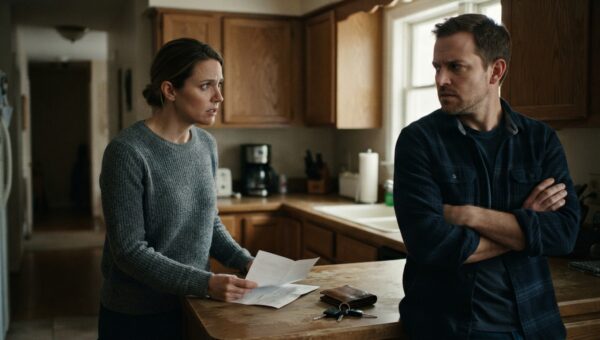
I pulled the manila envelope out of my apron and laid it flat in the middle of the red oilcloth table, right on top of the glitter and the glue bottles. Then I reached into my pocket and dropped the crumpled forty-mile pharmacy receipt right beside it, smoothing out the timestamp with the pad of my thumb so the black ink stared right up at them under the fluorescent light.
Maya went very still. The tube of school glue slipped from her fingers, rolling across the oilcloth until it dropped off the edge and hit the linoleum with a dull plastic thud. Her face didn’t go white like people say in stories; it just tightened up until the skin across her cheekbones looked thin and dry like parchment paper.
“What is this?” Thomas asked, reaching out to touch the corner of the envelope before pulling his hand back like the paper was hot. He looked from me to his wife, his brow furrowed in that slow, stubborn confusion of a hard-working man who still believes the world is basically honest. “Maya? What’s my mother putting on the table?”
Maya didn’t look at Thomas. She stared right at the receipt with those hollow, bruised eyes, her lower lip trembling just enough to show she was done running.
“Tell him about your mother’s house on Wednesday mornings,” I said, my voice dropping down until it was barely louder than the hum of the refrigerator. “Tell him about the pharmacy forty miles up Route 90. Or do you want me to read the numbers from Arthur Vance’s audit out loud for the little girl to hear?”
Thomas stood up so fast his chair tipped backward, hitting the pantry door with a sharp crack that rattled the empty mason jars on the top shelf. “Ma, what are you talking about? What audit? What money?”
“The college money, Tommy,” I said, looking right into my son’s eyes because someone had to be the one to hold the line. “The money your grandfather left in that trust for these children. It’s gone. Every last dollar of it went into online card games while you were down at the yards welding hulls in the dark.”
Thomas turned slowly to look at his wife, his mouth slightly open, his hands hanging at his sides like he didn’t quite know what to do with them anymore. “Maya? Tell me she’s lying. Tell me my mother’s making this up.”
Maya covered her face with both hands, her shoulders shaking as the dry, ugly sobs finally broke through her teeth. She didn’t deny a single word. She just sat there at the kitchen table with the pink glitter stuck to her knuckles, whispering the same three words over and over into her palms until they lost all meaning.
“I couldn’t stop,” she whispered. “I couldn’t stop.”
Thomas didn’t yell. That was the hardest part to watch. He didn’t smash a chair or throw the crawfish sack against the wall. He just walked over to the landline phone hanging on the wall by the calendar, picked up the receiver, and dialed Arthur Vance’s direct office number with fingers that didn’t shake at all.
“Mr. Vance,” Thomas said, his voice flat and hard as a rusted iron rail. “This is Thomas. My mother showed me the papers. I need you to meet me at the credit union first thing in the morning so we can lock every account my name is on, and I want to know what kind of lawyer we need to talk to about getting a custody order filed before Monday morning.”
Maya dropped her hands from her face, her eyes wide and wet with absolute terror as she looked up at her husband. “Thomas, please. Don’t do that. Don’t take the kids.”
“You took their future to play cards with strangers in Houma,” Thomas said, and he didn’t even look down at her when he spoke. “You took every dime they had for college while I was breaking my back down in the bilge.”
He hung the phone up on the cradle with a clean, sharp click that echoed in the quiet kitchen. The rain outside had slackened off to a steady, miserable mist, the kind that lingers over the marshes until noon the next day.
An hour later, Maya packed two suitcases in the upstairs guest room while Thomas sat down at the kitchen table with a yellow legal pad and a ballpoint pen, listing every single bill, every single debt, and every remaining asset we had left to our name. He didn’t look up when she carried her bags down the stairs and set them by the front door.
“My brother’s coming to pick me up,” she said softly, her hand resting on the brass door handle. “He said I can stay in the spare room until the clinic in New Orleans has an opening on Monday.”
“Go on then,” Thomas said, still writing down numbers on his yellow pad. “Just make sure you leave the keys to the truck on the counter.”
She laid the brass key ring right beside the crumpled grocery receipt without another word, pulled the heavy oak door open, and stepped out into the dark parish rain without looking back once.
The house was too quiet after she left, just the sound of the refrigerator motor and the slow drip of the kitchen faucet that Thomas promised he would fix on Sunday. We didn’t talk about her anymore that night. We sat across from each other at the oilcloth table until past midnight, going through bank statements and loan papers under the harsh light of the ceiling bulb, making sure the children’s bedrooms upstairs were still safe under our roof.
The next morning, after Arthur Vance met us at the brick-front bank on Main Street to freeze the remaining commercial lines and secure the title to the old fishing boat, Thomas and I drove back home in total silence. He didn’t turn on the radio, and I didn’t try to fill the empty space between us with cheap comfort.
When we pulled into the gravel drive, Thomas walked straight to the metal filing cabinet in the corner of the back porch where we kept the deeds and the insurance policies. He slid a heavy, old-fashioned brass key into the newly installed cylinder lock he had bought at the hardware store in town, turned it twice until it clicked solid into the steel frame, and pulled the key out with a steady, deliberate motion.
He pocketed the key, looked up at the grey sky over the bayou, and finally let out a long, slow breath that sounded like someone laying down a very heavy load after a long march in the sun.