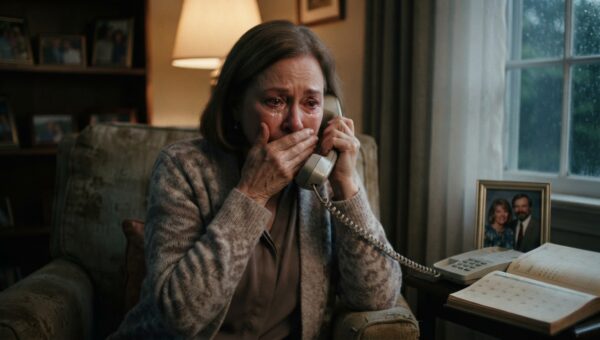
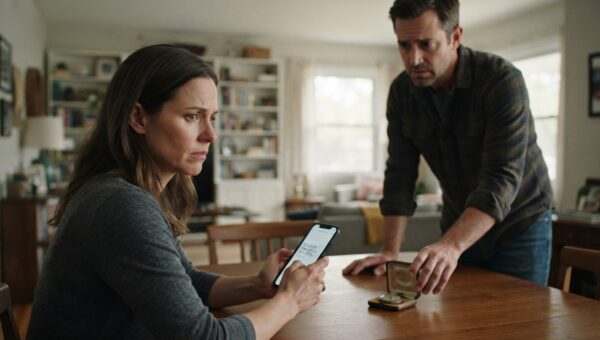
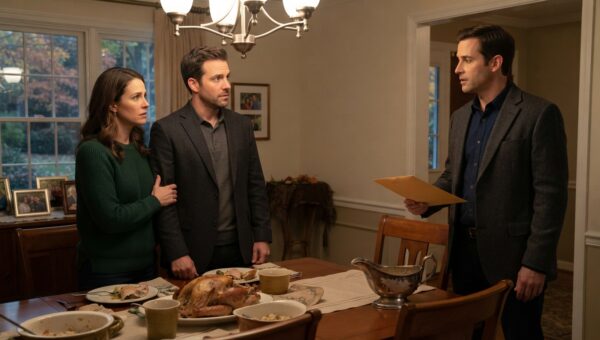
The fork hit the cherry-wood dining table with a sharp, ugly crack that made the water glasses shiver.
“If you stay, pay $2,000 a month, clean our three-story house, mop the hardwood twice a week, mow the yard every Thursday, and drive the kids to school by 7:30 sharp,” Vanessa said, leaning forward until her blond highlights caught the glare of the brass chandelier. “We’re not running a nursing home, and we’re certainly not carrying a useless freeloader.”
I didn’t blink. I didn’t reach for my napkin or drop my gaze to my plate.
Across the table, my only son, Noah, gave one slow, quiet nod, staring intently at the salt shaker between us as if it held the secrets of the universe. He didn’t look up. He didn’t say, “Now hold on, Vanessa, that’s my mother.” He just let the silence settle like wet cement.
I only smiled. It was a very small smile, the kind that doesn’t reach your eyes, but it made Vanessa twitch. She couldn’t know. Neither of them knew yet that the retirement announcement I had just made wasn’t an admission of helplessness. It was an audit.
Three days after that dinner, a crisp piece of computer paper taped securely to the peeling paint of my tiny third-floor bedroom door listed my new reality. HOUSE RULES, it read in bold, underlined twenty-point font. Item one: Up by 5:30 AM to start the coffee and empty the dishwasher. Item two: No long-distance phone calls on the household landline.
Item three: All personal laundry washed by hand in the basement sink so as not to wear out the family machine.
By sunrise on the fourth morning, the house smelled of industrial pine cleaner and boiling chicory. I moved through the downstairs rooms with a rag and a bucket of warm water, wiping down baseboards that hadn’t seen soap since Noah and Vanessa bought the mortgage seven years ago. I drove the twins, ten-year-old twins who barely muttered a hello, to Oakridge Elementary in my dented Ford sedan, listening to Vanessa’s parting reminder about picking up organic milk on the way back.
Back at the house, I set the groceries on the counter and pulled a fresh, golden-crusted apple pie from the carrier, letting the scent of cinnamon and butter fill the kitchen. It was a habit from forty years of marriage to Arthur, baking when my hands needed something honest to do.
I set it on the cooling rack, proud of the lattice top.
An hour later, Vanessa walked into the kitchen carrying a bulging black trash bag. She didn’t look at the pie. She didn’t ask whose it was. She simply swept her arm across the counter, shoving my baking dish straight down into the black plastic liner where the wet coffee grounds and potato peelings lived.
“We don’t eat sugar in this house,” she muttered, knotting the top of the bag without missing a beat as Noah walked in behind her, holding his briefcase. He saw the pie tin sink into the garbage. He looked at me, his mouth opening slightly, and then he just turned away toward the hallway closet.
That afternoon, the front door was open to let the spring breeze clear out the floor wax fumes when our next-door neighbor, Margaret, walked up the porch steps. Margaret had lived across the street under the massive, spreading branches of the sycamore tree since Noah was in grade school.
She paused on the threshold, sniffing the air with her eyes closed.
“Is that cinnamon?” Margaret asked, squinting against the bright midday sun. “I’d know that crust anywhere. You still making those, Martha?”
“Just finished one,” I said, leaning against the screen door. “Or at least I thought I did.”
Margaret shook her head, looking past me into the empty hallway before pulling a crisp fifty-dollar bill from her cardigan pocket. “Look, I have my sister coming over for tea tomorrow and I can’t bake to save my life. Take this. Bake me another one, and bring it over whenever you get a free second away from your daughter-in-law’s boot camp. Everybody in this neighborhood knows how Vanessa runs things.”
As Margaret walked back down the steps, the fifty-dollar bill felt crisp and cool between my fingers. I looked down at the crumpled copy of the HOUSE RULES I had shoved into my apron pocket. Then I looked past Margaret, straight across the asphalt street to the quiet, dignified brick colonial sitting beneath the sycamore tree. A crisp white FOR SALE sign was bolted to the wrought-iron fence, its black lettering standing out clear against the peeling green paint of Noah’s porch.
I didn’t walk back inside to finish scrubbing the pantry shelves. I folded Margaret’s fifty-dollar bill, tucked it into my pocket, stepped off the porch, and started walking toward the sign.
The real estate office was a small brick storefront two blocks down on Main Street, smelling of old paper and peppermint lozenges. The agent, a sharp-eyed woman named Brenda who had known Arthur when he was on the town zoning board, looked up from her desk over a pair of half-moon reading glasses.
“Martha? Goodness, I heard you sold your place on the river. Are you moving in with Noah and Vanessa?” Brenda asked, gesturing to the leather chair opposite her desk.
“For about four days now,” I said, sitting down and smoothing my skirt. “Brenda, that listing across the street under the sycamore. The Miller place. What’s the asking price?”
Brenda tapped her keyboard a few times, her screen casting a pale blue glow across her graying hair. “Well, it’s listed at three hundred and twenty thousand. The estate wants a quick cash close, no contingencies. Why do you ask? Are you looking for a rental for someone?”
I reached into my handbag, pulled out a thick manila envelope bearing the letterhead of the regional trust and investment division, and slid it across the mahogany grain of her desk. “I don’t need a rental. I need a deed in my own name, fully cleared, by Friday afternoon.”
Brenda pulled out the financial verification statement, her eyes widening as she scanned the bottom line. The sale of my riverfront home, combined with forty years of conservative municipal bonds and Arthur’s modest pension accumulated over three decades at the water authority, sat in a high-yield account totaling $412,650. Liquid. Unencumbered. Untouched by Noah’s mortgage or Vanessa’s spreadsheets.
“My word, Martha,” Brenda whispered, looking up from the paper. “Does Noah know about this?”
“Noah thinks I’m living out of a suitcase on his third-floor landing,” I said quietly. “Let’s keep it that way for just a little longer.”
The next forty-eight hours were a blur of quiet efficiency. While Vanessa was out at her Tuesday morning book club and Noah was stuck at his accounting firm downtown, I packed my two suitcases and the heavy cast-iron skillet Arthur had given me on our twenty-fifth anniversary. I didn’t leave a note on the third-floor door. I didn’t tell them a single word.
By Thursday morning, the moving truck parked in front of the sycamore house wasn’t a large interstate semi, but a local box van driven by two young men from church who whistled while they carried my oak dresser and my grandfather’s rocking chair through the bright red front door of my new home. The floors inside smelled of lemon oil and dry cedar. The kitchen had a deep porcelain sink that looked out right across the street, offering a perfect, uninterrupted view of Noah’s front porch.
At 4:45 PM on Thursday, the front door across the street banged open. Vanessa marched down her sidewalk, her car keys dangling from her fingers, looking furious. She strode right across the asphalt, marched up my new steps, and pounded on the brass knocker of the sycamore house before I even had the kettle on.
I opened the door slowly, holding a mug of chicory coffee in my hand.
Vanessa didn’t look at the freshly painted hallway or the polished hardwood floors. She pointed a manicured finger straight into my chest. “Where are the twins’ clean uniforms? And where is the two thousand dollars? It’s the first of the month, Martha, and you haven’t touched the basement laundry or mowed the side yard. You can’t just walk off when you feel like it!”
I took a slow sip of my coffee, letting the steam rise between us. I reached into my apron pocket, pulled out the crumpled HOUSE RULES sheet she had taped to my attic door days before, and pressed it firmly into her palm.
“You missed a spot,” I said, my voice barely above a whisper.
Vanessa frowned, unfolding the paper. “What is this nonsense? This isn’t a chore list. This is your contract!”
“It was,” I agreed, stepping back slightly so she could see past my shoulder into the sunlit living room where my boxes were neatly stacked against the baseboards. “And you made it very clear that I was a useless freeloader who didn’t pull her weight. So I found a place where the rent is zero, the rules are my own, and I don’t have to listen to anyone throw away a good apple pie.”
Vanessa went rigid, her mouth opening and closing like a fish out of water as her eyes tracked from my face to the brass numbers bolted beside the front door: 412. The exact house number she had looked at from her kitchen window every single day for seven years without ever wondering who owned the equity.
“You… you bought this?” she stammered, her voice dropping an octave as the reality of the deed began to sink through her anger. “With what money? Noah said you had nothing left after the river house!”
“Noah doesn’t know very much about arithmetic,” I said calmly. “Or about mothers.”
Just then, a blue sedan pulled into the driveway across the street. Noah stepped out, carrying his briefcase, looking tired and gray around the edges. He shut the car door and looked up, expecting to see Vanessa waiting on their porch. Instead, he saw her standing on the steps of the grand brick colonial directly across the street, holding a crumpled piece of paper, staring at his mother through the open screen door.
Noah froze beside his fender, his keys halfway to his pocket, his eyes moving slowly from Vanessa to me. He didn’t cross the street. He didn’t call out. He just stood there under the afternoon sun, the heavy weight of his own silence finally settling onto his shoulders.
I didn’t wait for him to walk over. I didn’t offer to help with his mortgage, or bail out his savings, or babysit the twins on Saturday night. I simply smiled, wished Vanessa a pleasant evening, and clicked the solid wood door shut.
The next morning, the sun broke warm and golden through the thick green canopy of the sycamore tree, casting long, peaceful shadows across my new porch. I set a fresh batch of apple pies on the kitchen counter, the sweet scent drifting lazily out the open window toward the quiet street. Margaret walked by twenty minutes later, waving cheerfully with a fifty-dollar bill already in her hand. I sat down in the wooden rocking chair, wrapped my cardigan a little tighter around my shoulders, and watched Noah pull out of his driveway in absolute silence.