PART 1
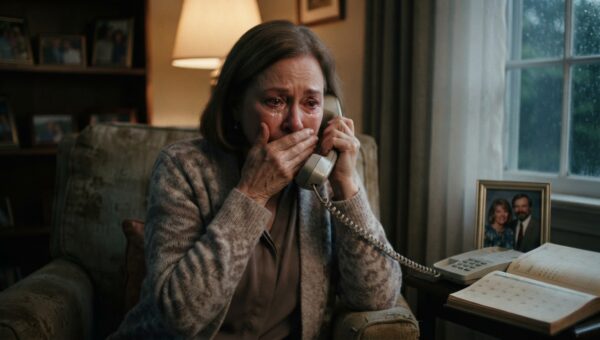
The debt collector’s voice came through the living room landline with the flat, practiced steady tone of someone who read numbers all day long.
“Mrs. Campbell, your balance across three separate accounts is $213,000,” the woman said.
I was standing by the bookshelf holding a damp cloth, half-wiped dust rag in my hand. I stared out the front window toward the maple tree in our yard where the autumn leaves were just starting to curl at the edges.
“There is some kind of mistake,” I said, my voice dropping an octave. “I don’t have any debt. My husband and I paid off our mortgage six years ago, and we use a local credit union for everything else.”
“We aren’t calling about a mortgage,” the collector replied. “Your husband co-signed seven personal and commercial loans between 2019 and 2024. Your name is listed as primary joint applicant on every single one of them.”
The rag slipped from my fingers, landing softly on the carpet. My chest tightened, a cold, hard band squeezing around my ribs. Seven loans. Two hundred and thirteen thousand dollars.
“I never signed any loan papers,” I said, the words coming out tight and thin.
“The applications were submitted online with electronic verification and verified signatures matching your state identification number,” she said smoothly. “If you believe this is fraudulent, you will need to file a police report and submit an affidavit of forgery. But the accounts are currently ninety days past due.”
The line went dead with a sharp click.
I didn’t call the police right away. Instead, I sat down at the kitchen table, opened my laptop, and logged into our primary credit monitoring service using the password Robert had set up for us back when we retired from the hardware supply company. My hands were shaking so badly I mistyped the security question twice before the dashboard loaded.
There it was. A tangled web of commercial credit lines, equipment loans, and signature notes totaling $213,000. Both names were listed. Robert’s signature was there, bold and sprawling. And mine was right beside it. My signature. Scrawled in a shaky, uneven line that looked nothing like my steady handwriting.
The audit trail attached to the digital filings showed that the funds had been disbursed through wire transfers directly to an address in Reno, Nevada.
Robert was out in the garage. I could hear the rhythmic whine of the electric buffer he used to polish the chrome on his old Ford pickup truck.
He spent hours out there lately, tinkering with tools he never used and listening to talk radio with the side door pulled halfway down.
I walked out through the laundry room, pushing open the heavy wooden door into the garage. The air smelled of warm wax and gasoline. Robert was leaning over the passenger fender, holding the buffer with both hands, his gray hair damp at the neck.
“Robert,” I said.
He didn’t turn off the buffer. He gave it one more pass across the metal before lifting the tool and clicking the power switch. The sudden silence in the garage felt heavy.
“What is it, Karen?” he asked, wiping his forehead with a rag tucked into his back pocket.
“I got a call from a collection agency today,” I said, keeping my voice as flat as I could manage. “They told me we owe two hundred and thirteen thousand dollars on seven loans taken out over the last five years.”
Robert didn’t blink. He tossed the rag onto his work bench and picked up a can of polishing compound.
“Those are investments, Karen,” he said, his tone casual, almost dismissive.
“Investments?” I stepped closer, the concrete cold beneath my sneakers. “What kind of investments? Whose name are they in? My signature is on those papers, Robert, and I never signed a single one of them.”
He kept his back turned, twisting the cap off the compound container. “You wouldn’t understand. It is complicated commercial paper. I needed capital to secure our future.”
“With forged signatures?” I raised my voice then, the fear finally breaking through the shock. “You forged my name to borrow two hundred thousand dollars and send it to Nevada?”
He finally turned around, his face set in that stubborn, stony expression he always used when he refused to lose an argument. He didn’t look guilty. He looked annoyed, as if I were a difficult customer complaining about a minor billing error at the hardware store.
“Drop it, Karen,” he said quietly. “I know what I’m doing.”
PART 2
I didn’t drop it. That night, while Robert was asleep in the guest room where he had been drifting off to watch television for the past six months, I sat at the kitchen table with my phone and dialed the FBI internet crime and financial fraud reporting line.
The process took forty minutes of answering automated prompts and speaking to an intake specialist who took down every detail about the wire transfers, the lender names, and the Nevada address. She gave me a case reference number and told me someone from the regional field office would be in touch.
Three days later, a silver sedan pulled into our driveway. A man in his late forties wearing a dark gray suit and carrying a leather portfolio walked up to the front porch and knocked twice. His name was Agent Miller.
We sat at the kitchen table where my laptop was still open to the credit report. He laid a slim manila folder across from him and opened it.
“Mrs. Campbell, your husband isn’t just investing in commercial paper,” Agent Miller said, looking directly at me with calm, steady eyes. “We pulled the corporate registration records from the Nevada Secretary of State’s office tied to those wire destinations.”
“What is it?” I asked, my throat dry.
“He’s funding a business in Reno,” the agent said. “A wholesale distribution warehouse.”
“A warehouse for what?”
Agent Miller hesitated for a fraction of a second, shifting a paper slightly. “Industrial supplies. But the company isn’t registered in his name. And it isn’t registered in yours, either.”
My stomach gave a hard, sickening lurch. “Then whose name is on the LLC?”
“It’s registered to a woman,” Agent Miller said quietly. “A woman who shares a residential address with a post office box in Sparks, Nevada, that matches Robert’s secondary mail forwarding account. And the business itself…” He paused, letting out a measured breath. “The business is licensed under your maiden name. Karen Vance.”
The kitchen seemed to tilt sideways. My maiden name. A name I hadn’t used on any legal document since the day Robert and I stood in front of a justice of the peace forty-one years ago. He had taken my family name, twisted it, and used it to cloak a secret life three states away while I sat in our suburban kitchen baking casseroles and keeping our ledger balanced down to the penny.
“Why?” I whispered, the word barely audible over the hum of the refrigerator. “Why use my maiden name?”
“Because if the loans default and the creditors come looking for assets, an inactive identity with a clean credit history from your home state makes it harder to trace the primary beneficiary,” Agent Miller explained, his tone professional and detached. “He built a shell around himself using your history.”
When Robert came home from his morning errand at the hardware store an hour later, he walked through the back door carrying a brown paper bag of groceries. He stopped in the kitchen doorway when he saw me sitting alone at the table with the manila folder closed in front of me.
“Karen? Who was here?” he asked, his eyes darting to the paperwork.
“Agent Miller from the FBI was here, Robert,” I said. I didn’t shout. I didn’t cry. The numbness had worn off, replaced by a cold, quiet clarity that felt like ice water in my veins.
Robert dropped the grocery bag onto the counter. A carton of eggs rolled out, hitting the linoleum with a dull thud, but neither of us looked down.
“You called federal investigators?” His voice rose, panic finally cracking through his stubborn exterior. “Are you out of your mind? You’ve destroyed forty years of marriage over some paperwork!”
“You destroyed it when you forged my signature seven times and registered a company in Nevada under my dead father’s family name,” I said, standing up from the chair. “You didn’t invest in our future, Robert. You bought a second life with my credit.”
PART 3
The legal unraveling moved faster than Robert ever anticipated. Once federal investigators and the lending institutions confirmed the systematic forgery across multiple financial institutions, the case shifted from a civil dispute to federal wire fraud and identity theft.
Robert tried to claim he had verbal consent, that we were partners in the venture, but his story fell apart the moment the banking records showed that every single wire transfer had been routed through accounts he controlled entirely without my knowledge or access. The woman in Nevada, a former supplier representative he had met during his final year at the hardware company before retiring, was served with asset-freeze notices within two weeks.
The confrontation that ended our marriage didn’t happen in a courtroom with a dramatic speech. It happened on a rainy Tuesday morning in our lawyer’s office downtown.
Mr. Henderson, the estate attorney who had drawn up our wills twenty years ago, sat behind his mahogany desk with a stack of property division forms and loan liability disclaimers. Robert sat across from me, looking older, smaller, his shoulders rounded under a windbreaker that suddenly looked too big for him.
“The federal prosecutors are offering a diversion agreement contingent on immediate restitution and the liquidation of the Nevada commercial assets,” Mr. Henderson said, adjusting his glasses. “That means the Reno warehouse, the equipment, and any remaining inventory must be sold off to satisfy the two hundred and thirteen thousand dollar balance.”
Robert looked across the desk at me, his eyes pleading for the first time since this started. “Karen, please. If they liquidate the warehouse now, I lose everything I put into it. We can sell this house instead. We can split the equity and—”
“This house was paid for with my inheritance from my parents,” I interrupted, my voice completely steady. “My name is on the deed alone. You are not touching a single brick of it.”
Mr. Henderson slid a paper across the table toward Robert. It was a formal separation agreement, a waiver of spousal claim against my protected assets, and a consent order for the immediate dissolution of the fraudulent corporate filings.
“Sign it, Robert,” I said. “Or you can explain your signature to a federal judge in Reno.”
He stared at the paper for a long minute, his pen hovering over the signature line. The man who had spent forty years acting like he was the undisputed master of our household looked completely hollowed out. With a shaking hand, he pressed the pen to the paper and signed his name for the last time on a document that separated our lives forever.
He packed his clothes that afternoon while the rain beat against the garage door. He didn’t say goodbye. He just loaded two suitcases into the trunk of his sedan, backed down the driveway without looking back, and drove away into the gray afternoon.
ENDING
The legal process took nearly eight months to fully close out. The federal restitution orders were satisfied through the liquidation of the Nevada warehouse assets and the closure of the secondary accounts Robert had opened in secret. My credit report was cleared of the fraudulent loans after the affidavits of forgery were formally accepted by the financial institutions.
The house is exceptionally quiet now. The autumn leaves have fallen and been cleared away, replaced by the sharp, clean frosts of early winter.
On a bright Saturday morning, I was sitting at the kitchen table going through the mail when I found an old, faded envelope at the very bottom of the basket. It was a Christmas card from my sister sent two years ago, addressed in my maiden name by mistake—Karen Vance—before we corrected her.
I looked at the handwritten name on the envelope, the name my father had given me, the name Robert had tried to weaponize against me in a state two thousand miles away.
I picked up a pen, crossed out the typed return address with a single, firm stroke, and wrote my own name across the front in clean, unbroken script. Then I dropped it into the recycle bin, walked over to the stove to pour myself a fresh cup of coffee, and watched the sunlight hit the kitchen window, clear and entirely my own.