PART 1
My son Thomas meant well when he sent the agency paperwork over email last month, but when Etta walked through my front door on a Tuesday morning wearing sensible shoes and carrying a canvas tote bag, I wanted nothing to do with her.
“Your son asked me to check in three days a week,” she said, her voice quiet and steady as she set her keys on the hall table. “Ninety dollars a visit, Mrs. Vance. Whether we talk or whether I just help you tidy up.”
I sat in my green armchair by the front window, keeping my shawl pulled tight around my shoulders. I resented every single dollar Thomas was spending on her, and I resented Etta even more for being there. I was seventy-four years old, and I had managed my own small house since my husband passed away five years ago. I did not need a stranger coming in to watch me breathe.
For the first three visits, I gave Etta every cold shoulder I could muster. I answered her questions with short nods, refused the weak tea she offered to brew, and stared at the television while she wiped the kitchen counters until they shone.
The trouble was that Etta did not get flustered, and she did not leave when I glared at her.
On her fourth visit, she walked into the living room carrying a small white paper bag from the bakery down the street.
She did not open it or wave it in front of me. She simply set it on the coffee table, pulled up the wooden straight-backed chair, and sat down directly across from my knees.
Then she watched me swallow.
I had just tried to force down three small sips of lukewarm chicken broth from the mug on my side table, the same thin broth I had been living on for eight solid months. Every time Thomas called from his office during his lunch break, I told him I was just not hungry, that my stomach had shrunk with age, and that he did not need to worry about my groceries.
Etta watched my throat work with painful effort, saw the way my eyes watered as the liquid scraped against raw tissue, and leaned forward.
“Ma’am,” she asked softly, her eyes locked on mine. “How long have you been hiding that you can’t swallow?”
PART 2
A heavy weight pressed down against my chest, so sudden and sharp I had to grip the wooden arms of my armchair.
For months, I had convinced myself that if I just kept my mouth shut and pretended everything was fine, the problem would go away on its own. I did not want to be a burden to Thomas. His wife had just lost her part-time job at the clinic, and they were barely keeping up with their mortgage payments across town. They had enough on their plates without me needing surgeries or hospital bills.
“It’s just heartburn,” I whispered, looking down at my slippers. “It comes and goes.”
Etta reached out across the small space between our chairs. She took my dry, papery hand in her warm palm and did not let go.
“This isn’t picky eating, Mrs. Vance,” she said, her voice dropping into a firm, gentle register that brooked no argument. “Something is closing in your throat, and the longer we wait, the worse it gets. You aren’t fooling anyone who is actually looking.”
I felt the tears prick the backs of my eyes, hot and sudden after months of keeping them locked away behind a brave face. “I didn’t want Thomas to worry,” I choked out. “He has too much on his shoulders.”
Etta didn’t waste time offering empty comfort or letting me make another excuse. She pulled her phone from her canvas bag with her free hand, unlocked the screen with steady fingers, and dialed a number from memory.
“I’m calling him,” she said simply.
“No, Etta, please—” I started, trying to pull my hand back.
“Quiet,” she said without raising her voice, holding the phone to her ear. “Hello, is this Thomas Vance? … Yes, Mr. Vance. This is Etta, your mother’s home aide. I’m calling from her living room.”
She listened for a moment as Thomas answered, likely panicked that something had happened to me.
“Your mother has been living on broth for eight months, Mr. Vance,” Etta said clearly, looking straight into my eyes while she spoke. “She has an obstruction in her esophagus that she’s been hiding from you because she was afraid of being a burden. I need you to leave your office right now and drive over here, or I am calling an ambulance to pick her up from the front porch.”
She paused, listened to his hurried, panicked response, and then handed the phone straight to me.
“Tell him,” Etta instructed gently.
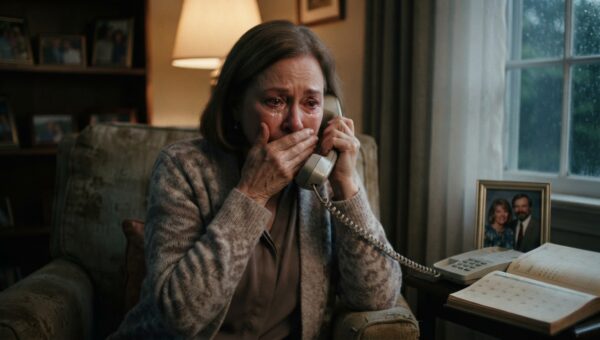
I took the phone with a shaking hand, pressed it to my ear, and heard my son’s voice break as he shouted my name through the speaker.
PART 3
Thomas arrived twenty-five minutes later, bursting through the front door with his tie loose and his car keys still clutched in his fist. When he saw me sitting in the chair with the empty broth mug and Etta standing by the window, the color drained entirely from his face.
He didn’t yell at me. He just walked across the room, dropped to his knees beside my chair, and put his arms around my shoulders, burying his face against my cardigan while his shoulders shook.
“Mom,” he whispered, his voice thick with a mixture of fear and guilt. “Why didn’t you tell me? Why would you keep something like this from me?”
“I didn’t want to cost you money, Tommy,” I murmured, using the childhood nickname I hadn’t spoken out loud in years. “I thought I could just wait it out.”
Etta stepped quietly toward the hallway, gathering her tote bag from the table. “I’ll leave you two to talk,” she said softly. “My hours are up for today anyway. But Mr. Vance, I left the name of the ear, nose, and throat specialist downtown on the kitchen counter. Call them before five o’clock.”
Thomas stood up, wiping his eyes with the back of his hand, and walked Etta to the front door. I couldn’t hear what he said to her, but I saw him press an extra folded bill into her hand alongside her regular envelope, and I saw Etta shake her head before finally accepting it with a tight nod.
The next three weeks were a blur of sterile waiting rooms, barium swallow tests, and hurried consultations. Etta was right. A stricture had formed near the base of my throat, requiring a minor outpatient procedure to clear the blockage before it closed completely.
The medical bills came in the mail, heavy and official-looking, but Thomas paid them without blinking an eye, taking on extra evening consulting work through his firm to cover the balance.
On a bright Thursday afternoon a month after my procedure, I was sitting at my kitchen table eating a small bowl of soft vegetable soup that I could actually swallow without pain. The doorbell chimed once, light and familiar.
I walked to the front door and pulled it open.
Etta stood on the porch, holding a small paper bag from the bakery. She smiled, her eyes crinkling at the corners.
“I’m not on the clock today, Mrs. Vance,” she said, holding up the bag. “I just thought you might want a cinnamon roll that doesn’t taste like chicken broth.”
ENDING
I stepped back, opened the door wide, and let her into the hallway.
“Well, come on then, Etta,” I said, my voice stronger than it had been in a year. “The kettle is already hot.”
We sat at the kitchen table together, eating warm pastries in the quiet afternoon sunlight while the clock ticked softly against the wall. I still managed my own house, and I still lived independently in the rooms my husband built, but the heavy secret that had nearly broken me was gone.
Sometimes, when I looked at the hallway table where Etta had first set her keys, I realized that the best help in the world isn’t the kind you ask for. It’s the kind that refuses to let you hide behind a polite lie.