PART 1
The photograph from 2009 still sat in the back of my cedar chest, tucked beneath a stack of wool scarves I never wore anymore. In it, my grandson Leo was six years old, standing by the oak tree in my front yard with a blue plastic shovel in his hand. He had a faint yellowish bruise along his left forearm, right where a small hand might grip too hard during an argument.
Back then, I looked at that bruise and let myself believe what my son Daniel told me. Daniel was his father, a man who could smile through a Sunday service and slam a kitchen door the second we got home. Daniel told me his ex-wife was bitter, that she was coaching the boy to lie, and that the marks came from playground roughhousing. I wanted to believe my own child. I wanted to think my blood could not be capable of cruelty. So I told the judge Daniel was a good father. I sat in the wooden courtroom bench, smoothed down my skirt, and swore to it.
That was the last time I had any say in what happened to Leo.
For the next thirteen years, Daniel sent no cards, no phone calls, no holiday notes. He moved two counties away, changed his phone number, and built a thick, silent wall between my front door and his life.
Whenever I thought of Leo, I opened the small tin box in my kitchen pantry. Inside sat thirteen birthday checks, each made out for forty dollars, dated year after year, waiting for a boy who never came to claim them.
My friends at the senior center told me to let it go. They said children grow up and forget their grandmothers when the parents split. But I knew it wasn’t forgetfulness. It was punishment.
Then last spring, an envelope arrived in my mailbox with a plain white return address and neat, unfamiliar handwriting. Inside was a heavy cardstock invitation to a high school graduation ceremony at the regional civic center. My son’s name wasn’t on it. It was addressed directly to me, in care of Leo’s name.
I didn’t call Daniel to ask if I should go. I didn’t tell anyone at my apartment building. On a Tuesday morning in May, I put on my navy coat, caught the crosstown bus, and went alone.
PART 2
The civic center auditorium smelled of floor wax and damp raincoats. Hundreds of families sat in the tiered red seats, holding balloons and homemade banners while teenagers in blue caps and gowns marched across the stage to receive their diplomas.
I sat near the back row, my hands folded tightly over my purse strap, scanning the faces in the graduating line. When they called the name Leo Vance, a young man stood up from the third row. He was nineteen now, tall and broad-shouldered, carrying himself with a quiet, steady dignity that reminded me of nobody I had ever known in our family. When he walked across the stage to accept his diploma and a scholarship folder worth twenty-eight thousand dollars for the state university engineering program, my throat tightened until it hurt.
After the ceremony ended, the crowd spilled out into the lobby in a chaotic wave of hugs, camera flashes, and laughter.
I stood near a concrete pillar by the exit, feeling small and out of place in my old coat, wondering if I should just slip back out to the bus stop without saying a word.
Then a shadow fell across the floor in front of me.
I looked up. Leo was standing there, still wearing his blue graduation gown, holding a thick white envelope in his hand. His eyes were the same deep brown as his father’s, but the hard, suspicious edge I remembered from photographs was gone. He looked at me with a quiet, careful expression.
“Grandma,” he said, his voice deep and steady.
I couldn’t speak. I reached out a trembling hand, and he took it, his fingers warm and strong as he gently pulled me out of the stream of foot traffic toward a quieter corner near the brick wall.
“You came,” he said softly.
“I wouldn’t have missed this for the world, Leo,” I managed to say, the tears finally breaking over my eyelashes. “You look so much like… you look wonderful.”
He didn’t smile at the mention of his father’s side of the family. He just looked down at the white envelope in his hand, his thumb tracing the corner of the paper.
“I saved a ticket for you,” Leo said. “Right in the middle row. I didn’t know if you’d sit in it, but I left it there anyway.”
PART 3
He held out the envelope toward me. I reached out and took it, the paper feeling heavy and significant against my palms.
“What is this, honey?” I asked, looking down at my name written in his clean, adult handwriting.
“Read it when you get home,” Leo said, his voice dropping into a tone that made my chest constrict. “Or read it now. It doesn’t matter. But Grandma… before you open it, there’s something I need to ask you.”
I stopped. The noise of the lobby seemed to fade away into a distant hum.
“Ask me what?”
Leo looked straight into my eyes, and the gentle look on his face hardened just enough to let me see the boy who had spent thirteen years wondering why his grandmother walked away.
“Grandma, on the day of the custody hearing back when I was six,” Leo said, each word deliberate and clear, “did you know why Mom had those pictures? Did you know I begged you to look at my arm?”
The question hit me like a physical blow. The memory of the 2009 photograph in my cedar chest flashed behind my eyes, sharp and clear. The bruise on his arm. The way he had tried to show me his sleeve before Daniel pulled him away to the car.
“I… your father told me it was nothing,” I whispered, the words tasting like ash in my mouth. “He said your mother was lying to hurt him.”
“She wasn’t lying,” Leo said quietly. “And you chose to believe him because it was easier than admitting your own son could hurt a child.”
He didn’t yell. He didn’t curse. He just stated it like a fact of nature, the way a surveyor reads property lines. Every defense I had carried for thirteen years, the loyalty to my family, the fear of a broken home, the excuses I made for a man who used charm like a shield, crumbled into dust right there on the lobby floor.
“I’m sorry,” I choked out, the tears spilling freely down my cheeks. “Leo, I am so, so sorry.”
He stood there for a long moment, watching me weep, the weight of a childhood spent in foster care and quiet struggle hanging in the space between us. Then he reached out, placed his hand over mine on the white envelope, and gave it a single, firm squeeze.
“I have to go meet my friends by the fountain, Grandma,” he said softly. “Read the letter. It tells you where I’m going next.”
He turned around and walked away, blending into the crowd of students and parents streaming out into the bright afternoon sunlight.
ENDING
I rode the crosstown bus back to my apartment in absolute silence, holding the white envelope in my lap like fragile glass.
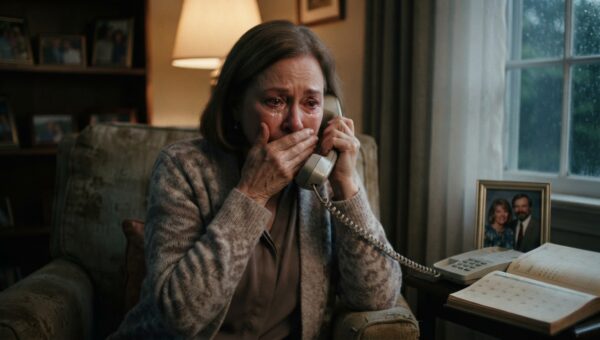
When I unlocked my front door, the rooms were dark and quiet. I walked into the kitchen, sat down at the small wooden table, and carefully slid my finger under the paper flap of the envelope. Inside was a single letter written on lined notebook paper, along with a photograph of Leo standing in front of his new college dormitory room.
I read the letter twice, letting every sentence settle deep into my bones. He didn’t ask me for money, and he didn’t demand an explanation for the lost years. He simply told me where he was studying, when his semester ended, and that if I ever wanted to write him a real letter instead of hiding checks in a pantry tin, his address was at the bottom of the page.
I folded the paper neatly, placed it beside the kitchen salt shaker, and walked over to the pantry. I pulled out the old metal tin containing thirteen uncashed birthday checks, carrying them back to the table one by one.
I picked up my pen, opened my checkbook to a fresh page, and began to write a new check for a boy who had finally learned how to build a life without waiting for anyone to save him.