Seventeen years is a long time to look someone in the face and call them by a borrowed title.
I ordered the thing on a whim because the radio ad said it took four weeks and ninety-nine dollars to find out where your bones came from. Claire told me I was throwing money away on a spit tube. She was at the kitchen island cutting up bell peppers for a salad when I pulled the cardboard box out of the mail carrier’s satchel, and she didn’t even look up from her knife work.
“You don’t have anyone out there, Julian,” she said, her voice steady and light the way it always was when she was trying to keep me grounded. “You’ve got me, and you’ve got the girls, and that’s the whole map.”
She was right, of course, or at least she had been for as long as I could remember. I was a closed adoption baby born back in 1978 in a county hospital three hours west of here, handed over to a tired nurse before my lungs had even finished clearing out. My adoptive parents were good, salt-of-the-earth people who never made me feel like I was anything less than theirs, but they were gone now. The old man went first, his heart giving out while he was cleaning the gutters, and my mother followed three years later after her breathing finally gave up. When they were both in the ground, I stopped having a history.
There was just the blank wall of the county records office and a sealed folder stamped with red ink that nobody was allowed to open without a judge’s signature.
So I spit into the plastic vial, snapped the blue cap down until it clicked, and dropped the prepaid box into the slot at the post office on Monday morning.
By Tuesday evening, the notification had landed in my inbox like a brick through a window.
I was sitting up here in the small room we called the office, the one with the ancient oak desk my father left me and the stack of old tax returns that needed filing. The house was quiet except for the low, steady hum of the refrigerator downstairs and the soft scrape of Claire’s spatula against the skillet. She was making ground beef with taco seasoning, the smell of cumin and garlic floating up through the heating vents the way it had every Tuesday for the past ten years.
I tapped the link on my phone first, then moved over to the laptop because the screen was bigger and my eyes have started acting up when the light gets low.
The screen flickered, loaded a white-and-blue interface, and spat out a list of two hundred and forty-seven relatives scattered across thirty states. Most of them were fourth or fifth cousins, people with names I had never heard of who shared half a percent of my DNA. Background noise. Digital dust.
I scrolled down without really looking, ready to close the tab and go down to help Claire set the table, until the top row stopped me cold.
Predicted relationship: Close relative. Half-sibling or uncle/niece.
The name attached to the profile wasn’t a stranger’s name. It wasn’t some random accountant from Ohio or a retired schoolteacher in Denver. It was a last name I had typed into holiday cards, written on birthday checks, and spoken out loud at family dinners for nearly two decades.
It was Claire’s maiden name.
I blinked once, hard, thinking the screen was glitching or my brain was playing tricks on me after a long day at the lumber yard. I sat there in the silence of the office, listening to the floorboards groan as Claire walked from the stove to the pantry.
I clicked the profile icon.
A photo loaded. A man with thinning gray hair, square wire-rimmed glasses, and a wide, easy grin that I had stared across Thanksgiving tables at for fifteen straight years.
Robert.
Born 1955. Died 2019.
My chest went hollow, like someone had reached in and scooped out everything that kept me upright. I knew that face better than I knew my own reflection in the shaving mirror. I knew the exact way he used to carve the turkey every November, standing at the head of the dining table with the electric knife humming in his hand while he told that same story about the time he drove a pickup truck through a frozen pond in Boone County. I knew the smell of his old wool hunting jacket that hung by the back door during deer season.
More than that, I knew the weight of him.
I had stood shoulder-to-shoulder with Claire’s brother and her cousin under a gray October sky five years ago, holding the polished cherrywood handle of his casket as we carried him out of the First Methodist Church and down the gravel path to the plot beside his wife. I was one of his pallbearers. I helped lower him into the dirt.
And now my laptop screen was telling me, with the cold, unfeeling certainty of a genetic database, that Robert was my father.
“Julian?” Claire’s voice floated up the stairwell, bright and ordinary, cutting right through the fog in my head. “The shells are getting hard. You coming down or do I need to bring a plate up to your cave?”
I didn’t answer her. I couldn’t get my vocal cords to tighten enough to make a sound. My fingers felt clumsy and thick on the trackpad as I scrolled down past the dates and the shared centimorgans, looking for some kind of error, some clerical mix-up in the lab tubes. There wasn’t one. The science was just sitting there, plain as day, linking my spit to a dead man who used to pat my shoulder and ask me how business was going at the yard.
I stood up so fast my office chair rolled back and hit the bookcase with a dull thud.
The adoption agency was closed, of course, because it was past six o’clock, but I didn’t care. I grabbed my phone off the desk, my hands shaking so badly I dropped it twice on the braided rug before I managed to dial the emergency line listed on the old paperwork I had kept in the filing cabinet since my mother died.
It rang four times before a woman picked up, her voice raspy and tired like she had been answering phones since the Carter administration.
“State adoption registry, records division. If this is an emergency adoption placement, press one. Otherwise leave a message after the tone.”
“I need help,” I said, my voice sounding thin and small even to my own ears. “I need someone to look at a file. Closed adoption. 1978. St. Jude’s in Cedar Rapids.”
“Sir, registry requests have to go through the mail-in portal,” she started, but I cut her off before she could finish the sentence.
“Listen to me,” I snapped, and the hardness in my own tone made me flinch. “I have my DNA results on my screen right now. I know who the father is. I just need you to confirm a name so I can stop believing what I’m looking at.”
There was a long pause on the other end of the line, the kind of heavy, bureaucratic silence where you could hear the hum of old fluorescent lights through the receiver.
“We don’t give out biological parent names over the phone unless a court order has been unsealed,” she said, her voice dropping into that official, defensive register.
“Was it Robert?” I asked. The name came out of my mouth before I even realized I was going to say it. “Robert Miller. Born in fifty-five. Died five years ago.”
Another pause. Longer this time. I could hear the faint rustle of paper turning over through the speaker, slow and deliberate.
“Sir, how did you acquire that name?” she asked, and the professional warmth had completely vanished from her voice, replaced by something cautious and sharp.
“I’m looking right at his picture,” I whispered. “He was my uncle. Or so I thought. He was married to my mother-in-law’s sister. He sat at my dinner table for fifteen years.”
The woman let out a low breath on the other end, a sound that told me everything I didn’t want to know.
“The biological father’s identity was sealed at the request of the family back in seventy-eight,” she said quietly, her words measured like she was reading straight off a yellowed ledger. “There was an agreement signed by the grandparents due to circumstances surrounding the mother’s age and the family’s standing in the community. The name on file for the biological father matches the individual you just mentioned. I am sorry you had to find out through a commercial database, Mr. Miller.”
She called me Miller. She used Claire’s last name, the name I took when we got married down at the courthouse because my own adoptive name was just a placeholder given to me by a caseworker who didn’t know any better.
“We’re first cousins,” I said, the words tasting like copper and old iron in my mouth.
“Sir?”
“My wife and I,” I said, my voice cracking right down the middle. “We’ve been married seventeen years. We have two kids. A fourteen-year-old girl and an eleven-year-old boy.”
The line went completely dead quiet except for the static in the wires.
“I cannot provide legal counseling,” the woman said after a moment, sounding smaller now, almost gentle. “You’ll need to consult with a family law attorney regarding genetic overlap disclosures in closed adoption jurisdictions. I’m sorry.”
The click of the line disconnecting sounded like a gunshot in the quiet office.
I sat back down in the swivel chair because my knees wouldn’t hold me up anymore. Downstairs, the microwave beeped three times, short and cheerful, followed by the sound of Claire opening the silverware drawer. I could hear the gentle clatter of forks hitting the plastic tray, ordinary and steady, the rhythm of a life that didn’t exist anymore.
Seventeen years.
I thought about the day I met Claire at the county fair back when we were both in our twenties, how she had spilled a cup of lemonade down the front of my canvas jacket and laughed until she cried while she tried to scrub it out with a damp napkin. I thought about the little white church where we said our vows, with Robert sitting in the third row on the bride’s side, wearing his good gray suit and crying into a linen handkerchief because he always was a soft-hearted man when it came to his nieces.
I thought about our kids. Our daughter, Mia, who had Robert’s exact nose, that high, stubborn bridge that didn’t belong anywhere near my side of the family tree. Whenever she got mad, she tilted her head down and squinted out from under her brow, and for fifteen years I had just thought it was a cute family quirk, something she picked up from watching her mother’s side of the clan too closely.
It wasn’t a quirk. It was a blueprint.
“Julian!” Claire called out again, her voice louder this time, carrying a mild, teasing edge. “The beef is going to dry out if you don’t get down here right now. What are you even doing up there? You look like you’re filing taxes on a Saturday night.”
I looked down at the laptop screen. The little blue circle was still spinning slightly, keeping the data alive.
The adoption file sitting in some damp basement in Des Moines said that my birth mother was just a girl from a neighboring county who had crossed paths with Robert back when they were both too young to know what the world cost. The family had closed the door on it before I ever drew my first breath, scrubbing the lines clean with legal ink and shipping me off to strangers in another town so nobody would have to look at the mistake at Sunday dinner.
They couldn’t have known that twenty-five years later, the boy they gave away would walk right back into their orbit, fall in love with Robert’s niece, and build a house fifty yards down the road from where Robert kept his old John Deere tractor.
Nature has a way of playing the long game, and it doesn’t care a bit about the paperwork we file to keep things neat.
I closed the laptop lid. The screen went dark, but the white Apple logo on the back caught the light from the hallway lamp, glowing like a small, accusing eye in the dim room.
My feet felt heavy as lead as I walked down the narrow wooden stairs, each step creaking in the exact same spot it always did.
When I reached the bottom, I could see Claire standing at the kitchen island, her back to me as she spooned sour cream onto a warm tortilla. She was wearing that old faded blue apron with the grease stain near the pocket, humming some old tune she must have heard on the country station while she was cooking.
She turned around when she heard my boots hit the linoleum, a bright, easy smile already forming on her face before she saw my eyes.
“You look like you just saw a ghost,” she said, setting the spoon down on the counter and wiping her hands on a dish towel.
I stopped three feet from the island, the laptop tucked under my arm like a heavy wooden plank, and I didn’t smile back.
“Claire,” I said, and my voice didn’t sound like mine at all; it sounded like it belonged to an old man standing on the wrong side of a closed door. “We need to sit down at the table.”
She froze with the dish towel still balled up in her fist, her smile fading into that quick, sharp look of concern she always got when she thought something was wrong at the yard.
“What is it?” she asked, taking half a step toward me across the floor. “Is someone sick? Did something happen at work?”
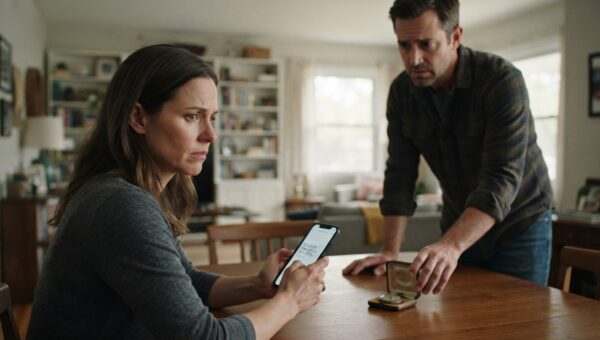
I didn’t answer her with words. I just pulled the laptop out from under my arm, set it flat on the scarred maple surface between the salt shaker and the napkin holder, and flipped the lid back open to the family tree.
The screen glowed bright in the warm kitchen light, casting a pale blue reflection across the two cooling dinner plates sitting side by side on the counter.
Claire looked down at the screen. She didn’t move for a long time. The humming had stopped completely, and the only sound in the whole house was the low, steady rattle of the refrigerator running in the corner.
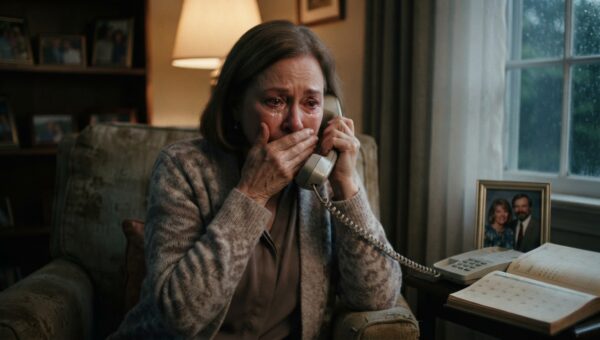
Slowly, her hand came up to cover her mouth, her fingers trembling just a little against her lips as she read the name floating right beside mine under the bold black heading of the DNA match.
Robert Miller.
She didn’t scream. She didn’t drop a plate or back away from the counter. She just stared at the screen for a long, quiet minute while the color slowly drained out of her face until she looked just like the photographs we had framed in the hallway from her parents’ fiftieth anniversary.
Then she looked up at me, her eyes wide and wet with a sudden, overwhelming terror, and she reached out across the table without saying a word, her hand finding mine and gripping my fingers so tight her knuckles turned white.
We stood there together in the quiet kitchen, holding onto each other across the maple wood while the dinner plates cooled off beside us, knowing that nothing in our world would ever be simple again.