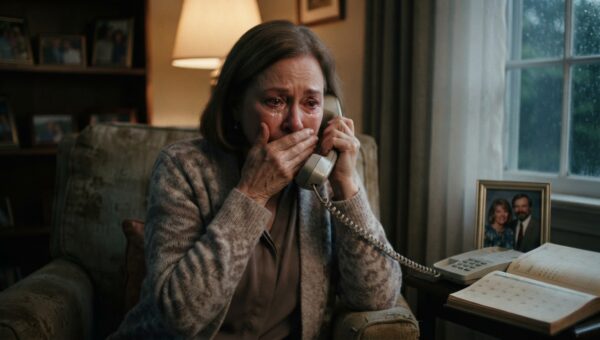
Terence died on a rainy Tuesday morning at 4:12, and by noon the lawyers were already asking about signatures. Eleanor stood by the French doors of our front room with a handkerchief she wasn’t using to wipe any tears, just folding it into smaller and smaller squares between her fingers. She didn’t look at me once while she told Arthur Vance, the family attorney, that the probate matters could wait until after the mourning period was observed by the proper people.
I sat on the edge of the velvet armchair Terence bought at an estate sale in Dayton five years ago, my hands resting flat on my knees, feeling the wool of my skirt scratch against my palms.
We had been married twelve years, quietly and without much fuss, in a little brick house off Route 48 that didn’t have any grand entryways or tall columns. Terence worked long hours at his engineering firm before he started his own venture, coming home with grease under his fingernails and smelling of old paper and solder. His mother never liked that house and she never liked me, treating us both like a temporary inconvenience she had to tolerate during holidays. When the doctors at Kettering Medical Center pulled the monitors away, Eleanor looked at me across the bed and said I had my own life to go back to now.
The funeral was small because Terence didn’t want a crowd of people who only knew him from the charity board meetings.
Eleanor took charge of the guest list anyway, making sure the local paper ran three columns about the family’s loss and the great philanthropic legacy of the estate. She wore black velvet that looked like armor, her chin tilted up the way it always did when she was making sure everyone knew who was running the room. I stood near the back under the maple tree, watching the heavy brass casket sink into the damp ground while Kendra scrolled through her phone behind me.
Twenty-four hours after the last car pulled away from the cemetery, Kendra and Eleanor were standing on our porch with two large cardboard boxes and a face like sour milk. The locks on the front door turned with a sharp double-click before I even finished packing my third suitcase in the upstairs bedroom. Kendra didn’t even bother coming inside, just stood at the top of the porch steps with her phone held out at arm’s length, recording the way my boots hit the gravel on the driveway.
Eleanor crossed her arms over her wool coat and told me I was taking more than my fair share of the family heirlooms.
“You took everything that actually matters, so just leave the junk,” Eleanor said, her voice thin and sharp like dry wire.
She didn’t wait for an answer before she heaved a heavy cardboard carton over the porch railing. It landed square in the middle of our wet lawn, the bottom giving way instantly in the mud and soaking the gray cardboard right through. Our wedding album tumbled out into the brown grass, the cream-colored linen cover instantly darkened by wet soil and dead leaves. I walked over through the cold slush, knelt down in the mud, and picked the heavy book up with both hands.
Kendra laughed from the top of the stairs, her phone light blinking red in the damp afternoon air. “Make sure you wipe your feet before you leave the property,” she called out, and then the front door slammed shut so hard the glass in the sidelights rattled.
I didn’t call the police and I didn’t yell back from the driveway.
I put the ruined album into the back seat of my old sedan, laid a clean towel over the wet cover, and drove thirty miles north to a small brick ranch house near the river that Terence had bought in secret three years prior. Arthur Vance was already waiting on the porch with a manila envelope and a set of heavy brass keys that didn’t look like anything Eleanor owned. He handed me a cup of black coffee from a paper tray and told me the ink on Terence’s independent trust was dry.
“He knew they were bleeding the main foundation dry,” Arthur said, sitting down at the kitchen table and pushing a stack of audited statements toward me. “They haven’t turned a legitimate profit in four years. They just borrow against Terence’s private patents to keep up appearances at the country club.”
For the next five months, the house by the river was the quietest place on earth. I spent my mornings cleaning the mud off the edges of the wedding album page by page with a soft brush and a bottle of distilled water, watching the ink of our signatures slowly emerge from behind the dried dirt. Outside, the world kept turning without us, but Arthur’s office reports kept arriving every Tuesday with the precise numbers of the family’s decline. The foundation Eleanor ran was insolvent by nearly two million dollars, its commercial notes backed by empty promises and property that wasn’t actually theirs to leverage.
Terence had left every cent of his independently accumulated five-hundred-million-dollar venture directly to me, completely separate from the family trust Eleanor claimed ownership of. Arthur spent those months quietly buying up the foundation’s distressed commercial debt through a series of anonymous corporate shells managed by the estate. By month five, every note, every mortgage, and every line of credit Eleanor and Howard used to fund their high-society galas belonged to me. They were dancing on glass and didn’t even hear the cracks starting underneath their shoes.
By month six, the annual charity gala for the Dayton Heritage Society was the only thing standing between Eleanor and total financial ruin. They spent eighty thousand dollars on imported orchids and a string quartet to host the event at the grand ballroom downtown, hoping to court three new wealthy patrons who might bail out their failing accounts. The local paper ran another spread about the family’s generosity, complete with photographs of Eleanor standing beside the ice sculpture in her emerald silk dress. I received an invitation in the mail addressed to the old house, forwarded by the post office with a red sticker on the front.
I wore a plain navy dress with no jewelry except for a thin gold band on my left hand that Terence had slipped on my finger during a rainy afternoon in Cincinnati twelve years ago. The ballroom was loud when I walked through the double doors at 8:15, the air thick with the smell of expensive perfume and roasted prime rib. Howard was standing near the stage talking to the bank president, his face flushed with wine and the easy confidence of a man who thought he still owned the town. The room was full of people who had looked right through me at the funeral, their eyes sliding off my coat as if I were part of the wallpaper.
Howard turned around as I stopped near the edge of the service corridor, his smile freezing halfway across his face like grease on a cold pan. He set his champagne flute down on a passing waiter’s tray with a sharp clink and walked over with his heels clicking hard against the marble. He didn’t look happy to see me, just annoyed that I was breathing the same air as his donors.
“You shouldn’t be here,” Howard said, his voice dropping into that low, ugly register he only used when he thought no one else was listening. “This is a private event for the board and its associates. Security will have you out on the street in thirty seconds if you don’t turn around right now.”
I didn’t flinch or look away from his eyes, keeping my voice low and even the way Terence used to when he was balancing a ledger. “You were right that I walked away with nothing that belonged to you, Howard,” I said, and the tiny pause between us felt like a door clicking shut. “Because everything you are standing on belongs to me.”
Howard let out a short, wet laugh that didn’t reach his eyes, his fingers twitching against the seam of his trousers. “You’re delusional,” he muttered, looking around to see if anyone from the press was watching us. “You couldn’t afford the parking outside, let alone a ticket to this room.”
Arthur Vance stepped out from the shadows near the service doors carrying a thick leather binder with the state seal embossed in gold on the front. He didn’t say a word, just laid the top document flat on the mahogany podium where the guest speaker was supposed to stand in ten minutes. The room went quiet in sections, the way a theater goes dark when the main lights fail one by one. Eleanor stopped halfway across the floor, her emerald dress rustling against the carpet as she turned to see what had interrupted the music.
“Every note on this building was called in at four o’clock this afternoon,” Arthur said into the microphone, his voice carrying clear and dry across the silent hall. “The foundation’s accounts are frozen under federal receivership for commercial fraud. And the primary lien holder is the estate of Terence Vance.”
Kendra pushed her way through the crowd from the buffet table, her face turning a bright, ugly red as she recognized the binder in Arthur’s hand. She pointed a shaking finger at me, her voice cutting through the silence like a saw blade. “She stole that! That money belongs to the family trust! Call the police right now!”
I walked past Howard without slowing down, my boots clicking softly on the marble until I reached the front row of empty chairs near the stage. I didn’t look back at Eleanor or her daughter, and I didn’t stay to watch the bank president pull Howard into the corner by his elbow. The music didn’t start up again before I reached the exit, and the heavy glass doors swung shut behind me with a clean, muffled thud that cut off every sound from inside.
The drive back to the river house took thirty-two minutes through the dark Ohio mist, the windshield wipers keeping a steady, quiet rhythm against the glass. When I unlocked the front door, the house was warm and smelled faintly of pine and old paper from the room where I worked. I walked into the living room, set my keys on the side table, and picked up the dry, clean wedding album from its spot on the mantel. The linen cover was smooth under my thumb now, every page flat and white beneath the light of the brass reading lamp.