The smell of black coffee always reminds me of December mornings when the frost on the kitchen window was thick enough to scrape with a quarter. For sixteen years, that smell was the only steady thing in my kitchen. I would wake up at 5:00 in the morning, pad across the cold linoleum in my wool socks, and fill the small tin pot.
I never varied the routine. Two scoops of chicory, four scoops of regular roast, and exactly six filters pulled from the box.
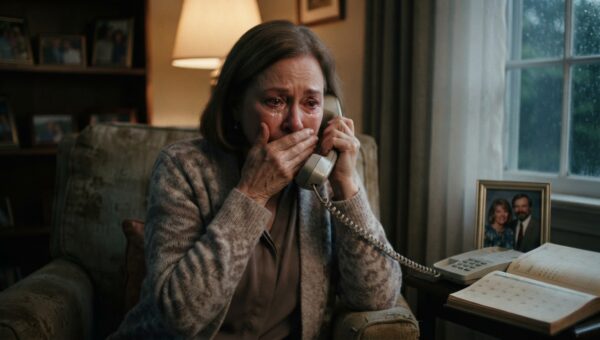
I told my daughter I would not attend her wedding. She was marrying a man from another faith, and in my small-minded arrogance, I thought I was protecting our family line, our traditions, and the quiet rhythm of the life we had always known. I stood right by the screen door with my arms crossed over my cardigan while she looked at me with those wide, betrayed eyes.
‘You’ll regret this,’ I said.
She married him anyway. That was 2010. For sixteen winters, her chair stayed empty at Christmas. I still set out six plates every single year, moving around the table like a ghost in my own house, setting the china that belonged to my grandmother, and then walking back around to put one plate back in the cabinet because there were only five of us left.
Five people keeping up appearances. Five people pretending nothing was broken while the silence in the house grew teeth.
Last Sunday, the air in the sanctuary was heavy with the smell of old hymnals and damp wool. Clara leaned over from the next pew during the opening hymn, her fingers trembling slightly as she pointed a blue-veined finger at the staple-bound paper in my hands. The church bulletin printed a local scholarship announcement. Dr. Naomi Harris had given $24,000 to local students entering the nursing program at the county college.
The name stopped me dead. My breathing just hitched right there in the middle of page two.
My neighbor Clara nudged my shoulder. ‘That’s your girl, isn’t it?’
I couldn’t answer her. The ink on the page seemed to blur and swim together until the letters looked like black ants crawling across the white paper. Sixteen years of telling myself she was the stubborn one, sixteen years of convincing myself that I was the guardian of some great moral standard, and there she was.
Dr. Naomi Harris. Not broken. Not ruined. Not begging for my blessing. Giving away twenty-four thousand dollars of her own hard-earned money to kids who needed a leg up in this dying valley.
I didn’t hear the rest of the sermon. I sat there staring at the back of the hymnal rack while my hands shook against my skirt.
After service, I didn’t wait for Clara. I walked straight out to my old sedan, the engine coughing twice before turning over in the gravel lot. I didn’t go home for my Sunday pot roast. I drove across the county line, following the address I remembered from the clinic notice at the bottom of the scholarship blurb. My knuckles were white against the steering wheel, the leather grip worn smooth from years of driving the same empty roads to the grocery store and back.
Her house sat on a quiet street corner under a canopy of old maples.
It was a solid, craftsman-style home with a wraparound porch and two blue bicycles leaning against the porch rail. A small wooden sign near the driveway read Harris.
I parked three houses down because I couldn’t bring myself to pull into their drive. My boots crunched on the pavement as I walked up the paved path. Every step felt like walking through wet concrete. My mind kept throwing back the words I had thrown at her in the hallway sixteen years ago. I kept hearing my own sharp, ugly voice echoing off the wallpaper.
I climbed the three wooden steps to the front porch. The door was painted a warm, inviting shade of forest green, nothing like the stark white storm door I kept bolted behind myself like a prison gate.
At the door, I lifted my hand and knocked twice. My knuckles hit the wood with a hollow, pathetic sound.
I waited. For a terrifying second, I hoped nobody was home. I hoped I could turn around, get back in my car, and go back to my empty plates and my bitter little routines.
The lock turned with a clean, metallic click. The door swung open.
Naomi stood there. She wasn’t twenty-two anymore. The sharp angles of her youth had softened into a quiet, striking grace. She wore a simple gray sweater, and her hair was pulled back with a tortoiseshell clip. She held a kitchen towel in one hand, having clearly been in the middle of chopping vegetables.
She froze. The color drained from her cheeks for just a second, but her eyes didn’t widen in fear or anger. They just turned steady. Guarded.
‘Mother,’ she said. It wasn’t a question. It wasn’t an invitation. It was just the word.
‘I saw the bulletin,’ I managed to get out. My throat felt like it was lined with dry sand. ‘At St. Jude’s. The scholarship.’
Naomi didn’t move from the threshold. She didn’t block the door with her body, but she didn’t open it any wider either. ‘Come in,’ she said quietly.
I stepped past her into the hallway. The air inside smelled of roasted garlic and lemon oil. It was warm and lived-in, completely devoid of the icy perfection I had imagined my daughter was living in all these years. To my left, a long gallery wall was covered in framed photographs. I stopped walking and stared.
There was Naomi in a white coat holding a stethoscope. There was Naomi standing under a floral chuppah laughing up at a tall, kind-eyed man with a neat beard. Tariq. There were school pictures of two children with dark, expressive eyes, a girl around twelve and a boy around nine. Maya and Noah. Sixteen years of a whole, beautiful life played out in frames while I sat in my kitchen counting my regrets like rosary beads.
‘You can sit at the kitchen table,’ Naomi said, her voice entirely flat.
I followed her back through the hall. The kitchen was bright, light pouring in through a large bay window that looked out over a backyard garden filled with late-summer tomatoes and squash. A man was sitting at the wooden table helping a young boy with a math worksheet, but when he saw me, he stood up immediately.
Tariq. He looked older too, temples dusted with silver, but his eyes were kind. He didn’t look like the monster my pride had invented in 2010. He looked like a husband and a father.
‘Naomi,’ Tariq said softly, placing a hand on her shoulder before looking at me. ‘Would you like some water?’
‘No,’ I whispered, pulling out a wooden chair and sitting down because my knees finally gave out beneath me. ‘No, thank you.’
Naomi leaned against the kitchen counter, crossing her arms over her chest just like I used to do. Except she wasn’t standing in judgment. She was just waiting.
‘Twenty-four thousand dollars,’ I said, staring down at the grain of the wooden table. ‘That’s a lot of money to give to St. Jude’s. After everything.’
Naomi was quiet for a long moment. She looked out the window at the garden before looking back at me. ‘I didn’t give it to the building, Mother. I gave it to the kids. The kids in that parish who don’t have anyone backing them up when they want to make something of themselves. I remember what it felt like to have doors slammed in my face because of who I loved.’
Her words hit me right in the chest, sharp and undeniable.
‘I came here to tell you something,’ I said, and my voice cracked right down the middle. All the armor I had worn for sixteen years just crumbled into dust on that clean kitchen floor. ‘I told you that you would regret it.’
Naomi didn’t interrupt. She just watched me.
‘I was wrong,’ I whispered, tears finally breaking free and running hot down my cheeks. I didn’t bother wiping them away. ‘I was the one who regretted it. Every single Christmas. Every single day I sat in that big empty house by myself. You built a wonderful life. You built a family. And I spent sixteen years starving myself of you just to prove I was right.’
Tariq quietly ushered the young boy out of the room toward the living area, giving us space, but he offered me a small, respectful nod as he passed. He didn’t gloat. He didn’t glare. He just showed a grace I didn’t deserve.
Naomi walked slowly across the kitchen and pulled out the chair directly across from me. She sat down, resting her hands on the table. They were strong hands. Medical hands. Hands that healed people.
‘We built a good life, Mother,’ Naomi said gently. Her voice wasn’t angry anymore; it just sounded tired of holding onto the heavy things. ‘Tariq loves me. My children know who they are. We didn’t need your approval to be happy, but… it’s hard knowing my mother chose her pride over her daughter for half my life.’
‘I know,’ I choked out. ‘I know I don’t have the right to ask for anything. I don’t expect you to just let me back in like nothing happened.’
‘Good,’ Naomi said with a faint, sad ghost of a smile. ‘Because we aren’t going to pretend the last sixteen years didn’t happen. We can take this slow. You can come for dinner on Sundays, if you want. But there are rules. No lectures about faith. No looking down on my husband. And no playing the victim.’
I looked at my daughter, really looked at her, and saw the incredible woman she had become despite my best efforts to break her spirit.
‘I can do that,’ I whispered.
She stood up and reached across the table, placing her hand briefly over mine. Her skin was warm.
The drive home took half the time. The sun was dipping low behind the ridge, casting long shadows across the asphalt as I pulled into my empty driveway. The house was cold when I walked inside, the hallway dark and quiet.
I walked straight into the dining room. The heavy mahogany table sat there in the fading light, looking stiff and formal. Without taking off my coat, I walked to the china cabinet, pulled open the glass door, and reached for the sixth plate.
I carried it over and set it down alongside the other five.
Then, for the first time in sixteen years, I left it right there.