I got it wrong at first. I spent eleven years believing that if you fold yourself up small enough, if you trade the heavy steel filing cabinets of a joint intelligence task force for the damp, sweet smell of a neighborhood flower shop, the past will simply lose your scent in the grass. I was wrong. The past does not rot away in the dark; it just waits for a midnight telephone call to remind you that your old life was never really buried, only sleeping.
The hospital telephone on the counter of my shop rang at 12:44 in the morning, a flat, ugly sound that cut through the quiet hum of the refrigeration units holding my loose stems. It was an ER intake nurse from St. Jude’s, her voice tight and hurried, telling me they had just admitted nineteen-year-old Maya after an unregistered SUV dropped her at the ambulance bay like an old sack of feed. They did not wait for paperwork or insurance cards. The driver had hit the gas before the heavy glass doors even finished sliding shut, leaving my girl on the linoleum with three broken ribs, a concussion, and her face bruised into something I could barely look at without my stomach turning inside out.
I drove the four miles to the hospital through a freezing drizzle, my knuckles white against the steering wheel of my old sedan. When I walked into the waiting room, Detective Miller was leaning against the admissions desk, chewing on a plastic toothpick and looking entirely too comfortable for a man whose precinct was supposed to be investigating an attempted murder.
He told me it was just a rough fraternity prank gone sideways, that college kids would be college kids, and that I should probably sign the intake waivers and take my daughter home once she woke up. I did not yell at him. You do not waste breath on a local cop who has already sold his badge to the highest bidder in the county.
Instead, I walked past him down the sterile hallway to the private consultation room where the real owners of this town were waiting for me. There were three of them sitting around the mahogany table, smelling of expensive scotch and dry-cleaned wool. Richard Sterling sat at the center, a private equity titan whose face I recognized from the financial pages, flanked by two other fathers whose sons had helped carry Maya’s limp body out of that estate and onto the pavement. None of them looked like fathers whose children had just committed a felony. They looked like board members preparing to liquidate a failing asset.
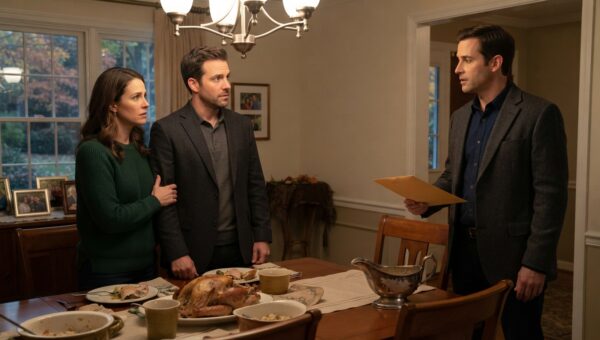
Richard slid a thick manila envelope across the polished wood toward me without standing up. Inside was a cashier’s check for precisely one million dollars drawn from an offshore holding account, along with four pages of binding non-disclosure language that would legally gag Maya and me until the day we died. He told me it was a generous settlement, that my little flower shop on Elm Street wouldn’t gross that much in twenty years of selling funeral sprays and anniversary bouquets, and that I should sign before the local prosecutor decided Maya was trespassing where she didn’t belong.
I did not touch the check. I did not even look at the figures printed in black ink in the top right corner. I picked up my coffee mug, walked over to the heavy oak door, and turned the deadbolt until it clicked solidly into place.
Then I pulled the small, encrypted satellite comms token out of the lining of my leather key pouch, a piece of hardware I had not powered on in eleven years, and laid it flat on the table between Richard’s silver pen and his gold-plated watch.
Richard frowned, leaning back in his leather chair with a dry, dismissive chuckle. He asked me if I needed a magnifying glass to read the arbitration clauses, or if I just didn’t know how to write my own name. I didn’t answer him. I pressed the thumbprint authentication pad on the side of the matte-black metal token and waited twelve seconds for the secure handshake to clear through the orbital relay.
General Marcus Vance picked up on the third ring, his voice as gravelly and steady as it had been back when we were mapping out deep-cover financial corruption networks for Task Force Obsidian. He didn’t ask why I was calling at 4:15 in the morning. He just listened while I read out my old operational clearance code, followed by the specific federal routing numbers tied to Richard Sterling’s private equity conglomerate and the local police precinct’s discretionary fund. I told Marcus that three wealthy heirs had just attempted to murder my daughter, and that the local authorities were actively burying the estate’s security footage to protect their campaign donors.
By 5:00 in the morning, the shadow wheels of the federal government began to turn with terrifying, unstoppable precision. The first wave didn’t arrive with sirens howling through the damp streets; they arrived in unmarked black suburbans that cut off the hospital exits before anyone inside realized the perimeter had been locked down. Federal marshals walked through the front doors of St. Jude’s with unsealed warrants signed by a federal judge who answered to Washington, not to county commissioners. They relieved Detective Miller of his badge, his service weapon, and his personal cell phone before he even had time to finish his plastic toothpick.
The second wave hit the estate where Maya had been beaten, seizing the cloud-linked security servers before the fraternity heirs could scrub the high-definition footage of them dragging my unconscious daughter across the gravel driveway and tossing her into the back of an unregistered vehicle. Down to the last digital timestamp, every text message coordinating the cover-up, every offshore wire transfer padding the local police captain’s retirement account, and every corporate shell company used to funnel illicit defense subcontracts was frozen by midday under emergency anti-corruption statutes.
By 6:15 in the morning, Richard Sterling stepped off the private elevator into the hospital lobby expecting to hand off another set of papers to his lawyers. Instead, he walked straight into a federal arrest cordon flanked by armed marshals and an Assistant U.S. Attorney carrying a heavy leather briefcase. He turned around to retreat back toward the elevators, but two federal agents were already blocking the doors, their hands resting easily on their holstered sidearms as the morning news vans began pulling up to the ambulance bay outside.
Julian Sterling, Tyler Ross, and Chad Vance were escorted out of the hospital in heavy steel handcuffs just as the first pale rays of sunrise broke over the wet asphalt, their designer jackets rumpled and their arrogant expressions completely shattered by the sudden, brutal weight of federal law. Their fathers stood frozen by the glass doors, clutching their expensive briefcases and watching their multi-million-dollar empires dissolve into a series of unbailable felony indictments for kidnapping, aggravated assault, and corporate racketeering.
I left them standing there in the cold morning light and walked back down the quiet corridor to Maya’s room. The heart monitor beside her bed was beeping in a steady, even rhythm, keeping time with the quiet breathing of my girl. I reached into my coat pocket, pulled out a small pair of stainless steel shears, and set to work on the bunch of fresh white hydrangeas I had brought with me from the shop, clipping the stems at a clean angle before sliding them into the glass vase on the bedside table. Maya’s hand stirred against the white cotton sheet, her fingers sliding slowly into my palm and gripping my hand with a warm, steady pressure as the morning sun finally filled the room with light.