PART 1
The snow was sticking to the windshield of my car by four o’clock that afternoon, turning the main street into a blurry stretch of gray lights and tired commuters rushing home. When Arthur Vance called me into his second-floor office, I thought he was going to hand me a holiday bonus check or at least a bottle of cheap wine like he did every year for the seven years I managed his regional shipping accounts.
Instead, Arthur was standing by the window with his hands folded behind his back, staring out at the parking lot. Two men in dark winter coats sat on the folding chairs near his desk. One of them had a metal badge clipped to his belt.
“Close the door, Clara,” Arthur said without turning around. His voice was flat, stripped of the booming warmth he usually put on when clients were in the building.
I stepped inside, letting the heavy oak door click shut. “Arthur? What is this about? I have three final delivery manifests to clear before five so the holiday crew can close out.”
The man with the badge stood up. “Mrs. Higgins, I am Detective Miller with the city police. We received a corporate audit report from Mr. Vance’s office this morning detailing an unauthorized electronic wire transfer of eight thousand dollars moving from the main payroll clearing account into an unverified external routing number.”
I stared at him, blinking against the sudden hum of fluorescent light overhead. “An eight thousand dollar wire? I don’t move corporate funds. That’s the accounting department’s job. My desk handles vendor scheduling and route tracking.”
Arthur turned around then. His face looked older than his sixty years, set in lines of heavy disappointment. “The transfer originated from your terminal login, Clara. Last night at nine-forty-two p.m., while the cleaning crew was downstairs. Your individual password key was entered twice. The bank routing number attached to the destination account belongs to a regional credit union two towns over.”
“That’s impossible,” I said, my chest tightening as the small office suddenly felt airless. “I was at home last night by seven. My daughter was there with me. We were wrapping presents on the living room floor.”
“The audit trail is definitive,” Arthur said quietly, walking over to his mahogany desk and picking up a printed spreadsheet.
He didn’t look me in the eye. “I trusted you, Clara. When your husband passed away four years ago, I kept you on through the lean quarters. I didn’t think you’d repay me by looting the holiday reserve fund.”
The two policemen escorted me out of the building fifteen minutes later. They didn’t put handcuffs on me because Arthur asked them to handle it quietly for the sake of the company’s holiday image, but the humiliation was absolute. As we walked through the open-plan office past rows of desks where my coworkers sat frozen in silence, I kept my eyes fixed on the linoleum floor. Nobody spoke. Nobody raised a hand to wave goodbye.
By midnight, I was sitting in a freezing studio apartment three miles away, staring at a cardboard box containing my desk calendar, a ceramic coffee mug, and a framed photo of my daughter Maya. By New Year’s Day, I had lost my job, my reputation in the local logistics community, and my modest apartment lease because the management company panicked when they heard about the police investigation.
My husband had died leaving me with twenty-four hundred dollars in savings, and now that cushion was gone, eaten up by a cheap motel room and the retainer fee for a public defender who looked at my case file like it was a minor paperwork annoyance. For five years, I tried everything to prove I hadn’t done it. I requested forensic audits, subpoenaed server logs, and begged my former colleagues to speak on my behalf. Every door stayed bolted shut. Arthur Vance had a clean corporate reputation and deep municipal ties. I was just a widowed clerk whose terminal login happened to match a crime.
PART 2
Five years came and went like a slow, grinding wheel. I took night shifts at a commercial laundry facility, folding sheets until my fingers bled and my shoulders ached from the constant damp heat. Maya had to drop out of her second year of community college to pick up evening hours at a diner so we could keep our heads above water. The shadow of that accusation followed us everywhere, a quiet, invisible mark that kept us living on the edge of town in a building where the front door lock was always broken.
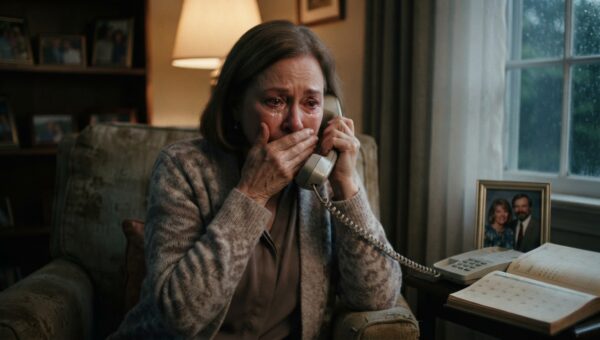
Then, on a Tuesday morning in late October, the phone on the laundry room wall rang. The supervisor handed it to me with a grunt.
“Clara Higgins?” a woman’s voice asked. It was crisp, slightly raspy, and carried a weight I hadn’t heard in years.
“Yes?” I said, wiping my soapy hands on my apron.
“My name is Sarah Vance. Arthur Vance was my father. He passed away on Saturday from congestive heart failure.”
My grip on the plastic receiver tightened so hard my knuckles turned white. “I’m sorry for your loss, Ms. Vance. But I haven’t worked for your father’s company in over five years. Whatever business—”
“I know exactly who you are, Clara,” Sarah interrupted, her tone sharpening. “And I know about what happened to you on Christmas Eve five years ago. My father left instructions before he went into hospice care. He told me to find you. He told me to give you something that’s been sitting in his private drawer since the day he died.”
An hour later, I was sitting in my car in the gravel parking lot behind a quiet diner near the highway, my hands resting on the steering wheel. Sarah Vance had pulled up beside me in a dark sedan, rolled down her window just an inch, and handed a small black USB drive through the gap before driving away without another word.
I took the drive home, plugged it directly into the side of my battered laptop, and opened the single folder stored on the root directory.
There were two files. The first was named *Security_Log_1224*.
I double-clicked it. A video player opened, showing high-definition security camera footage from the second-floor hallway of Vance Logistics, dated December twenty-fourth, five years ago. The time stamp read nine-thirty-eight p.m.
I watched the screen in disbelief. The hallway was dark, illuminated only by the emergency exit signs. A figure in a heavy winter parka walked up to my office door, pulled a small plastic keycard from their pocket, and slipped past the electronic lock. Two minutes later, the figure emerged carrying a small manila envelope and walked quickly toward the back stairwell.
As the person turned beneath the ceiling-mounted camera, the hood of the parka fell back for a single second, revealing the sharp profile and dark hair of Arthur’s nephew, Daniel Vance, who had been serving as the company’s IT director at the time.
I sat back in my chair, the breath rushing out of my lungs. Daniel. He had the administrative override codes for every terminal in the building. He was the one who had framed me.
My fingers hovered over the mouse. There was a second file in the folder: *Dad_Letter.txt*.
I opened it. It was a scanned letter typed on Arthur’s personal stationary, dated three weeks before his death.
PART 3
The words on the screen blurred as I read through Arthur’s final confession.
*Clara,*
*If you are reading this, it means Sarah followed my instructions and found you. I owe you an apology that five years of silence cannot mend, but I need you to know the truth.*
*Three days before Christmas Eve, Daniel came to my office. He had run up forty thousand dollars in gambling debts with local bookmakers who were threatening to break his legs if he didn’t clear the balance before the holiday. He had already hacked the payroll system and stolen the eight thousand dollars from the reserve account using a ghost routing number.*
*When the morning audit caught the discrepancy, Daniel panicked and shifted the originating terminal logs to your login ID because he knew you were the only clerk who occasionally worked late without logging out of her central hub. When the police arrived, I knew within forty-eight hours that Daniel was the thief. I found his deleted cache files on the server.*
*I wanted to clear your name. I wanted to tell the detectives the truth. But Daniel was my only sister’s boy, and my health was already failing, and the board of directors was threatening to initiate a public fraud investigation that would have liquidated the company and put fifty families out of work right before winter. Daniel threatened to burn down the entire firm and drag my name through the courts if I exposed him.*
*So I let them take you. I traded your innocence to protect my family name and my company’s balance sheet. It is the coward’s sin, and I carried it like a stone in my chest every day since. The attached video file is legally unsealed through my personal estate executor. You are free now.*
*Arthur Vance*
I stared at the glowing monitor for a long time. There was no triumphant surge of joy, no sudden rush of vindication that made the last five years disappear. There was only a cold, heavy emptiness where the anger used to live.
I didn’t call the police that afternoon. I called a local attorney whose office was located above a hardware store two blocks away, a man who didn’t look at me like I was a criminal when I slid the USB drive across his scarred wooden table.
It took three weeks for the legal machinery to turn. When the prosecutor’s office formally motioned to vacate my conviction based on newly surrendered corporate exculpatory evidence, Daniel Vance was already living in Arizona, working under an assumed name after the company went into receivership following Arthur’s death.
They didn’t send him to prison for long. A suspended sentence and restitution orders he would never pay were deemed sufficient by a judge who noted the statute of limitations on the initial corporate theft charge had been complicated by the company’s subsequent bankruptcy.
The local newspaper printed a three-sentence retraction on page four, tucked between an advertisement for snow tires and a report on the town council meeting. No front-page apology. No restitution check from the corporate estate that could buy back the five years of night shifts, the cold apartment, or the look in Maya’s eyes when we had to pack our boxes in the dark.
On a Saturday morning in February, I walked into the local park where the snow was finally beginning to melt into gray slush around the base of the oak trees.
Maya was sitting on a green wooden bench, holding a hot cup of coffee from the diner down the street. She had just received her acceptance letter to return to her nursing program in the fall, her tuition partially covered by a state grant for displaced families.
I sat down beside her, pulling my wool coat tighter around my shoulders.
“Did you hear back from the clerk’s office?” Maya asked softly, looking over at me.
“Yes,” I said, opening my handbag and pulling out the single piece of stiff white paper bearing the judge’s signature clearing my name of all charges. “It’s officially over. The record is clean.”
Maya let out a long, shaky breath, her shoulders dropping an inch as the tension of the last five years finally began to drain away. She leaned her head against my shoulder.
ENDING
We sat there together on the bench in silence, watching a pair of sparrows hop across the damp grass near our boots.
I reached into my pocket, pulled out the small metal key to our new apartment’s front door, and dropped it into the palm of my hand. The metal was cold, but the weight of it felt steady and real.
I folded my fingers around the key, slipped my hand back into my coat pocket, and watched the winter clouds finally begin to break apart above the trees.