Mr. Sterling’s office smelled like stale coffee and old wool carpet that hadn’t been replaced since the Reagan administration. I remember staring at a water stain on the acoustic ceiling tile right above his bald spot while he droned on about probate fees and executor duties. My aunt Clara had been dead for six days, and her lawyer was treating her passing like a bureaucratic filing error that needed six signatures in blue ink before five o’clock.
“The house on Grand Avenue, the 2011 Honda Civic, and the remaining balance of one hundred seventeen thousand, four hundred twenty dollars,” Mr. Sterling said, tapping his reading glasses against the corner of a manila folder. “All yours, Brenda. Provided you meet the conditions laid out in the final codicil.”
I shifted my weight in the stiff vinyl chair. I had bills piling up from my part-time bookkeeping gig at the lumber yard, and my landlord had just sent a text about raising the rent on my two-room apartment another seventy-five bucks starting next month. Clara’s estate felt like a parachute opening three seconds before impact. I didn’t care about conditions. I just wanted to know when the keys were mine so I could call a real estate agent, slap a ‘For Sale’ sign on the front lawn, and clear my debts.
“What conditions?” I asked, my voice grating against the quiet of the stale office. “Does she want me to clean out the attic? Paint the trim? I can hire a dumpster.”
Mr. Sterling didn’t look up immediately. He turned the heavy, stapled document over, running a yellowing fingernail down the bottom paragraph of page six. Clara had typed it herself on her old Smith Corona typewriter, the lowercase ‘e’ striking just a little higher than the rest of the line. It was a detail I would have recognized anywhere after spending every Sunday afternoon of my childhood eating saltines at her kitchen table while she clacked away on letters she never mailed.
“You may take possession immediately, Brenda,” Mr. Sterling said, his voice dropping into that professional drone lawyers use when they are about to deliver bad news with a polite smile. “You may live in the dwelling, drive the automobile, and draw upon the savings for necessary maintenance. But you are expressly forbidden from listing, selling, leasing, or transferring ownership of the real property located at 4124 Grand Avenue for a period of exactly twelve months from the date of probate filing.
If you attempt to breach this clause, the entire residual estate reverts to the regional humane society.”
I sat there, the silence in the room suddenly feeling very heavy. Twelve months. A whole year tied down to a drafty, cedar-sided house in a declining Dayton suburb just so I could inherit a roof over my head and some cash. I almost stood up right then and told him to give the cats the money. I had a life, or at least a semblance of one, thirty miles away near Springfield. I had my job, my routine, and the small, safe circle I’d carved out after my divorce five years ago. Tying myself to Clara’s dusty, wallpapered mausoleum for a year felt like a sentence.
“Why?” I asked, my hands tightening into fists in my lap. “Why a year? She knew I wanted to clear my debts. She knew I needed to move on.”
Mr. Sterling closed the folder with a dry slap that kicked up a tiny puff of dust. “Your aunt was a very thorough woman, Brenda. She left explicit instructions explaining the condition in an addendum filed with her personal effects at the house. She said you wouldn’t understand the value of the place until you spent a few seasons breathing its air. Now, sign here and here, and I’ll hand over the keys.”
I signed. I signed because I was broke, because my rent was going up, and because somewhere beneath my irritation, a stubborn part of me wondered what Clara was up to from beyond the grave. She had always been a mystery, a woman who lived alone for forty years after her partner walked out and never spoke his name again.
Three days later, I was hauling my two plastic laundry baskets of clothes through the front door of 4124 Grand Avenue. The air inside smelled of old peppermint, lemon oil, and cedar chests. It was the exact same smell I remembered from when I was eight years old, right down to the ticking grandfather clock in the hallway that Clara had kept wound with a heavy brass key every Sunday night.
The next few weeks were an exercise in slow, grinding misery. The house needed work I didn’t know how to do. The kitchen faucet leaked a steady, rhythmic drip that sounded like a metronome keeping time for my regret. I spent my weekends scraping peeling floral wallpaper off the plaster in the spare bedroom and hauling bags of damp insulation out of the crawlspace under the back porch. My back ached, my hands were raw from stripping paint, and every time I looked at the calendar on the fridge, counting down the months until I could finally list the property, I felt like a prisoner doing time in my own family history.
I didn’t think Clara had left me anything other than chores. I figured the one-year clause was just her final, petty way of controlling me from the grave, making me sweat for every square foot of linoleum I had to scrub.
Then came Tuesday, October fourteenth.
It was raining hard, the kind of steady, gray Ohio downpour that makes the sky look like wet cement and turns the gutters into gushing waterfalls. I was down on my hands and knees in the kitchen, trying to figure out why the bottom cabinet door wouldn’t shut all the way. The wooden hinge was swollen from humidity, so I reached under the bottom shelf to feel for the alignment screw.
Instead of metal, my fingers brushed against something taped to the underside of the particle board with yellowed masking tape.
I pulled it down. It was a plastic Ziploc sandwich baggie, thick with dust and held shut with a rusted paperclip. Inside was a single brass key on a greasy ring and a folded piece of lined notebook paper covered in Clara’s looping, slanted handwriting.
I sat back on my heels, the cold linoleum biting through my jeans. My heart did a weird, slow thud against my ribs. I unfolded the paper. There were no instructions about the roof or the plumbing. It was just a list of six names, paired with dates stretching back to 1974, and a brief note scrawled across the bottom margin in ink that had faded to a dusty purple.
*Find them before the year is up, Brenda. Tell them I stayed too long.*
Below the final name on the list was a ten-digit phone number with an area code I didn’t recognize. No explanation. No apology. Just a name at the bottom of a list like a marker on a trail through the woods.
I stared at that paper for twenty minutes while the rain hammered against the kitchen window. I didn’t want to call the number. I wanted to burn the paper in the sink and go back to stripping wallpaper. But the weight of Clara’s twelve-month clause suddenly felt different. It wasn’t a punishment for me. It was a trap she had set, not to keep me out, but to keep me in long enough to find what she had been too cowardly to face while she was breathing.
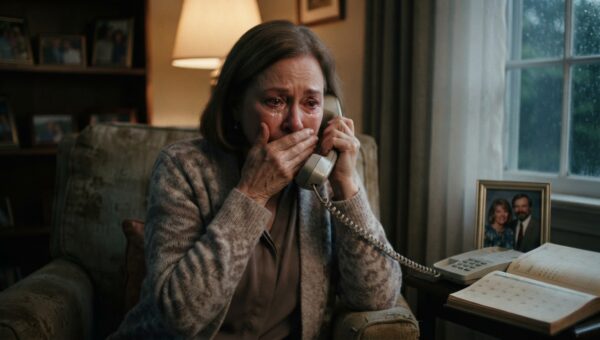
I walked over to the landline phone on the wall, the old push-button rotary style she refused to replace, and picked up the heavy black receiver. The dial tone was a low, steady hum. I punched in the numbers one by one, listening to each click echo in the quiet kitchen.
It rang three times. Then a click, followed by the sound of heavy, uneven breathing.
“Hello?” a man’s voice rasped. It sounded like sandpaper dragged over dry wood, old and tired and guarded.
I swallowed hard, my thumb tracing the worn plastic of the receiver cord. “Is this Arthur Vance?”
The line went dead silent. Not a pause for thought, but the kind of absolute, carved-out silence that happens when someone stops breathing because they think they’re hearing a ghost. I could hear the faint hiss of static on the line, and far in the background, the ticking of a clock that sounded entirely too much like the one in Clara’s hallway.
“Who is this?” he asked finally, his voice dropping an octave, shaking with something that sounded dangerously like fury. “How did you get this number?”
“My name is Brenda,” I said, my voice barely louder than a whisper. “Clara was my aunt. I’m living in her house on Grand Avenue now because of her will. I found her list in the kitchen.”
Another long, agonizing stretch of silence settled over the wire. I could hear him shifting his weight, the creak of an old chair, a sharp intake of breath. When he spoke again, all the anger had drained out of him, leaving only a hollow, brittle sound that made my skin prickle.
“Did she finally give you the…”
The sentence drifted off, hanging in the empty space between our houses like smoke.
“Give me what?” I asked, leaning closer to the wall as if I could push my voice through the receiver. “Mr. Vance? What was she supposed to give me?”
He didn’t answer. He let out a long, shuddering exhale, and then the line went dead with a sharp click.
I stood there in the dim kitchen for a long time, the receiver still pressed to my ear, listening to the monotonous dial tone until the phone company’s automated voice cut in with a warning to hang up.
I didn’t hang up right away. I just looked around the room, at the faded floral wallpaper, at the dripping faucet, at the Ziploc baggie lying on the linoleum beside my knee. The house wasn’t an inheritance. It was a crime scene of silence, and Clara had left me behind to sweep up the glass.
I spent the rest of that night tearing through the house. I didn’t care about the rain or the late hour. I went through every drawer, every closet, every cardboard box of tax returns and grocery receipts stored in the damp fruit cellar. I found old photo albums with the faces neatly cut out with kitchen shears. I found bank statements from the seventies showing monthly transfers to an account in a town three counties away. And finally, tucked behind the hot water heater in the basement inside an old rusted cedar box, I found the rest of the story.
It wasn’t a grand conspiracy or some dramatic embezzlement. It was smaller, uglier, and far more human. In 1974, Clara and Arthur Vance had been partners in a small local hardware supply business along with four other families on that list. A bad contract, a forged signature on a loan document, and a stubborn refusal to talk things out had destroyed the partnership overnight. Clara had kept the business, kept the house, and let Arthur take the blame and the debt, hiding behind her cold silence for forty-two years while everyone else picked up the pieces of their ruined lives. The $120,000 wasn’t a windfall. It was the exact principal of the loan plus interest, calculated to the penny, meant to be returned with a confession.
Two days later, I drove out to Arthur Vance’s house in a quiet subdivision near Xenia. I didn’t call ahead. I just drove out there in Clara’s rattling Honda with the cedar box sitting on the passenger seat between two bags of groceries.
Arthur opened the front door himself. He was older than his voice suggested, leaning heavily on a wooden cane, his white hair standing up in tufts around his ears. He looked at me through the screen door, his pale blue eyes wide and bloodshot, taking in my jacket, my muddy boots, and the wooden box in my arms.
“You’re Clara’s niece,” he said, his voice cracking slightly.
“Brenda,” I nodded. I didn’t wait for an invitation. I unlatched the screen door and pushed it open, stepping past him into the hallway. “She didn’t give it to me, Mr. Vance. She left it for me to find. And I think it’s time we finished the conversation.”
He didn’t stop me. He just turned slowly on his cane, watching me walk into his tidy, sunlit living room where a single photograph of a young woman with Clara’s exact jawline sat on the mantelpiece, face down.
We sat at his small laminate kitchen table for four hours. We didn’t yell. We didn’t cry. We just went through the papers in the cedar box, one by one, laying out the ledger of forty years of stubbornness and pride. I watched the tight, defensive lines around his mouth slowly relax as he read Clara’s final, clumsy letter of confession, the one where she admitted she had known he was innocent all along and simply lacked the courage to say it out loud.
When I left his house that evening, the sun was dipping low behind the flat Ohio cornfields, casting long, golden shadows across the asphalt. I drove back to Grand Avenue with the radio off, listening to the hum of the tires against the wet pavement.
The one-year clause didn’t expire for another ten months. But as I pulled into the gravel driveway and sat there in the idling car, looking up at the warm yellow light glowing through the kitchen window, I knew I wasn’t going to sell the house. I wasn’t going to list it, and I wasn’t going to hand it over to the humane society.
I sat on the front porch swing later that week as the autumn wind started to strip the last dead leaves from the oak trees, holding the polished brass key to the kitchen drawer between my thumb and forefinger while the house behind me stood quiet, painted, and finally, truly lived in.