The smell of damp cedar sawdust still sits at the back of my throat every time I walk down the back steps into the yard. It is a sharp, sour smell that doesn’t belong in a garden where things are supposed to grow. When the taxi dropped me off at the curb after five days visiting my sister in Madison, I didn’t notice the sky at first.
I just hauled my blue nylon suitcase up the front walk, unlocked the screen door, and dropped my keys on the white laminate counter. The house was stuffy, smelling of stale air and unwatered ferns. I set my canvas tote down on the kitchen table, poured myself a glass of lukewarm tap water, and walked out through the sliding glass door to check the hydrangeas.
My feet stopped moving before my brain could catch up. The whole southern half of the sky looked strange, wide and glaring and empty, like a missing tooth. The horizon line had dropped. Where the forty-year-old canopy of leaves should have filtered the afternoon sun into green and gold patches on the lawn, there was only blinding white light beating straight down on the grass. I walked across the turf, my sneakers sinking into damp clover, until I reached the property line.
There was no tree left. There was only a pale, raw circle of wood ringed with amber sap, sticking up six inches above the dirt like a gravestone.
My pulse kicked against my ribs with a hard, irregular thud. I reached out and touched the flat, pale grain of the cut wood with my fingertips, half-expecting it to be warm, as if the saw had just passed through it minutes ago. The cedar sawdust was still thick in the grass around the roots, smelling sharp and fresh and wrong. It was the white oak David and I planted on the exact afternoon we brought our oldest home from the county hospital, back when the neighborhood was just three houses and a gravel road. David had dug the hole himself with a borrowed shovel while I sat on an overturned milk crate holding a tiny bundle wrapped in blue flannel. We watched that sapling survive two severe droughts, an ice storm that snapped utility poles for three counties, and twenty years of changing neighbors.
A white business envelope was pinned to the top of the stump with a rusted three-inch galvanized nail.
I pulled the nail out with my thumbnail, my hand shaking so hard I nearly dropped the paper.
Inside was a slip of pink paper, a counter check from the local credit union filled out in neat, aggressive block letters. $500.00. Across the memo line, written in black ballpoint, were the words: Tree removal compensation. Sorry for the mess. Arthur Vance.
I stood there in the glaring afternoon sun with that ridiculous pink slip in my hand, staring across the low chain-link fence into Arthur’s manicured backyard. His kidney-shaped swimming pool was glittering with chlorinated perfection, completely free of the single brown leaf that apparently justified destroying four decades of living history. Arthur wasn’t home, but his stainless-steel grill sat gleaming on his concrete patio like an altar to his own small-minded convenience.
“Dropping leaves in his pool,” I whispered to the empty air. The words tasted like ash.
I didn’t cry then. Grief has a way of turning into something much colder when you are tired and alone.
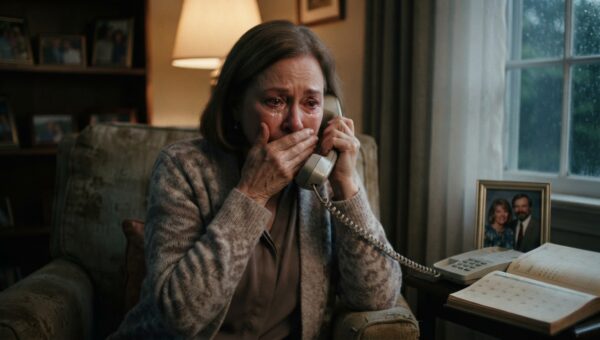
I walked back inside, set the check on the kitchen table right beside my water glass, and picked up the landline phone. I called the municipal code enforcement office first, but the recording told me offices were closed for the day. Then I called Sarah at the county records desk, a woman I had known since our kids sat together in kindergarten. She picked up on the third ring, her voice raspy from a summer cold.
“Sarah, it’s me,” I said, keeping my voice very flat so she wouldn’t hear the shaking in it. “Arthur Vance cut down my white oak while I was in Madison.”
There was a long silence on the other end of the line, just the sound of papers shuffling and a radio playing faint country music in the background. Sarah let out a low whistle through her teeth.
“The big one by the fence line?” she asked, already knowing the answer. “The one David planted?”
“There’s just a stump left,” I told her. “And a five-hundred-dollar check pinned to it.”
“He didn’t pull a permit,” Sarah said immediately, her tone hardening from neighborly sympathy to professional disgust. “I would have processed it. Nobody asked me for a tree removal permit for forty-one hundred Lincoln Street. Not this month, not all year. Arthur didn’t file a thing.”
“Thank you, Sarah,” I said. “I needed to know that.”
I hung up the phone and walked over to the window, staring out at the white glare where the shade used to be. Arthur Vance had lived next door for six years, ever since he bought the brick rambler and immediately cut down all the mature pine trees on his own lot so he could install that turquoise swimming pool. He was the kind of man who treated every living thing like it was an obstacle on a balance sheet. Whenever we spoke over the fence, it was usually about property lines or my hydrangeas straying six inches onto his mulch bed. I had tried to be civil because living next to an unfriendly neighbor is a special kind of exhausting torture, but civility apparently looked like weakness to him. He figured a retired widow on a fixed income would come home, grumble about the mess, cash his little five-hundred-dollar hush money check, and let him expand his patio sunbathing zone.
He didn’t know anything about timber trespass laws in this state. But he was about to find out.
The next morning, I called Marcus Sterling, an attorney whose office downtown smelled of old paper, leather floor mats, and damp wool. Marcus had handled my sister’s estate settlement when her husband passed away, and he had a quiet, methodical way of listening that made you feel like your problem was the only thing in the world that mattered to him. I sat across his scarred walnut desk with the pink check in my palm and the certified plat map of my property spread between us. Marcus didn’t interrupt while I laid out the story, his fountain pen clicking against the blotter as he took small, precise notes.
When I finished, he leaned back in his leather swivel chair and looked at me over the top of his half-moon reading glasses.
“A mature white oak of that diameter, planted within a residential conservation zone and established for over forty years, is not treated as a mere landscaping nuisance by the courts,” Marcus said, his voice level and steady. “It falls under commercial timber trespass and heritage property statutes. People think trees are just sticks in the dirt until they have to replace them. Let’s get an arborist out there this afternoon to do a proper trunk assessment before the stump dries out any further.”
That afternoon, a quiet, sun-weathered man named Dale Higgins arrived at my back gate carrying a heavy metal clipboard and a set of specialized measuring calipers. Dale spent an hour walking around the stump, measuring the diameter of the remaining cambium ring, inspecting the root flare that extended three feet onto my side of the property line, and taking core samples from the sawdust left in the grass. He was thorough and slow, speaking in low, technical terms about heartwood rot resistance and canopy replacement formulas.
When he finally clicked his clipboard shut, he looked me straight in the eye with a sympathetic expression.
“This wasn’t a sick tree, ma’am,” Dale said, shaking his head slowly. “This was a textbook specimen. Healthy as they come. To replace a white oak of this caliper with a nursery-grown mature equivalent, transport it on a flatbed, crane it over a fence, and guarantee root establishment in municipal soil… you are looking at replacement and restoration costs totaling twenty-seven thousand, four hundred dollars. Minimum.”
I stared at him, the number hanging in the warm afternoon air like a physical weight. Twenty-seven thousand dollars. Arthur had tried to settle forty years of memories, shade, and ecological damage with a five-hundred-dollar check and an apology note.
“Put it in writing, Dale,” I said quietly.
On Monday morning at 8:30 sharp, Marcus Sterling filed a formal civil complaint in the county circuit court. The charges weren’t just standard property damage. They included willful timber trespass, destruction of registered heritage flora, and statutory double damages for malicious removal without municipal permits. We didn’t mail the notice; Marcus had a county sheriff’s deputy hand-deliver the summons directly to Arthur Vance’s front door while Arthur was loading his golf clubs into the trunk of his Mercedes.
By Tuesday afternoon, the shockwaves hit Arthur’s side of the fence.
I was sitting at my kitchen table shelling butter beans into a yellow ceramic bowl when the phone rang. It wasn’t Arthur, and it wasn’t Marcus. It was an insurance adjuster named Miller from the statewide mutual carrier that insured both of our properties. He had intercepted a priority risk notification filed by the municipal code office regarding unpermitted commercial felling and intentional property destruction.
“Mrs. Gable?” the man’s voice crackled through the landline speaker with a brisk, sterile efficiency. “I’m calling regarding policy holder Arthur Vance at forty-one-ought-five Lincoln Street. We received notification of pending litigation involving unauthorized timber removal and severe structural liability.”
“I’m listening,” I said, not stopping my hands from sliding the pale green beans out of their pods.
“I need to inform you for the record that our underwriting department has reviewed the municipal code violation report and the arborist’s preliminary findings,” the adjuster said, pausing as if waiting for me to gasp. “Intentional, unpermitted property destruction of this scale constitutes a direct violation of policy exclusion clauses regarding malicious torts. We have officially voided Mr. Vance’s homeowner’s liability coverage effective immediately. Any legal judgments, civil penalties, or restitution orders arising from this lawsuit will be entirely out-of-pocket expenses for him.”
“I see,” I said, my voice as flat as a tabletop. “Thank you for letting me know, Mr. Miller.”
I hung up the phone and looked out the window at the empty patch of sky where the oak tree used to live. Arthur Vance was completely naked to the wind now. He had spent years feeling clever, cutting corners, and treating his neighbors like minor inconveniences to be managed, believing his insurance policy and his shiny car would protect him from the consequences of his own arrogance. Now he was facing a twenty-seven-thousand-dollar legal judgment with zero coverage and a canceled policy that would make finding homeowners insurance in this county next to impossible for the next ten years.
The real breaking point came on Wednesday evening, just as the sun was beginning to dip below the rooflines and cast long, sharp shadows across the bare grass.
I was out on the back patio sweeping up the last bits of stray cedar sawdust with a stiff broom when the gate latch clicked. I looked up and saw Brenda Vance standing by the edge of the old stump. Brenda was a quiet, nervous woman who spent most of her time tending to her potted geraniums and trying to keep out of Arthur’s way. Tonight she looked ten years older, her hair pulled back into a messy clip, her face pale and exhausted, her fingers twisting the strap of a worn leather handbag like she was trying to wring water out of it.
“May I come in, Martha?” her voice trembled, thin and small against the evening breeze.
I leaned the broom against the side of the house and wiped my hands on my apron. “You’re already here, Brenda. What do you want?”
She walked slowly toward the stump, looking down at the pale, scarred wood with a look of deep, crushing shame. She didn’t look like an arrogant neighbor now. She looked like a woman who had just realized her husband had driven their family off a financial cliff while whistling a tune.
“Arthur’s beside himself,” she whispered, her voice cracking as a tear finally spilled over her lower lashes and traced down her cheek. “He got the notice from the insurance company this morning. They dropped us, Martha. They dropped our whole policy because of this… because of the tree.”
“That’s between Arthur and his insurance carrier,” I said, my voice staying steady even though my chest felt tight. “He should have thought about that before he hired those itinerant tree cutters to sneak into my yard while I was out of town.”
“He lied to me,” Brenda broke down, her hands flying to cover her face as she let out a ragged, ugly sob that sounded like months of suppressed misery finally breaking through the surface. “He told me he talked to you about it before you left. He said you agreed to let him clear the overhanging branches so his pool filter wouldn’t clog. I swear to God, Martha, I didn’t know he cut the whole thing down until I looked out the kitchen window and saw the sky.”
She dropped her hands and stepped closer, her eyes wide, desperate, and pleading, searching my face for any sign of mercy.
“We don’t have twenty-seven thousand dollars,” she begged, her voice dropping to a low, shaking plea. “Arthur’s business has been slow all spring, and if we have to pay that arborist valuation out of pocket, plus your lawyer’s fees… we’ll lose the house. We’ll have to sell everything. Please, Martha. Please, I’m begging you as a neighbor. Drop the lawsuit. Let us pay for a small cleanup, or let us give you five thousand dollars in installments. Please don’t ruin us.”
I looked at Brenda standing there by the raw stump where my husband’s memory used to stand tall and green, and for a second, I felt the heavy, suffocating weight of her panic pressing against my own ribs. I knew what it felt like to be blindsided by life, to feel the ground pull away beneath your feet when you thought everything was safe and secure. I could have pitied her. I could have listened to the soft voice inside my head telling me that enough was enough, that taking a smaller settlement would spare me the ugliness of a protracted court battle.
Then I remembered the note pinned to the stump with a rusted nail. I remembered the insulting pink check for five hundred dollars written in arrogant block letters. I remembered forty years of shade, strength, and quiet dignity reduced to a pile of sawdust in less than two hours because Arthur Vance didn’t want a single brown leaf floating in his turquoise swimming pool.
“Brenda,” I said, and my voice was so quiet she had to lean forward to hear it. “When David and I planted that oak tree forty years ago, we didn’t do it to inconvenience your pool. We did it because we built a life here, brick by brick, root by root. Arthur didn’t make a mistake. He made a choice. He chose to trespass, he chose to destroy something sacred that didn’t belong to him, and he chose to treat me like an old widow who wouldn’t have the stomach to fight back.”
Brenda flinched as if I had struck her across the face, her lips parting in a silent gasp.
“I am not dropping the lawsuit,” I continued, every word falling like a stone into the quiet evening air. “Your husband wanted a clean, unobstructed view. He’s going to get one. But we are going to settle this on my terms, not his.”
She stared at me, terror and resignation fighting behind her wet eyes. “What… what are your terms?”
“First, the full twenty-seven thousand dollars in court-ordered restitution, enforced by a formal property lien against your title if necessary,” I said, ticking the conditions off on my fingers with absolute clarity. “Second, a signed, public apology recorded and submitted to the neighborhood association detailing exactly what laws were broken. And third…”
I pointed a finger straight at the narrow strip of property frontage running right along the front boundary line between our two driveways, right where Arthur’s precious sunbathing patio sat exposed to the glaring western heat.
“Third, you will grant my arborist unhindered access to install a heavy commercial-grade cedar planter box directly over this old stump, right on the property line. And we are going to crane in a brand-new, twelve-foot mature oak sapling right in the exact same spot. Arthur is going to watch it grow every single afternoon from his lounge chair without an inch of shade to protect him.”
Brenda didn’t say another word. She just stared at me for a long, heavy moment, the reality of her husband’s arrogant folly finally settling over her like a shroud. She turned slowly around, her shoulders slumped, and walked back across the dead grass toward her house without looking back once.
Two weeks later, the legal settlement was signed, sealed, and entered into the county court records with the permanence of an anchor dropped in deep water. Arthur Vance didn’t come out to watch when the flatbed truck arrived, and his white Mercedes stayed locked inside the garage with the window shades pulled tight against the afternoon glare.
The heavy cedar planter box sits directly atop the sanded surface of the old, weathered stump now, anchored firmly to the earth with galvanized bolts and filled with rich, dark compost. Cradled safely in the center of that wooden vessel is a thriving young oak sapling, its vibrant green leaves catching the last warm rays of the summer sun. Every afternoon, when the heat beats down mercilessly on Arthur’s bare, unshaded patio and forces him inside, I sit on my back porch with a cold glass of water and watch the new leaves catch the breeze. The stump where memory lived is hidden beneath the soil now, but the roots go deep, and the shadow is coming back to stay.