The wrapping paper on the bottom box had a small tear near the corner where I’d pulled the tape too tight, and I spent five minutes trying to smooth it down with my thumb before I even looked at the screen.
My phone had buzzed twice while I was tying the red ribbon on the bicycle helmet for Leo.
Three weeks before Christmas, my son texted: “Dad, we already filled your seat.
Jessica thinks it’ll be less awkward if dinner is just for immediate family.”
I blinked at the screen in my empty kitchen. I raised that boy after my wife died, double shifts at the plant, missed birthdays, a lifetime of sacrifice. For twelve years I paid their mortgage, car insurance, daycare, vacations, over $320,000, I never complained. Now I wasn’t family anymore. I sat in my armchair surrounded by presents wrapped for my grandchildren and realized I was just a wallet to them. So I made a quiet decision. I canceled every payment, silently, without a word. He thinks I’ll just…
It’s funny how the brain tries to keep you comfortable even when the floor is dropping out from under your boots. I stared at that little blue text bubble for a long time, waiting for my eyes to clear, thinking maybe the light from the refrigerator was hitting the glass wrong.
Marcus was thirty-four years old. He had a gray sedan in the driveway that I’d helped him pick out when he got his promotion at the logistics firm, though promotion was a generous word for a guy who spent half his shift trading stock options on his work laptop.
I set the roll of Scotch tape down on the linoleum. It rolled three inches and bumped against the leg of the kitchen table, making a dry little click that seemed way too loud in the quiet house.
Twelve years is a long time to keep a ledger in your head. People talk about love like it floats around in the air like dust motes, but for me, love had always looked like a series of bank confirmations.
Back when Clara was still here, before the hospital bills ate through our savings and left me with a stack of envelopes that took four years to clear, we used to sit at this exact table and talk about how we’d make sure Marcus never had to scrape the way we did.
Clara had this habit of tapping her coffee spoon against the rim of her ceramic mug twice whenever she was worried about money.
I hadn’t heard that tapping since the autumn of 2011, right after the funeral, when Marcus stood by the back door with his hands shoved deep into his pockets and told me he and Jessica were expecting their first baby and the rent on their duplex was jumping another hundred and fifty dollars.
“I don’t know how we’re going to swing daycare, Dad,” he’d said back then. His voice had that little hitch in it that always made me feel like I was failing him.
So I swung it for him. I swung it for twelve solid years.
I walked over to the desk in the corner of the living room, right beside the floor lamp with the frayed green shade that Clara had found at an estate sale back when Eisenhower was in office. The house smelled faintly of lemon oil and dry cedar.
My desktop computer hummed to life with that old familiar click of the hard drive spinning up, slow and heavy like an old hound getting out of a porch bed.
The internet bill was on auto-pay, too. Everything was on auto-pay. That was the beauty of modern banking. You set up the ACH transfers once, you sign the authorization forms at the credit union on Main Street, and then you just go to work and let the machinery do the walking.
I pulled up the credit union portal. My fingers felt stiff on the plastic keys.
User ID: Vance 4402. Password: [********].
The balance on the checking account flashed green in the top corner. $14,280.45. That was supposed to cover the property tax installment due next Tuesday and whatever groceries I needed to get through the month.
I clicked into the recurring transfers tab.
There it was, listed in neat, boring rows like headstones in a quiet cemetery. Account ending in 8841. Marcus and Jessica checking. $1,450.00 every first of the month for the mortgage subsidy. Account ending in 9012. Jessica’s car insurance. $184.50. Account ending in 4429. The kids’ private preschool tuition. $850.00.
Every single month, like clockwork. Rain or shine, overtime shift or sick day.
I didn’t call Marcus. I didn’t text him back asking what he meant by “less awkward.”
I just moved the mouse pointer over to the little blue box that said *Manage* and clicked *Delete*. Then I did it again for the second one. And again for the third.
The screen blinked. *Are you sure you wish to cancel this recurring payment instruction?*
I clicked *Confirm*.
It took me less than three minutes to wipe out twelve years of financial scaffolding.
The kitchen was dead quiet when I turned the computer off. No cheering, no dramatic music playing in the background like you see in those pictures on the television. Just the hum of the old refrigerator in the corner and the gray light of a December afternoon pressing against the windowpane.
The next few days felt strange, like wearing a pair of shoes that were half a size too small.
I went to the hardware store on Thursday morning to pick up some weather stripping for the back door because the draft was starting to whistle through the latch every time the wind came down off the river. Hank behind the counter asked me how my Christmas prep was coming along.
“Fine, Hank,” I told him, tossing a package of gray foam tape onto the counter. “Getting things wrapped.”
“Marcus and the kids coming up for the big dinner?” he asked, wiping his thumb across his nose. Hank always asked about Marcus because they’d played little league together back when the turf was real dirt and clover.
“They’ve got other plans this year,” I said, keeping my voice flat.
Hank didn’t press it. People in our town know when to drop a line before it snags on something ugly. “Well, the weather’s supposed to hold until Sunday anyway.”
I walked back out to the truck with the weather stripping tucked under my arm. The parking lot was slushy, gray salt crusting the edges of the curbs where the snowplow had pushed it aside two nights before.
For the first time in twelve years, I didn’t check my phone while I was driving home. Usually around Thursday afternoon, Jessica would send a text about some unexpected fee, ballet shoes, field trip money, or a sudden change in insurance deductibles, and I’d mentally calculate how many hours of overtime I’d need to log down at the plant to cover the difference before the weekend statement cleared.
My phone stayed silent in the cup holder.
By Tuesday of the following week, the first automated notice would have hit their end.
I imagined Marcus sitting at his kitchen island with his laptop open, drinking his dark-roast coffee from the mug I’d bought him for Father’s Day two years ago, the one that said *World’s Okayest Dad* in faded blue letters, staring at a red warning banner from the mortgage servicer.
I didn’t feel angry. That was the part that surprised me most. I just felt… empty. Like an old barn after the hay had all been hauled out and burned.
Wednesday evening brought the first call.
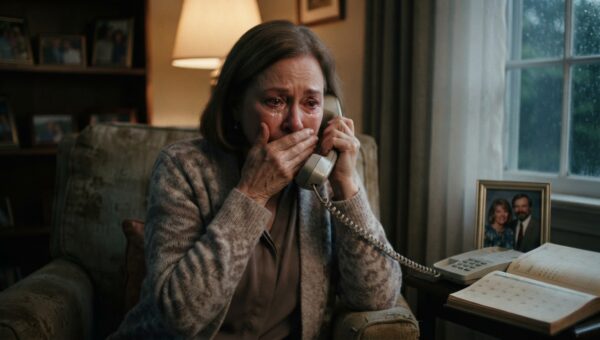
I was sitting in the green armchair with a cup of black tea, watching the local news report on a tractor-trailer that had jackknifed over on Route 9, when the landline on the side table gave its loud, old-fashioned ring.
I let it ring three times. On the fourth, I picked up the receiver.
“Dad?”
Marcus didn’t sound like a man who was organizing a cozy family dinner. His voice had that thin, sharp edge to it that he only ever used when his car wouldn’t start in the middle of a rainstorm.
“Hello, Marcus,” I said.
“Did you change the account settings?”
I took a slow sip of my tea. The mug was warm against my lower lip. “Which settings would that be?”
“Don’t play games with me, Dad. The mortgage payment didn’t go through. The bank just sent an automated alert saying the ACH transfer was rejected due to an invalid routing instruction or account closure. Jessica’s in tears because she’s on the phone with the mortgage company right now and they’re talking about a late fee.”
There was a silence on the line then, heavy and ragged, the kind of silence that usually came right before he asked me to spot him five hundred dollars for new tires.
“I didn’t close the account, Marcus,” I said, keeping my tone level. “I just stopped putting money into it.”
A sharp intake of breath on the other end. “What do you mean you stopped? That’s our house payment! You’ve been handling that since we bought the place on Elm Street!”
“Twelve years,” I said. “That’s a long time to rely on someone who isn’t even immediate family.”
The line went dead silent for three whole seconds. I could hear the faint sound of Jessica crying in the background, muffled by what sounded like a kitchen towel.
“Dad,” Marcus said, his voice dropping an octave, trying to find that old childhood register that used to make me reach for my wallet without thinking. “What are you talking about? That text was… Jessica was just stressed about the seating chart. You know how she gets when her sister comes into town. It wasn’t meant like that.”
“It was very clear, Marcus,” I told him. “You said dinner was for immediate family. And since I’m apparently just a guest who doesn’t fit the seating arrangement, I figured I shouldn’t be handling your household overhead either. Seems only fair to let immediate family take care of immediate expenses.”
“You can’t just cut us off three weeks before Christmas!” His voice cracked on the last word, climbing up into that shrill, panicked pitch that always meant he was realizing he couldn’t talk his way out of a corner. “We have bills coming due! The insurance lapsed this morning! If I get into an accident on the way to the office tomorrow, “
“Then you’d better drive careful,” I said.
And I hung up the phone.
I didn’t slam it down. I just placed the heavy plastic base back on the cradle with a soft, final click, right beside the wooden coaster Clara had embroidered with little blue cornflowers back when we were first married.
My hand didn’t shake. That was the other thing. I thought I’d feel sick to my stomach, like I’d just kicked a dog or thrown a wrench into a delicate machine. But my hand was steady as I picked my tea mug back up and took another swallow.
The phone started ringing again ten seconds later. I reached over, pulled the small gray cord right out of the wall jack, and let the house settle back into its proper silence.
By Friday afternoon, the weather had turned sour again, a fine, greasy drizzle coating the windshields of every car parked along Main Street.
I was at the small diner down by the post office, drinking a cup of coffee that tasted like it had been sitting on the burner since Tuesday, when the bell above the door jangled with a sharp, aggressive rattle.
Marcus didn’t look like he’d slept in two days. His coat was half-zipped, and his hair was sticking up on one side where he’d been running his fingers through it. Jessica was right behind him, her face tight and pinched under her woolen hood, her eyes red around the edges.
They spotted me in the corner booth by the window before I could even set my spoon down.
“Are you out of your absolute mind?” Marcus didn’t bother to lower his voice. Half the diners turned around from their eggs and toast to look at us. Old man Henderson, who runs the hardware store annex, lowered his fork halfway to his mouth and stared straight ahead like he was studying the wallpaper.
I didn’t look up from my coffee. “Keep your voice down, Marcus. People are eating.”
Jessica slid into the vinyl bench opposite me without waiting for an invitation. Her breath smelled like stale peppermint and panic.
“Arthur,” she said, using my first name for the first time in five years, a sign of pure, unadulterated desperation. “You can’t do this to us right before the holidays. Do you have any idea what’s happening at the house? The bank called about the second mortgage notice. They’re saying if we don’t wire the funds by Monday morning, they’re starting default proceedings.”
“That sounds like an immediate family problem,” I said, stirring a half-packet of sugar into my coffee.
“Don’t do this,” Marcus hissed, leaning across the sticky laminate table until his face was six inches from mine. His eyes looked wild, the pupils small and dark. “You raised us. You told us family always sticks together. You said we never had to worry about the roof over our heads as long as you were around.”
“I said a lot of things when I thought I was part of the family,” I told him, finally looking up to meet his eyes. “Turns out I was mistaken. According to you, I’m just an outsider who disrupts the seating arrangement.”
“That was a text!” Jessica snapped, her voice rising to a harsh, brittle screech that made the waitress drop a coffee mug behind the counter with a loud, clattering smash. “I was talking about table space! The dining room table only seats six comfortably with Aunt Sarah coming in from Ohio! We didn’t mean you weren’t family!”
“Oh, you meant it,” I said softly. “You meant every word of it. You just didn’t expect the bill to come due at the same time.”
Marcus stared at me like I was speaking a foreign language. For twelve years, whenever he’d looked at me like that, I’d reached for my checkbook. I’d told him about the extra shifts at the plant, how the overtime was piling up nicely, how it was no trouble at all to help a boy get his footing in a hard world.
I hadn’t mentioned the arthritis in my left knee that made climbing the loading dock stairs feel like walking on hot coals. I hadn’t mentioned the nights I sat alone in the dark kitchen eating cold soup because I didn’t feel like cooking for one.
“We need the transfer reinstated, Dad,” Marcus said, his voice dropping into a flat, ugly register that sounded less like my son and more like a stranger standing in a dark alley. “Right now. Today. Before the bank closes.”
“No,” I said.
“What do you mean, no? It’s your money! What else are you even spending it on? You live in this drafty old house by yourself! You don’t go anywhere! You don’t buy anything!”
“You’re right,” I said, taking another calm sip of the lukewarm coffee. “I don’t. And as of today, I’m going to have a lot more of it left over at the end of the month.”
Jessica stood up so fast the vinyl bench scraped against the linoleum with a sound that set my teeth on edge. “You’re a selfish, bitter old man,” she spat, her face dark with fury. “You’re punishing your own grandchildren because your feelings got hurt over a stupid dinner table!”
“The grandchildren have presents under my tree,” I said, my voice not shaking by so much as a hair. “They’re welcome to come pick them up anytime they want. But the wallet stayed home.”
They didn’t stay for coffee. Marcus stood up, grabbed Jessica by the elbow with a little more force than looked comfortable, and hauled her toward the door. The bell jangled again as they pushed out into the gray drizzle, leaving the door half-open so a cold gust of wind blew straight across the floorboards and made the paper napkins flutter in their plastic holder.
Henderson didn’t look up from his eggs, but I saw the corner of his mouth twitch into something that looked suspiciously like a dry, quiet grin.
I finished my coffee, dropped two quarters on the Formica table for the tip, and walked out to my truck.
The drive home took twelve minutes. The heater in the old Ford was clicking rhythmically behind the dashboard, smelling faintly of warm dust and antifreeze.
When I pulled into the driveway, the house looked small and gray against the bare maples at the edge of the property line.
I didn’t go inside right away. I sat in the cab with the engine idling, watching the windshield wipers sweep back and forth across the glass in a slow, steady arc.
Three weeks before Christmas.
The presents were still sitting in the corner of the living room, piled neatly around the base of the artificial fir tree that Clara and I bought back when Marcus was six years old. The plastic needles were starting to shed a little bit at the joints, leaving little green needles on the braided rug like pine-scented dust.
I’d spent over three hundred thousand dollars keeping them upright for twelve years. I’d traded my youth, my quiet evenings, and whatever was left of my joints for the privilege of being their personal bank. And the moment they wanted to clear the room for better company, they’d shoved me out the back door like an old coat left on a peg too long.
Well, the coat was off the peg now.
I turned off the ignition. The engine gave one last shudder and died, leaving only the sound of the wind rattling the dry oak leaves against the side of the metal shed out back.
I got out, walked up the wooden steps to the front porch, and unlocked the heavy oak door.
The house was cold, but it was my cold.
On Christmas morning, the sun came up over the river like a slice of raw copper, burning off the thin skim of frost that had crusted the top of the horse trough by the barn.
I didn’t turn on the television. I didn’t check the landline to see if the red message light was blinking.
I made a pot of black coffee on the old stove, real coffee, strong enough to float a horseshoe, and poured it into the heavy ceramic mug Clara had painted back in ’88.
Then I walked out onto the front porch with my coat unzipped, holding the warm mug between both hands.
The air was crisp and sharp, smelling of woodsmoke from somewhere down the valley and wet pine needles. Down the road, about a quarter mile off, I could see the roof of the small brick house where Marcus and Jessica were probably trying to figure out how to sell their second television set to cover the water bill.
I didn’t feel sorry for them. Pity is for people who think they’re still in the game.
I stood there on the porch boards, feeling the cold air hit my face and the hot coffee burn the back of my throat, and for the first time in twelve years, I took a deep, full breath that belonged entirely to me.
The front door stayed shut behind me, locked tight against every unearned expectation, every quiet insult, and every dollar that ever tried to buy a place at my table.