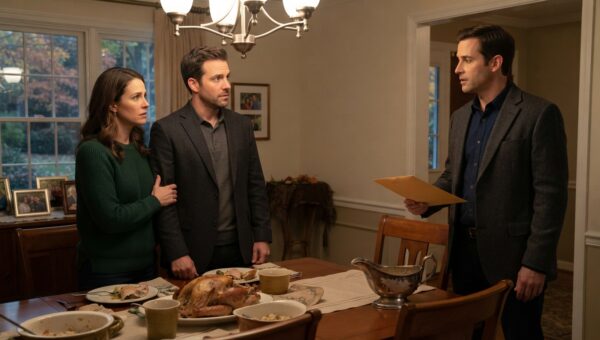
The silverware had that heavy, solid ring against the porcelain that only happens when my mother pulls out the good stuff for company. Or in this case, for Chloe. We were sitting around the dining room table in Bakersfield, the desert chill pressing hard against the double-paned glass while the furnace rattled itself half to death in the hallway. My father was carving the ham with his usual slow, theatrical precision, making sure everyone watched the blade slice through the glaze.
Arthur loved a good audience. And tonight, his audience was entirely focused on my younger sister.
Chloe was leaning back in her chair with a glass of Pinot Noir balanced delicately between two fingers. She had on a silk blouse that cost more than my entire winter coat, and she made sure the gold links of her bracelet caught the light of the brass chandelier every time she made a point. Which was often.
“It is just about positioning, Dad,” Chloe said, waving her wine glass just enough to threaten the white tablecloth. “If you do not command the room from day one, they walk all over you. That is why my base is fifty thousand a month now. Before bonuses. My director of operations title actually means something in Los Angeles.”
My mother, Martha, let out a soft, admiring sigh and rested her chin in her palm. Martha always looked at Chloe like she was watching a movie star on a Sunday afternoon matinee. ” fifty thousand,” Martha repeated, as if tasting a very expensive piece of candy. “Every single month.
I still cannot wrap my head around it, Chloe. Imagine what you could do with that kind of income, Julian.”
She turned her head slightly to look down the table at me. I was sitting near the foot, halfway in the shadow of the china cabinet, quietly working my way through a piece of dry turkey. I had worn a plain gray sweater, the kind you buy at a box store because it is warm and nobody looks at you twice in a hardware store.
“Julian is still figuring out his next chapter,” my father said, not even looking up from the ham. His voice had that dry, flat tone he reserved for things he considered beneath discussion. “Some people are built to run divisions. And some people are built to tinker in the garage. Nothing wrong with being quiet, I suppose. Just a shame he never had Chloe’s drive.”
Chloe gave a little sympathetic smirk. It was the kind of expression people use when they look at a stray dog with a limp. “It is fine, Dad. Not everyone has the stomach for corporate warfare. Some people just need to find a nice, steady little desk job where nobody expects much. I told him last year he should look into municipal data entry. The benefits are decent, at least.”
Nobody asked what I actually did. They had stopped asking four years ago, right after I walked out of Arthur’s failing industrial parts distributorship with a cardboard box and a check for three weeks of severance. Back then, Arthur told me to my face that I had the business instincts of a fence post. He told me I was too soft, too slow, and entirely unemployable in any serious market. He told me I would be crawling back within six months asking for a job in the warehouse loading pallets.
I remember the smell of stale coffee in that old office. I remember the way the fluorescent light hummed a high, jagged C every time the compressor kicked on. I remember walking out into the gravel lot and deciding right then that I would never answer to another man’s ledger again.
The silence at the Christmas table stretched out for a second, heavy with that familiar, suffocating pity. Martha reached across and patted my hand once, patronizing and soft. “Don’t feel bad, honey. We all have our gifts.”
I put my fork down. The metal clicked against the ceramic plate, a little louder than I intended.
“Fifty thousand a month,” I said. My voice was low, almost conversational.
Chloe blinked, surprised that I was speaking at all. “Before equity grants, yes. That is what happens when you climb the ladder instead of sitting at the bottom of it.”
I looked right at her. I looked at the way her shoulders stiffened under that expensive silk. “Then your salary drops to twenty thousand tonight.”
The table went dead still. Martha’s hand froze halfway back to her water glass. Arthur stopped the carving knife an inch above the bone. For a second, nobody breathed. Then Chloe let out a sharp, incredulous bark of laughter that sounded entirely too loud in the small dining room.
“Are you out of your mind?” she snapped, her face flushing a bright, angry pink. “Drop my salary? To twenty what? Thousand? You are sitting there in a ten-dollar sweater acting like you control my payroll. Have you lost your actual mind, Julian?”
Arthur finally set the knife down, his brow furrowing into deep, offended folds. “Julian. That is enough. Do not sit at my table and act bitter just because your sister has achieved more by thirty than you ever will. Apologize to her right now.”
“I am not bitter, Arthur,” I said. I used his name instead of calling him Dad, a small habit I picked up when I realized he stopped being a father the day he tied our family’s worth to profit margins. “I am just doing some internal restructuring.”
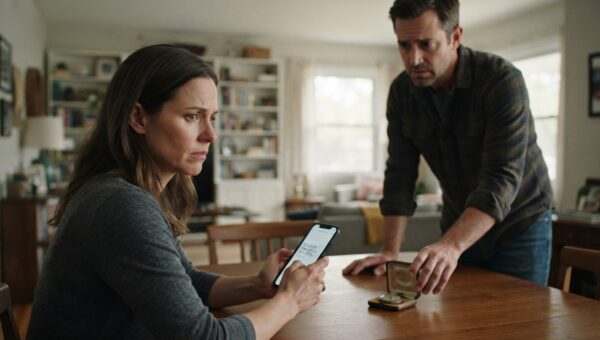
I reached into the pocket of my gray sweater, pulled out my phone, and tapped the screen twice. A dark blue administrative dashboard lit up my face, casting a cold, steady glow across the ham and the silver gravy boat. At the top of the interface, right beneath the corporate logo of the logistics holding firm that handled West Coast distribution for three major tech supply chains, my name sat clearly under the bold title of Managing Founder and Majority Shareholder.
“What is that?” Chloe asked, leaning forward, her voice losing a fraction of its sharp edge. “What are you looking at?”
“The parent company,” I said quietly. “The one that bought out your firm three years ago through an anonymous holding entity. The one that keeps your little subsidiary afloat and authorizes every single line item on your monthly P and L statement.”
Arthur squinted across the table, his eyes straining against the glare of the phone screen. “What holding entity? Chloe works for Vanguard Logistics. They are out of Century City.”
“Vanguard is a shell subsidiary,” I said. I turned the phone slightly so the corporate seal was visible in the center of the table. “I founded it six months after I left your warehouse, Arthur. Built it from a single desk in a sublet office in Fresno. Now we clear forty million a year in automated freight routing. And three years ago, when you were all bragging about Chloe landing that big corporate gig, she actually applied through an open blind portal.”
Chloe’s breath hitched. I saw her throat move as she swallowed hard. “That… that is not possible. I interviewed with a board. I went through three rounds.”
“You interviewed with an automated HR filter that forwarded your resume to my desk,” I said, my voice dropping an octave. “I saw your name. I knew you needed the stability because your last startup went under with thirty thousand in back taxes. So I approved you. I gave you the mid-level director slot, and when you asked for a raise last year, I signed off on the fifty grand a month because I still had some stupid, lingering habit of protecting family.”
The room was so quiet now you could hear the refrigerator motor humming through the wall.
“You’re lying,” Chloe whispered, her voice shaking now. She reached blindly for her wine glass, her fingers trembling so badly she nearly knocked it over. “You couldn’t build a lemonade stand. Dad said so. Dad said you didn’t have the head for business.”
I looked at Arthur. My father looked smaller suddenly, sitting there at the head of the table with his carving fork still gripped in his fist. His face had gone that dull, pasty gray of a man who suddenly realizes the foundation of his house is built on sand.
“Arthur,” I said softly. “Did you ever wonder why your little parts distributorship suddenly stopped losing contracts to out-of-state competitors three years ago? Did you ever wonder why Vanguard quietly bought up your commercial debt and restructured your loans at half the interest rate?”
Arthur’s mouth opened, but no sound came out. His hands began to shake slightly against the edge of the mahogany table.
“It was me,” I said. “I kept your little shop alive because Mom liked the house and you were too proud to take a direct handout. I let you keep pretending you were the patriarch of this family while I paid the mortgage through three different shell companies.”
Chloe stood up so fast her chair screeched across the hardwood floor, the legs making a terrible tearing sound. “This is a joke. This is some sick, pathetic joke because you hate that I am successful. Dad, tell him to get out of the house. Tell him right now.”
I didn’t blink. I didn’t raise my voice. I just looked at my sister, seeing past the silk blouse and the expensive wine, looking right at the terrified, fragile person underneath who had never earned a single thing in her life without someone else holding the door open.
“Tomorrow morning at 8:00 AM, two documents are hitting your corporate email, Chloe,” I said, standing up slowly from my chair and buttoning my sweater. “One of them reduces your base salary to twenty thousand a year, matching your actual output over the last twelve months. The other is your resignation letter. You can sign the first one and stay on as a warehouse inventory clerk, or you can sign the second one and go try your luck in Los Angeles without my servers behind you.”
“You can’t do that!” she screamed, her voice cracking with pure panic as the reality finally broke through her arrogance. “I have a lease! I have a car payment! You can’t just, “
“I built the company, Chloe,” I said quietly. “I can do whatever I want.”
Arthur lunged forward, his hands flat on the table, his face twisted in a desperate, pleading mask. “Julian, wait. Let’s not be hasty. She’s your sister. We’re family. You can’t treat family like a business transaction. Sit back down. We can talk about this. Please, son.”
“Don’t call me son,” I said.
I picked my coat off the back of the chair and slipped my arms into the sleeves. The tweed was heavy and familiar, smelling faintly of engine oil and old wool from the garage where I spent my weekends building the algorithms that made me free.
Martha started to cry, small, thin wet sounds coming from behind her napkin, but I didn’t look back at her. I didn’t look at the half-cut ham or the expensive wine or the brass chandelier casting light on a family that only knew how to love a ledger sheet.
I walked down the hallway, my boots heavy and steady against the floorboards. Behind me, Arthur was calling my name, his voice cracking into something small and broken, but I kept going. I opened the front door and stepped out into the crisp, biting Bakersfield air, pulling the collar of my coat up against the wind as the front door clicked shut behind me for the very last time.