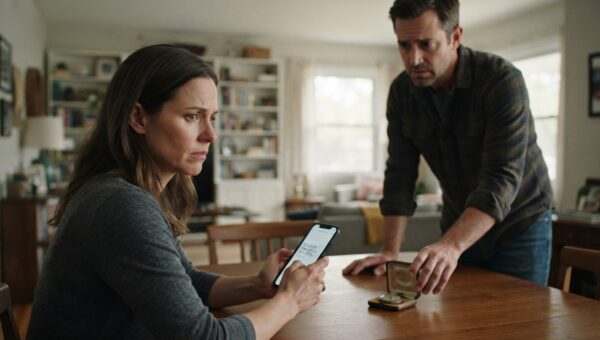
My phone buzzed against the laminate counter at 6:42 in the morning with a notification from our banking app that made my stomach drop into my shoes. It wasn’t an alert about a grocery run or a utility bill. It was a transfer confirmation for $2,400 moving out of our joint account into a separate savings number I didn’t even recognize.
I stared at the little green digits glowing in the dim kitchen light while the refrigerator motor hummed its familiar, hollow rattle. Three days ago, my monthly pharmacy technician direct deposit of $3,000 had hit that exact account. By this morning, almost all of it was gone. I remember standing there with my work badge still clipped to my lanyard, wondering how I was going to explain to my four-year-old daughter why her breakfast was a handful of dry oats from a plastic cup.
Derek was still asleep in the bedroom, snoring softly through his nose the way he always did after a late night of gaming with his buddies. I had spent the last six months working double shifts at the retail pharmacy down on Broad Street, standing on my aching feet for twelve hours at a time, calculating insurance co-pays and filling rows of orange bottles while my wrists throbbed from repetitive strain.
Derek had taken over the household app management back in November under the guise of helping me streamline our budget so I wouldn’t have to stress about the bills. He told me I worked too hard to worry about numbers. I believed him because I was too tired to argue, and because he was my husband, and husbands are supposed to have your back when the world feels like too much to carry.
The front door clicked open before I could put my phone down, and my dad walked into the kitchen carrying a brown paper grocery bag that smelled faintly of fresh yeast and damp earth. Dad was sixty-eight years old, with calloused hands that smelled of pine sawdust and a gray crew cut that he trimmed himself in the bathroom mirror every Sunday morning. He had retired from carpentry two years ago, but he still moved with that slow, deliberate grace of a man who spent forty years measuring twice before he made a single cut.
He didn’t knock because we had given him a spare key the year Mia was born, back when we still thought we were building something solid together in this little three-bedroom house in Columbus.
“Morning, Lily-bug,” Dad said softly, pulling off his worn leather work gloves and tossing them onto the counter beside my car keys. Then he stopped dead in his tracks. He didn’t take off his canvas jacket yet. He just stood there by the doorway, looking past me at the open refrigerator door where the light bulb flickered yellow against wire shelves holding nothing but a jar of expired mustard and half a wedge of cheddar cheese with green fuzz blooming on the corner. Mia was sitting right there on the cold linoleum floor, her little bare legs tucked under her nightgown, crunching quietly on dry Cheerios from a plastic Batman cup. Dad looked down at the cup, then up at the empty shelves, and finally at my pharmacy uniform pants with the bleach stain on the knee.
“Where’s the milk, Lily?” Dad asked, his voice entirely too quiet, the kind of quiet that meant a storm was gathering behind his eyes.
“We ran out yesterday, Dad,” I muttered, feeling the heat rise up my neck until my face burned. “I’m going to stop at the store after my shift this afternoon.”
Dad didn’t answer right away. He set his grocery bag down on the laminate table, pulled out a carton of whole milk, a pound of butter, and a dozen brown eggs, and set them down one by one with deliberate slowness. Then he looked around the kitchen as if he were seeing it for the first time. He noticed the scuff marks on the baseboards that I hadn’t had time to clean, the pile of unpaid water notices stuffed behind the toaster, and the empty fruit bowl that usually held apples or bananas. He reached out and touched the edge of the empty shelf inside the fridge, his thumb tracing the white plastic coating.
“You make three thousand dollars a month down at that pharmacy, honey,” Dad said, his voice dropping into that deep register he used when he was trying very hard not to lose his temper. “I know what they pay lead techs. I helped you negotiate that hourly rate last year. So you tell me why my granddaughter is eating dry cereal out of a plastic cup while your refrigerator looks like it’s been abandoned for the winter.”
Before I could invent another lie to protect Derek, footsteps padded down the hallway. Derek appeared in the kitchen doorway wearing his gray sweatpants and a black hoodie, rubbing his eyes and yawning like he didn’t have a care in the world. He took one look at my dad standing by the open fridge with the milk carton in his hand, and the sleepy expression on Derek’s face shifted into that familiar, defensive smirk he always wore whenever he knew he was cornered but refused to admit it. Derek scratched the back of his neck, looked at Mia on the floor, and then looked right at my father without a single ounce of shame.
“Relax, Arthur, it’s not a federal case,” Derek said, waving a hand dismissively as he walked over to the coffee maker. “Most of her paycheck had to go to my mother. Evelyn had some pressing car repairs and property taxes due this week, and family takes care of family. It’s called being a decent human being.”
Dad slowly slipped off his jacket. He hung it over the back of the wooden kitchen chair with agonizing slowness, smoothing out the collar with two fingers before he turned back around to face my husband. The air in the kitchen went dead still, so quiet you could hear the hum of the refrigerator motor chugging away in the corner and the distant sound of a garbage truck grinding its gears down on the main road outside.
“Say that again, son,” Dad whispered.
“I said Evelyn needed the money,” Derek repeated, his voice rising a notch as he poured water into the coffee reservoir. “My mother lives on a fixed pension in that drafty house across town. Lily’s salary covers our baseline, and my mom needed emergency support. It’s just temporary until the summer contract kicks in.”
“Temporary,” Dad said, taking one slow step toward the kitchen island. “You took three thousand dollars out of a working mother’s account to pay your mother’s bills while your own kid doesn’t have milk in the icebox?”
“She’s my mother!” Derek snapped back, slamming the coffee carafe onto the hot plate hard enough to make the glass rattle. “What was I supposed to do, let her lose her car? You old-school guys don’t understand how modern families share resources. Lily agreed to let me handle the finances so we didn’t have to fight about money every month.”
I opened my mouth to tell him that I never agreed to any such thing, that he had bullied me into handing over my app login credentials back in December when we were behind on the electric bill, but the words stuck in my throat like dry bread. I looked down at my phone still glowing on the counter with the transfer confirmation showing the destination account ending in 4412, the exact same number Evelyn used for her personal checking union. Derek didn’t just help his mother with emergencies; he funded her entire lifestyle. She went out to lunch twice a week at the country club bistro with her friends, drove a leased SUV that we apparently subsidized, and bought new patio furniture while Mia wore shoes with holes in the toes.
Dad didn’t yell. He walked past Derek like Derek wasn’t even standing there, knelt down on the linoleum next to Mia, and scooped her up into his arms with a gentleness that made my chest ache. “Come on, sweet girl,” Dad murmured into her curls. “Let’s go down to the diner and get you some scrambled eggs and pancakes. Your mama’s coming with us.”
“Wait a minute, Arthur, you can’t just take my kid out for breakfast in the middle of a weekday morning,” Derek protested, stepping between us and the front door. “We need to talk about this like adults instead of running away to throw a pity party.”
“Move,” Dad said. He didn’t raise his voice. He didn’t shake his fist. He just looked up at Derek with those pale blue eyes that had seen thirty years of rough framing jobs and site foreman arguments, and Derek actually took a half-step back, his mouth opening and closing like a fish out of water. “You’ve been talking for six months, son. Now it’s time for the rest of us to look at the math.”
We didn’t go to the diner. Instead, Dad drove us straight to the downtown branch of our credit union parked right across from the county courthouse, where the morning sun was glinting off the tall glass windows of the municipal offices. Mia sat quietly in the back seat munching on an apple Dad had pulled from his glove compartment while I sat in the passenger seat with my fingers trembling over my phone screen. Dad didn’t let me hesitate. He walked me right through the glass doors of the bank lobby, past the security guard who gave us a sympathetic nod, and straight up to the customer service desk where a young loan officer named Brenda looked up from her computer terminal with a welcoming smile that faded the second she saw our faces.
“Good morning, Arthur,” Brenda said, recognizing my dad from the community board meetings down at the union hall. “Everything alright?”
“We need to print six months of transaction history on joint account ending in 8832,” Dad said, placing his heavy palm flat on the mahogany counter. “And then I need my daughter here to open a brand-new checking account in her name only, with zero outside access, starting with her next direct deposit.”
Brenda looked at me, her eyes darting to my pharmacy badge and then back to my dad’s weathered face. She didn’t ask any questions. She just nodded once, clicked her mouse a few times, and the heavy thermal printer behind her desk began to hum and spit out a continuous stream of white paper with blue lines that kept rolling down onto the floor like a paper tongue.
For the next twenty minutes, Dad and I sat at a small round table in the corner of the bank lobby while I fed sheet after sheet of transaction history through my trembling fingers. The numbers didn’t lie. They never do when you finally stop looking away from them. Every single month for the last half-year, almost to the day, Derek had transferred ninety percent of my pharmacy salary out of our joint account within twelve hours of the deposit clearing. The money went straight to an external routing number registered in Evelyn’s name. There were transfers for $2,400, $2,800, and sometimes even the extra holiday overtime bonus I had earned by working Christmas Eve through the night. The grocery store transactions on our end were limited to a few boxes of generic pasta and discount milk purchased with whatever loose change I managed to scrape together from my tip jar at the pharmacy counter.
“Look at this one,” Dad whispered, pointing a calloused finger at a line item dated three weeks ago. “That’s four hundred dollars paid to a boutique salon in the North End. That’s not car repair, Lily. That’s a haircut and highlights.”
I felt a cold numbness spread outward from my chest until my fingertips went entirely cold. The realization didn’t hit me like a lightning bolt; it settled over me like a heavy, suffocating blanket of gray ash. I hadn’t bought a new winter coat in three years. I wore my pharmacy scrubs until the seams frayed because buying a new pair of pants meant cutting into Mia’s shoe fund. And all that time, Derek had been playing the dutiful, struggling husband while funneling my sweat and sore feet into a retirement fund for a woman who treated us like hired help.
“I was so tired, Dad,” I whispered, the first real tear finally breaking free and rolling down my cheek. “Every time I tried to look at the app, Derek told me he was handling the investments and the bills so I could focus on my patients. I just wanted peace.”
“Peace isn’t something you buy by letting someone else lock you in a cage, honey,” Dad said, putting his arm around my shoulders and pulling me against his flannel shirt. “Now we know what the plate looks like. Time to clear the table.”
We went back to the house around noon. Dad stayed in the truck with Mia while I unlocked the front door, my heart hammering against my ribs like a trapped bird. Derek was sitting at the kitchen table with his laptop open, a half-empty mug of coffee beside him and his phone buzzing against the wood with a string of text notifications. He looked up as I walked in, his expression instantly hardening into annoyance as he crossed his arms over his chest.
“Where the hell have you been?” Derek demanded, standing up so fast his chair scraped loudly against the linoleum. “Mom’s been calling me every five minutes because her insurance payment didn’t go through this morning. What did you do to the account?”
I didn’t yell. I didn’t cry. I walked straight past him, opened my purse, pulled out the thick stack of printed bank statements we had just pulled from the credit union, and dropped them right onto the middle of the kitchen table with a heavy, satisfying thud that made him flinch.
“I didn’t do anything to the account, Derek,” I said, my voice sounding stranger to my own ears than it did to his, calm and flat like cold water. “You did. For six months. You took fifteen thousand dollars of my earnings and gave it to your mother so she could play lady of the manor while our daughter ate dry cereal off the floor.”
Derek stared down at the top page of the printout, his eyes scanning the columns of numbers where every single unauthorized transfer was highlighted in yellow highlighter by my father’s carpenter pencil. His face didn’t go white; it flushed a dark, angry red as he tried to find an angle, a lie, anything to rebuild the wall he had lived behind.
“That’s out of context,” Derek stammered, reaching out to grab the papers. “You don’t understand how tight things are, “
“Don’t,” I said, stepping forward and placing my hand flat over the papers so he couldn’t touch them. “The context is right here in black and white. Every shift I worked on my feet for twelve hours while you lied to my face about our bills. My direct deposit has already been redirected to a new account at the credit union. You don’t have access to it anymore. You don’t have my app login, and you don’t have my paycheck.”
Derek’s jaw dropped, and for a second, the real panic finally broke through his arrogant veneer. “You what? You opened a separate account behind my back? Without talking to me?”
“I talked to you for six months, Derek,” I said, my voice dropping into that same quiet register Dad used earlier. “You just weren’t listening because you were too busy spending my life on your mother. So here is how it works from now on. You have twenty-four hours to pack your bags and go stay with Evelyn. If you want to be married to me, you go to financial counseling, you cut off her access to our household income completely, and you earn every single dime that comes into this house yourself. If you can’t do that, don’t bother coming back on Friday.”
“You can’t kick me out of my own house!” Derek shouted, his voice cracking with sudden rage as he slammed his fist onto the table. “This is my home too! My mom is going to call her lawyer, “
“Let her call whoever she wants,” I said, turning away from him and walking toward the refrigerator. “The locks are getting changed at five o’clock. Dad brought his drill.”
Derek lunged toward his phone on the counter, frantically dialing Evelyn’s number with trembling fingers, shouting into the speaker the second she answered. “Mom, she locked the accounts! She’s kicking me out, “
I didn’t wait to hear Evelyn’s shrill voice screaming through the speakerphone. I walked past him into the hallway, opened the front door, and let the cool afternoon air sweep through the stale rooms of the house like an open window after a long winter.
Dad was standing by the truck with Mia on his shoulders, pointing up at a red-tailed hawk circling lazily over the maple trees across the street. When he saw me step out onto the porch, he set Mia down gently and looked at me with that quiet, steady pride that made me feel like I was ten years old again and had just built my first birdhouse without cutting my fingers.
“Everything set inside?” Dad asked, walking over to the porch steps.
“It’s set,” I said, the weight finally lifting off my shoulders until I could take a full, deep breath for the first time in six months.
We walked inside together, the three of us, leaving the front door wide open to let the spring breeze clear out the last of the stale air. I walked straight to the kitchen, opened the refrigerator door, and placed a brand-new carton of whole milk and a carton of fresh eggs right on the middle shelf where they belonged. I closed the door firmly with a soft click, and then I sat down at the kitchen table with my daughter and my father, listening to them laugh together while the house finally felt like our own again.