My dad pulled open my nearly bare fridge and softly asked why his granddaughter had almost nothing to eat when I made $3,000 a month-then my husband shrugged that most of my paycheck had gone to his mother, and Dad slowly slipped off his jacket.
Lily was eating dry cereal from a plastic cup when Dad arrived at our Columbus, Ohio, house.
The refrigerator motor hummed behind him as he stared at the nearly empty shelves, then at my pharmacy uniform. My scrubs were still stiff from the double shift I had just pulled behind the counter at CVS, ringing up blood pressure cuffs and generic allergy pills while my feet throbbed against the linoleum. I had driven home thinking about the half jar of peanut butter in the pantry and hoping it would stretch until payday next Friday.
For months, Derek had controlled our accounts under the gentle disguise of household budgeting. I had to explain every gallon of milk and every pack of diapers while he kept buying things for his truck and sending cash across town. Three days earlier, my $3,000 monthly paycheck hit our joint checking account. By that night, almost all of it was gone, leaving us with a balance of $12.43 and a kitchen that looked like we had just moved in or were about to move out.
Dad let the refrigerator door swing shut with a soft click. He turned around very slowly, his gray eyebrows pulled together over his wire-rimmed glasses. He looked from the bare wire shelves to Derek, who was scrolling on his phone on the brown plaid couch.
“I asked a question, Derek,” Dad said. His voice was quiet, the kind of quiet that meant he was counting to ten in his head. “Where is the grocery money?”
Derek didn’t even look up from his screen right away. He did that little half-shrug he always did when he wanted to make me feel small. “It went where it needed to go, Arthur. Evelyn had some bills. You know how it is.”
That was when Dad started unzipping his windbreaker. He pulled his arms out of the sleeves one by one, folded the jacket neatly, and laid it across the back of the kitchen chair like he was settling in for a long stay.
That gesture told me everything. Dad wasn’t just dropping by to drop off tomatoes from his garden. He was staying until the math made sense.
“My daughter works sixty hours a week counting pills on her feet,” Dad said, his voice dropping into that low register he used when he was fixing a broken fence post that wouldn’t budge. “And my granddaughter is eating dry Cheerios out of a plastic cup. Explain the math to me again.”
Derek finally put the phone down, his face flushing red around the edges of his beard. He stood up and threw his hands out. “She knows how we handle things. Evelyn needed her car insurance paid or she was going to lose her license. What was I supposed to do, let my mother walk everywhere at her age?”
“My daughter’s kid is eating dry cereal,” Dad repeated, each word flat and heavy as a brick.
I stood there in my pharmacy nametag, feeling the familiar knot twist tight in my stomach.
For a whole year, Derek had convinced me that I was terrible with numbers. He had taken over the login credentials for my direct deposit because he said his credit union had better online tools. Whenever I asked why the grocery envelope was empty by the tenth of the month, he would sigh and tell me about rising utility costs and inflation. I believed him because I trusted him. I believed him because he said we were a team.
Dad walked over to the kitchen table and pulled out a chair for me. “Sit down, Lily.”
“Dad, it’s fine,” I murmured, rubbing the back of my neck where the scrub collar always chafed. “We’ll figure it out when the next–“
“Sit down,” he said again, a little firmer this time, though his hand on my shoulder was light.
Derek crossed his arms and leaned against the counter, glaring at both of us. “Oh, go ahead. Call me the bad guy because I take care of my mother. That’s right, make me the villain in my own house.”
“Your house?” Dad asked, looking around the small kitchen with its peeling laminate counters and mismatched chairs. “Last I checked, Lily’s name was on the deed, and her paycheck paid for the roof over your head.”
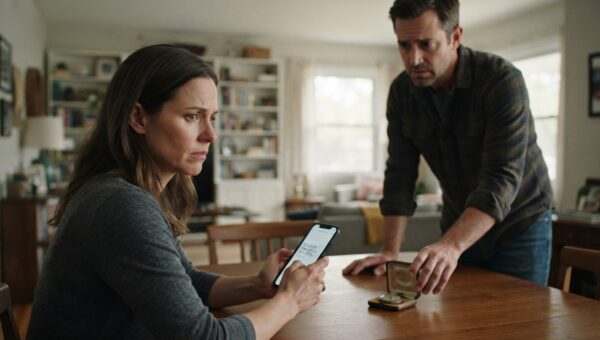
I pulled out my phone with trembling fingers. The screen lit up with the blue logo of our bank app. I hadn’t looked at the full statement ledger in months because Derek always handled the exports, telling me it was too complicated with our tax withholdings. But sitting there under Dad’s steady gaze, I tapped my thumb against the screen and logged in with my own passcode.
“Let’s just look,” I whispered, mostly to myself.
Three weeks later. No, that wasn’t right. This was right now, tonight, but the numbers stretching back over the last year felt like a blur of weeks stacking up. I tapped on the transaction history, expanding the date range back to last spring.
The numbers started scrolling. At first, they looked like ordinary grocery store trips and gas station stops. But as I scrolled faster, a pattern jumped out that made my breath catch in my throat. Every single month, within two hours of my $3,000 direct deposit hitting the account, an automatic wire transfer of $2,400 went out to an external routing number. The recipient name listed in the fine print was Evelyn Vance.
“Derek,” I said, my voice sounding far away to my own ears. “What is this?”
He didn’t answer. He just looked at the popcorn ceiling.
“Look at me,” I said, louder this time, the pharmacy weariness suddenly burning away into something hot and sharp. “What is twenty-four hundred dollars every month going to Evelyn for?”
“Her mortgage,” Derek spat out, finally dropping the casual act. He pushed off the counter and stepped toward the table. “She’s on a fixed income, Lily. Her social security doesn’t cover her property taxes and the upkeep on that house. If we don’t pay it, she loses it. She’s my mother.”
“And what about your daughter?” Dad asked, his voice shaking just a little with rage. He pointed a finger at the plastic cup of cereal on the table. “Does she get a fixed income for breakfast?”
“We manage!” Derek shouted, his face turning dark. “Lily agreed to pool our resources. We talked about this a year ago when Evelyn’s hip went bad.”
“We never talked about twenty-four hundred dollars,” I said, standing up so fast my chair scraped loudly against the floorboards. “You told me we were putting three hundred away for savings and the rest was going to electric and groceries. You lied to me every single month.”
“I didn’t lie, I just didn’t want to stress you out with the details!” Derek yelled back, slamming his hand down on the counter so hard the salt shaker bounced. “You’ve always been dramatic about money. If I told you every time my mother needed help, you’d throw a fit about your shoe budget.”
“My shoe budget?” I stared at him, the absurdity of it hitting me like cold water. I hadn’t bought a new pair of work shoes in two years. I wore cheap sneakers with worn-out soles that left my arches aching by noon. “I haven’t bought a pair of shoes since my baby shower.”
“You agreed to be a partner,” Derek muttered, crossing his arms again and looking away.
Dad stood up slowly, towering over Derek by a full head even at his age. He didn’t yell. He didn’t raise his hands. He just looked at his son-in-law with a cold, flat disappointment that seemed to shrink the room.
“You’re not a partner, son,” Dad said quietly. “You’re a parasite with a good-looking haircut.”
Derek bristled, his face twisting into an ugly sneer. “Oh, sure, listen to the old man. Go ahead, file for divorce, see how well you do paying the mortgage and daycare on a pharmacy tech salary by yourself.”
That threat hung in the air for a second, heavy and sharp. For months, that exact fear had kept my mouth shut. I was scared of being broke. I was scared of failing little Lily. But looking at the empty fridge and my father’s steady hands resting on the back of the chair, the fear suddenly evaporated into something much harder.
“I won’t have to pay it by myself,” I said, my voice steady for the first time all evening. “Because you won’t be living here anymore.”
Derek laughed, a short, barking sound that had no humor in it. “You’re kicking me out? Over a few bills?”
“You’re leaving tonight,” Dad said, stepping between Derek and me. “Or I can call the sheriff down from the county line and we can have a nice long chat about financial fraud and unauthorized wire transfers from a joint account. Take your pick.”
Derek stared at Dad’s face, looking for any sign of a bluff. He didn’t find one. Dad had spent forty years running a heavy equipment repair shop; he knew how to spot when someone was cornered.
The next morning, the sun came up pale and cold over the Columbus rooftops. Derek had packed two duffel bags of clothes around two in the morning and gone to stay with his mother across town, slamming the front door so hard it rattled the frame. The house was quiet. Too quiet. But for the first time in over a year, the air didn’t feel like it was pressing down on my chest.
Dad and I sat at the kitchen table before my morning shift. My phone sat between us, unlocked to the banking app. With Dad guiding my hand through the menu options, I navigated to the direct deposit settings, unlinked the old account entirely, and routed my upcoming paycheck straight to a brand-new credit union account down on Broad Street where Derek’s name wasn’t anywhere on the paperwork.
“You ready for this part?” Dad asked gently, handing me my car keys.
“I’m ready,” I said.
We drove down to the credit union right after breakfast, little Lily babbling happily in her car seat with a fresh box of crackers Dad had bought her at the 24-hour gas station down the road. Opening that account took twenty minutes and a signature from me alone. When the teller handed me the temporary debit card and the paperwork confirming the new deposit routing, my hands didn’t even shake.
That evening, Derek tried calling twice while I was at work, then sent a long, angry text about how Evelyn couldn’t buy groceries for the week because the automatic transfer had bounced. I read the message on my break, locked my phone, and slipped it back into my scrub pocket without replying. I didn’t need to explain anything anymore.
When I got home from my shift, the kitchen smelled like warm toast and fresh butter. Dad was standing by the refrigerator with a plastic grocery bag from the local market, pulling out gallon milk jugs, fresh fruit, and eggs in a cardboard carton. Little Lily was sitting at the little wooden table, coloring with green and yellow crayons on a piece of scrap paper.
I walked across the kitchen floor, took a carton of fresh milk from Dad’s hands, and placed it neatly onto the brightly lit shelf of our refrigerator. The motor hummed softly in the corner, steady and reliable. Dad looked over at me, a small, tired smile lines crinkling around his eyes, and handed me the last carton of eggs without a word.