The digital clock on the bedside table read 4:12 in the morning when Clara started crying again, and my back felt like somebody had taken a baseball bat to my lower spine. I pulled myself up off the mattress, my legs shaking under me from the sheer exhaustion of the last two weeks, and shuffled down the hallway toward the nursery.
My stitches were still pulling every time I took a breath, and the heavy fog of those nineteen hours of back labor in the hospital seemed like it was never going to clear out of my head. I picked Clara up out of her wooden bassinet, pressing her tiny, warm cheek against my shoulder, and whispered that everything was going to be fine even though my own chest felt tight and hollow.
Back then, I still thought we were a team. I still thought that when you marry someone and build a home together, the hard things get shared right down the middle like everything else.
The mail had come around noon that Tuesday, sliding through the brass slot in the front door with a dry snap against the hardwood. Mark had grabbed it on his way to his home office where he spent his days doing remote consulting work for a logistics firm, an office he could lock whenever the baby’s crying got too loud for his conference calls.
I had been sitting on the couch trying to nurse Clara, half-asleep and wearing the same gray sweatpants for three days straight, when he walked back out into the kitchen and dropped a thick square envelope right beside my coffee mug.
He didn’t say a word at first. He just stood there pouring himself a fresh cup of coffee from the pot I had brewed an hour earlier, his shirtsleeves neatly rolled up to his elbows.
“That came for you,” Mark said, nodding toward the envelope before taking a sip of his coffee.
I looked down at the heavy blue paper peeking out of the windowed seam. The bold black lettering across the top read St. Jude Regional Medical Center, Billing and Collections Division. Below that, typed in neat, merciless computer font, was my maiden name and my old address from before we got married, though my married surname had somehow been dropped off the second line entirely.
I pulled the stiff paper out, my thumb catching on the perforated edge, and my eyes locked immediately on the bottom right corner where the balance forward was printed in stark, unyielding ink.
$9,347.12.
I stared at the numbers until they started blurring together into a gray smudge. We had health insurance through Mark’s company, a policy he swore up and down was the gold standard when we signed up for it during open enrollment last November. I looked up at him, waiting for the exasperated sigh he usually gave whenever a utility bill ran ten dollars higher than expected, waiting for him to tell me he would call the insurance desk and sort out whatever clerical mess had misrouted the claim.
“Mark,” I said, my voice cracking from fatigue. “The insurance didn’t cover the delivery room stay. Or the epidural. They’re saying this whole chunk is out-of-network because the attending physician wasn’t on their preferred list.”
Mark didn’t look up from his coffee mug. He leaned his hip against the edge of the laminate counter and crossed his arms over his chest, the way he always did when he was about to explain why something was objectively my fault.
“Well, that’s unfortunate,” he said, his tone flat and administrative, like he was talking about a delayed shipment of office supplies. “You chose that hospital. I told you we should have looked at the clinic across town.”
“I was in active labor for nineteen hours, Mark,” I said, and I could feel the heat starting to rise up the back of my neck. “The ambulance didn’t give me a pamphlet to review on the way down Route 9. The doctor on duty was the one who delivered our daughter.”
He took another slow sip of his coffee. “Doesn’t change the paperwork. The intake form lists your name as the primary patient. They served YOU.”
I actually laughed for a second because I thought he was trying out some dry, terrible joke to break the tension of a sleep-deprived house. “You’re joking. Right? It’s our hospital bill. For our child.”
“I am not joking, Marcia,” he said, and his voice dropped into that cold, level register that always meant he had already closed the ledger in his head. “I already cover the mortgage, the utilities, and the grocery budget. Not to mention I’m the one paying the monthly premium for the health plan itself. I’m not paying nine thousand dollars out of pocket for a bill with your name on the top line. That’s your responsibility to figure out.”
The kitchen went dead quiet except for the low hum of the refrigerator in the corner. I stood there holding our two-week-old daughter against my chest, feeling her tiny chest rise and fall in a steady, innocent rhythm, while the man who had held my hand through the first three hours of contractions looked at me like I was a bad tenant behind on my rent.
“I gave birth to our daughter, not got a massage,” I said, and the words came out sharper than I intended, tasting like copper and old tears.
Mark just shrugged, a small, dismissive twitch of his shoulders that made my stomach turn over. “I’m not paying for that too. You wanted this baby just as much as I did. Figure it out.”
He turned around, walked back into his office, and clicked the heavy wooden door shut with a solid, final-sounding click.
The next few days passed in a blur of gray exhaustion and cold silence. Mark continued his routine down to the minute, waking up at seven, making his French press coffee, retreating to his office for eight hours of calls, and coming out at five to complain that dinner smelled too much like onion. He bought a pack of diapers and a tub of formula at the local grocery store on Thursday, tossing the plastic bags onto the kitchen table with a receipt on top, making sure I saw the exact total highlighted in yellow marker like he was auditing a government grant.
Every time I looked at that receipt, something inside me that had stayed soft and hopeful for five years of marriage just quietly dried up and turned to dust.
I didn’t argue with him anymore. There is a specific kind of exhaustion that comes from realizing arguing requires both people to care about the same reality, and Mark was living in a reality where his earnings were his personal capital and my maternity leave was just an extended vacation he was reluctantly subsidizing. I started spending my nursing sessions scrolling through our joint bank account statements on my phone while Clara dozed against my arm.
The numbers didn’t lie, even if Mark’s stories did. For the past three years since I had taken the partial-remote job at the county library, every dollar of my paycheck had gone straight into the joint account to cover our groceries, car insurance, and house repairs, while Mark’s substantially larger salary quietly built up a separate personal savings account at a credit union downtown that he never mentioned during dinner conversations. He had systematically walled off his own money the moment he knew I would be stepping away from my hours to have the baby, treating my temporary income drop like a personal insult against his net worth.
On a rainy Friday morning when my mother drove down from Manchester to watch Clara for two hours, I didn’t stay home to sleep the way I usually did. I put on my second-best pair of slacks, ran a brush through my hair for the first time in four days, and drove straight to the brick office building on the corner of 4th and Main where Miller & Associates handled family and financial law.
Mr. Miller was an older man with graying hair and glasses that kept sliding down his nose, and he listened to my story without interrupting once, tapping a yellow legal pad with a wooden pencil while I laid out the timeline of the hospital bill, the birth, and Mark’s precise wording about the intake forms.
“People get confused about medical debt during marriage in this state,” Mr. Miller said quietly, leaning back in his leather desk chair and looking at me with eyes that had seen forty years of domestic wreckage. “Your husband thinks that because his name wasn’t the primary signature on the line by the admitting clerk, he’s legally clean. But under state marital property statutes, medical expenses incurred for family care during the subsistence of a marriage are a joint obligation. Furthermore, deliberately attempting to force one spouse into default while retaining independent funds can cross the line from a domestic disagreement into financial abandonment.”
He slid a form across the desk toward me.
“You don’t have to pay that bill out of your maternity savings, Mrs. Vance,” he said. “And you certainly don’t have to take orders on how to finance a medical emergency from a man who thinks his family is a subsidiary.”
I walked out of that office into the misty Iowa rain feeling something I hadn’t felt since the contractions started nineteen hours before that hospital bed: steady ground beneath my boots.
Over the next week, I didn’t mention the bill to Mark. I let him believe he had won the argument, let him keep his smug, quiet routine where he acted like the patient landlord of a boarding house. He even made a point of mentioning at dinner on Wednesday that he had transferred fifty dollars into my personal account for household incidentals, adding with a patronizing little smile that I should try to make it stretch until the end of the month.
I smiled back, told him I would do my best, and thanked him like a dutiful Victorian wife.
The execution happened on a Thursday morning while Mark was deep in a three-hour strategy call with his regional managers. I had spent Tuesday evening with Mr. Miller’s paralegal signing three formal documents: a notice of joint marital liability filed directly with St. Jude Regional’s legal department, a formal request for wagegarnishment allocation on joint household debt, and a certified motion for temporary financial maintenance to cover postpartum healthcare costs under state family support statutes.
The process server didn’t go to Mark’s office downtown. He came straight to our front door at 10:15 in the morning, wearing a brown canvas jacket and carrying a thick leather folder that smelled faintly of damp wool and cold coffee.
When the doorbell rang, I was sitting at the kitchen table folding tiny cotton onesies while Clara slept peacefully in her swing. I walked over and opened the door before Mark could even emerge from his office down the hall.
“Delivery for Mark Vance,” the man said, holding out a clipboard.
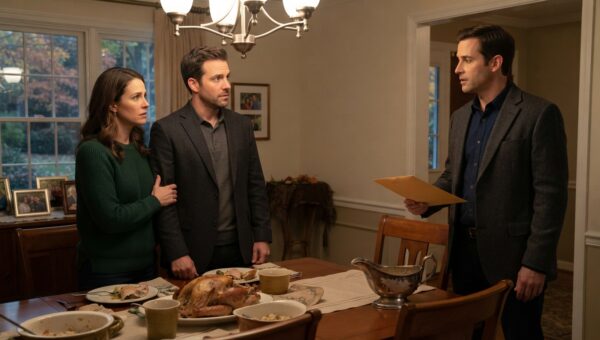
I signed my initials cleanly on the electronic pad, took the heavy manila envelope, and thanked him with a polite nod. As the front door clicked shut, Mark’s office door swung open and he stepped out into the hallway, looking annoyed that someone had interrupted his conference call.
“Who was that?” he asked, frowning as he buttoned the top button of his flannel shirt. “I told you not to sign for packages during my morning block.”
I didn’t answer right away. I walked back into the kitchen, sat down at the table, and laid the thick envelope right on top of the grocery receipt he had highlighted the week before.
Mark walked over, his eyes narrowing as he read the return address from the county courthouse legal services division. He picked it up, pulled out the stiff white papers, and his face went through three distinct changes in about four seconds: the annoyed employer look, the confused husband look, and finally the pale, wide-eyed stare of a man who realized the floor had just dropped out from under his feet.
“What is this?” he asked, his voice pitching up an octave higher than usual. “What did you do?”
“It’s a notice of joint marital debt allocation and a temporary maintenance filing,” I said, my voice completely level, not shaking at all. “Turns out under state law, a hospital bill from a childbirth isn’t a parking ticket. It belongs to both of us. And since you made it clear that you weren’t going to pay your half voluntarily, the court has elected to handle the transfer directly through your employer’s payroll department starting next cycle.”
Mark stared at the paper, his hands trembling slightly as he turned the second page over to look at the seal of the district court. “You went to a lawyer? You spent money on a lawyer over a medical bill?”
“I didn’t spend money out of my savings, Mark,” I said, looking right into his eyes for the first time in weeks without looking away. “The legal consultation fee was covered under the emergency household provision because of your refusal to provide basic postpartum care. And the nine thousand three hundred and forty-seven dollars? Your payroll department is going to split it fifty-fifty between our joint account and your separate credit union savings account by Friday afternoon.”
He slammed the papers down onto the kitchen table so hard that my coffee mug rattled against the wood. “You can’t do that! That’s my personal account! That money is for my investments, not for your medical bills!”
“It’s marital property earned during our marriage, Mark,” I said, standing up slowly from my chair so I was standing tall over him, the way he used to stand over me when he delivered his lectures about household budgets. “Just like our daughter is our joint responsibility. You wanted to run this house like a business where every expense is an invoice. Well, congratulations. The audit is complete.”
He stood there sputtering for a minute, looking for the right phrase, the right condescending line to put me back in my place, but the words didn’t come. The smugness had entirely drained out of his face, leaving him looking smaller than I had ever seen him, just a man standing in a kitchen holding a court notice he couldn’t talk his way out of.
“We need to talk about this,” he said, his voice dropping down to a shaky, defensive mumble. “We can’t just involve the courts over a disagreement. That’s insane.”
“We talked about it two weeks ago,” I said, walking past him toward the hallway to check on Clara, who was starting to stir in her swing. “You told me it was my problem because they served me. I just made sure they served both of us.”
That afternoon, Mark spent four hours in his office with the door shut, making frantic phone calls to someone he knew at a local firm, but by four o’clock I heard him come out, walk over to the kitchen counter, and pick up the second page of the court notice. He didn’t say another word about it for the rest of the evening, and he ate his dinner in total silence while I fed Clara in the rocking chair by the window.
The real shift didn’t happen overnight, but it happened right there on the kitchen counter where the old life ended. The next morning, sitting right beside the mail tray where the court confirmation letter had just arrived, was a newly opened separate bank account statement in my own name, showing the first direct transfer of my independent library salary and my half of the household reserve fund safely out of his reach. A signed financial agreement sat right on top of it, spelling out every dollar of shared responsibility in black and white, marking the exact boundary where my independence began and his financial tyranny finally stopped.