The notification on my phone came through while I was sitting in my truck outside the dry cleaners in Norfolk, just staring at the steering wheel and trying to adjust to being on dry land again. It was just a routine alert from the Navy credit union confirming that my monthly allotment had cleared into the joint account back home in West Virginia.
Six thousand dollars. Month after month, deployment after deployment, while I stood watch in the dark and missed every holiday on the ship. I always figured that money was keeping the roof over my parents’ heads, keeping my mother’s medicine cabinet full, and letting them live without the kind of constant, grinding worry about grocery prices that we grew up with.
I didn’t know yet that the account had been hollowed out for months. I didn’t know that my mother was living on saltines and church pantry handouts while my father drove around town in a brand new Ford F-150. That text notification was just the last normal thing I saw before the whole picture cracked wide open.
Driving up through the mountains toward home on Mother’s Day morning always felt like stepping back in time. The air up in Pendleton County had that damp, green smell of pine and wet shale, and the dogwoods were blooming along the two-lane roads.
I had a bouquet of hothouse carnations sitting on the passenger seat and a card with three months of back pay sitting in my sea bag in the trunk. I wanted to surprise them. My father didn’t know my ship had docked early, and my mother thought I wouldn’t be back until June.
When I pulled my car into the gravel driveway behind the house, the first thing that struck me wasn’t the scenery. It was the truck. It was a midnight-blue F-150 with chrome trim, sitting right there by the back porch like it owned the place. My father always drove a rusted-out Dodge Ram with a blown-out muffler that rattled the windows whenever he pulled in from the club. This truck looked like it rolled right off a showroom floor. I didn’t think much of it at first. Maybe he finally got a decent construction contract, I figured. Maybe things were turning around for them.
I killed the engine, grabbed the carnations, and walked up the three wooden steps to the back screen door. It was unlocked, just like it had been for thirty years. I stepped into the kitchen, expecting to hear my mother humming over the stove or the sound of the small radio she kept tuned to the local country station.
Instead, the kitchen was dead quiet. The air smelled stale, like cold grease and old newspapers.
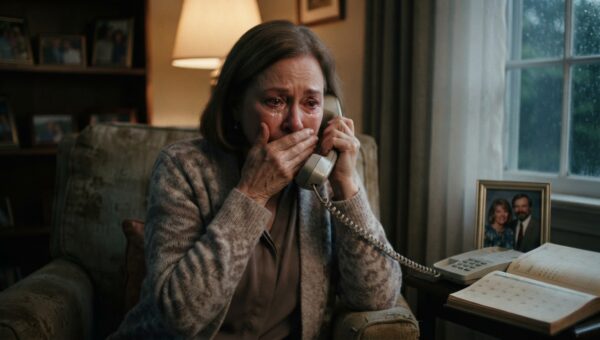
My mother was standing by the counter near the sink. The moment the screen door squeaked, she jumped like she’d been struck, her whole body jerking sideways in a frantic motion. I watched her shove something behind her hip, pressing it hard against the edge of the laminate counter. She was breathing through her mouth, her eyes wide and wet, staring at me as if a ghost had just walked through the wall.
“Hey, Mom,” I said, holding up the flowers. “Happy Mother’s Day.”
She didn’t reach for the flowers. She just kept her right arm pinned tight against her lower back, her fingers curled around whatever it was she was trying to hide. Her grey hair was pinned up sloppy, and the house dress she had on hung off her shoulders like she’d lost twenty pounds since I last saw her on leave.
“You’re home,” she whispered. Her voice sounded thin, like paper tearing. “You weren’t supposed to be home until June.”
“We pulled in early,” I said, taking a step toward her. “What’s that behind your back?”
She flinched, her chin trembling. She looked over her shoulder toward the hallway leading to the living room, listening for my father’s heavy boots. Then she leaned in close, her eyes darting around the empty kitchen.
“Don’t tell your father Mom is eating this,” she whispered, terrified.
She pulled her hand out from behind her back. In her palm was a dented, unlabelled silver tin with a grease-pencil mark across the top. A church charity pantry can of green beans. It hadn’t even been warmed up. She had been standing there by the cold stove, eating cold beans straight from the tin with a bent aluminum spoon.
I looked from the can in her hand to the counters. There was nothing else. No roast in the oven, no coffee perking, no sign of a holiday meal. Just a stack of past-due electric bills held down by a salt shaker and a yellow notice from the water department warning of shut-off by Tuesday.
“Mom,” I said, and my voice dropped flat. “Where’s the money?”
She looked down at the linoleum, her shoulders rounding inward as if she wanted to disappear into the floorboards. “Your father said… he said the Navy cut your pay. He said you got busted down in rank out there on the water. He said you couldn’t send anything anymore because you had gambling debts of your own to pay off in Norfolk.”
I stood there in the middle of that quiet kitchen, and my brain just stopped working for a second. Twelve thousand dollars a month for the last six months, and six thousand before that. Seventy-two thousand dollars total routed straight from my DFAS account into the joint checking account they shared at the bank down on Main Street.
“I never missed a month,” I said, and the words sounded small in the empty room. “Not one month. Every single payday.”
“He told me you stopped calling because you were ashamed,” she whispered, a single tear cutting a clean path down the flour dust on her cheek. “He said you forgot about us.”
That was the moment the slow poison of the last year stopped circulating in my veins and pooled right in my chest. I didn’t yell. I didn’t throw the carnations. I just set my duffel bag down by the back door and walked past her down the dark hallway toward my father’s home office.
The house felt different now. I noticed the details I had missed when I walked in. The thermostat in the hall was set to fifty-eight degrees, even though it was damp and raw outside. The rugs were threadbare, and the small porcelain figurine of the cardinal that my grandmother had left her was missing from the side table. Probably pawned to keep the lights on for another week.
My father’s office door was shut. I turned the brass knob. It gave way with a sharp click.
The room smelled like cheap pipe tobacco and stale beer. His roll-top desk was a disaster area of old sales flyers, empty cigarette packs, and scratch-off lottery tickets torn into little green confetti strips. But right there in the middle of the blotter sat a thick leather folder with the bank’s logo stamped in gold leaf.
I didn’t hesitate. I opened it.
Inside were the statements from the local bank going back twelve months. Every single direct deposit from my Navy pay showed up clear as day: six thousand dollars on the first and fifteenth. But right underneath those deposits were the withdrawals. Three thousand to the regional Ford dealership for the blue F-150 parked outside. Two thousand to the Riverboat Casino across the state line in Wheeling. Five hundred here, a thousand there, paid out to local guys whose names I recognized from the hardware store, men who ran the high-stakes poker games in the back of the pool hall.
There was a receipt for a high-end Benelli shotgun. There was a receipt for custom truck wheels. And right next to them were unopened final-notice letters from the propane company, marked with red ink.
I pulled my phone out of my pocket and brought up my Navy mobile banking app. I logged in, bypassed the security prompts with my thumbprint, and brought up the ledger of every allotment transfer for the past year. Seventy-two thousand dollars. Verified, cleared, and stolen.
“You shouldn’t be in here,” a voice said from the doorway.
I didn’t jump. I just turned around slowly.
My father was standing in the doorway, blocking the narrow exit. He had on a brand-new, bright orange fishing shirt with ventilated mesh vents across the back, clean khaki pants, and expensive leather loafers that looked like they cost more than my first car. He was holding a plastic bag of ice in one hand and a six-pack of imported beer in the other.
He took one look at my face, then looked down at the bank statements spread across his desk. The color didn’t drain from his face; instead, his jaw set hard, and his eyes narrowed into mean little slits.
“You’re home early,” he said, and his voice had that greasy, defensive tone he always used when he got caught doing something he shouldn’t have. “Always sneaking around. Never learned to knock.”
“Where is it?” I asked. My voice was lower than I intended, steady and flat, the way I talked when we were running drills in the engine room.
“Where’s what?” He tossed the bag of ice onto the corner of the bed in the guest room next door and leaned his shoulder against the doorframe, trying to look casual. “You got no right going through my private papers. That’s mail tampering.”
“Seventy-two thousand dollars,” I said, holding up the bank statement between two fingers. “Mom was eating cold charity beans in the kitchen while you were driving around in a sixty-thousand-dollar truck. You told her I cut them off.”
“Your mother talks too much,” he snapped, his face reddening. “She doesn’t understand how the world works. Prices are high. Inflation is killing people on fixed incomes. A man has to maintain his credit.”
“You bought a truck and played cards with my deployment pay.”
“I invested it!” he barked, pushing off the doorframe and stepping into the small room. “That truck gets me to my contracting jobs. It’s for the family. You think money grows on trees out there on that grey water? You think you’re the only one who works for a living?”
“You haven’t worked a framing job in three years,” I said. “Everyone in town knows you spend your afternoons at the pool hall.”
“You shut your mouth!” he shouted, taking another step forward, his chest puffed out the way it used to do when he wanted to intimidate me as a kid. “I raised you! I put a roof over your head! You owe me every dime of that back pay and more for the way you talk to me in my own house!”
I didn’t back up an inch. I stood my ground right there beside his messy desk, looking down at the man who had spent a year lying to a woman who still mended his socks by hand.
“The allotment was canceled ten minutes ago,” I said quietly.
He stopped dead in his tracks. The red in his face turned a sick, muddy purple. “What did you say?”
“I used my phone app while I was standing in the hallway,” I told him, holding the screen up so he could see the confirmation number glowing in the dim light. “The monthly transfer is stopped. Permanent block. And the truck? The loan is in your name alone, isn’t it? Because Mom’s credit was already ruined from the last time you bought something you couldn’t afford.”
He lunged forward then, his hand coming up to grab the papers out of my grip. “Give me that phone! Give me those statements!”
I didn’t move. I just caught his wrist before his fingers touched my hand, squeezing down with the kind of grip you learn when you have to haul heavy lines in a heavy sea. He stopped, gasping slightly, his eyes bulging as he realized the dynamic in the room had shifted permanently.
“You’re done,” I said, letting go of his arm and stepping past him into the hallway. “You’re going to pack what belongs to you, and you’re going to figure out how to pay your own truck note starting tomorrow morning. Because Mom is leaving with me right now.”
“She ain’t going nowhere!” he yelled down the hall behind me, his voice cracking with panic. “Evelyn! You tell him! You tell this ungrateful boy who’s keeping a roof over his head!”
I walked back into the kitchen. My mother was sitting at the little round table now, her hands folded in her lap, staring down at the empty tin of green beans. She looked up as I walked in, her eyes swimming with tears but her chin held a little higher than it had been ten minutes ago.
“Did you hear him, Mom?” I asked gently, kneeling down beside her chair so I was looking right into her face. “Do you want to stay here?”
She looked toward the hallway where my father was standing out of sight, muttering curses under his breath. Then she looked back at me, and the last thirty years of fear seemed to drop off her shoulders all at once.
“No,” she whispered. “I want to go home with you.”
“Let’s get your things,” I said.
We didn’t pack much. Most of what she owned fit into two faded floral suitcases that smelled faintly of mothballs and lavender. While she gathered her winter coat and her mother’s small photo albums, my father stood in the kitchen doorway, arms crossed over his new fishing shirt, watching us with a look of pure, venomous hatred.
“You’re cutting your own throat,” he muttered as I lifted the heavy suitcases toward the back door. “You think she can live without me? You think some Navy apartment is going to feel like home?”
I didn’t answer him. I didn’t waste another breath on him. I put the bags in the trunk of my car, walked back inside, and helped my mother down the wooden steps. She paused at the bottom, looking back at the midnight-blue truck sitting in the gravel drive, then at the peeling white paint of the porch pillars.
“The beans were really cold,” she said softly, almost to herself, as she settled into the passenger seat.
“I know, Mom,” I said, closing the door softly and walking around to the driver’s side. “You’re never eating cold beans again.”
We drove away down the gravel road without looking in the rearview mirror. Behind us, the house sat quiet and cold under the mountain sky, waiting for the first utility shut-off notice to arrive on Tuesday morning.
That evening, we sat together at the small wooden table in the sunny kitchen of the temporary apartment I rented near the base in Norfolk. There was no grand celebration, just a warm meal of fresh pork chops and sweet potatoes on clean plates, and the sound of the refrigerator humming quietly in the corner.
The unopened can of charity beans sat right there on the counter beside my sea bag, tucked away where I could see it every time I walked past. It wasn’t a trophy. It was just a reminder of what happens when you trust the wrong person with the things that matter most, and a promise that nobody in my family would ever be left starving in the dark again.