Why do we spend so much time believing the people who are supposed to protect us, even when our own bones are telling us a different story? I asked myself that question for twelve solid hours while my car tires hummed against the asphalt cutting through the desert toward home. Twelve months of ninety-hour workweeks on a rusted-out gray hull in the middle of nowhere, twelve months of salt spray biting my face and missing every holiday, all of it funneled straight into a joint account back in Tucson.
Six thousand dollars every single month. Seventy-two thousand dollars total. I figured my mother, Elena, was finally sleeping in an air-conditioned room instead of worrying about the electric bill, and I figured my father, Frank, was keeping his promise to look after her while my knees gave out from standing watch.
The digital dashboard clock read 10:42 in the morning when I pulled the sedan into the gravel drive of the old stucco ranch house. The desert air was already baking hot, smelling of creosote and dry dust, but the house looked dead quiet. No wind chimes. No radio playing old country hits from the porch. The front screen door hung slightly crooked on its bottom hinge, just like it had when I left for boot camp five years ago. I cut the ignition and grabbed the small canvas bag with her real gift inside, a silk scarf I bought at a port call in Valencia that cost more than two weeks of my grocery budget, just wanting to see her face light up without any of Frank’s complaining hanging over her.
I didn’t knock. I just turned the brass handle and walked right into the dim hallway that always smelled faintly of old coffee and bleach. The house was too quiet, the kind of heavy, hollow quiet that usually means someone is hiding or hurting. I walked back toward the kitchen, my boots clicking softly on the worn linoleum tiles, and stopped dead right at the threshold because of what I saw by the pantry.
My mother was standing there with her back half turned to me, wearing that faded blue cotton house dress she’d had since I was twelve. Her shoulders were curved inward like a question mark, thin enough that you could count every vertebra through the cloth. She was frantically trying to shove something behind her hip against the side of the wooden cabinet.
“Don’t tell your father Mom is eating this,” she whispered, terrified. Her voice sounded like dry paper scraping across pavement, and her eyes were wide and bloodshot, fixed on me with a raw panic that didn’t make any sense at all.
I took two steps forward before my brain could even process the metal cylinder in her trembling hand. It was a cold can of generic pork and beans with a stamped church pantry label stuck right over the faded paper brand. No opener used; she had peeled the rusted pull-tab back halfway with her bare thumbnail, and a little gray grease had dried around the rim. The refrigerator hummed a low, tired buzz from across the room, and when I walked over to pull the heavy white door open, the inside light flickered on to reveal half a stale package of saltine crackers, a withered lime, and absolutely nothing else. No milk. No eggs. No meat. Just empty wire shelves collecting dust.
“Mom,” I said, and my own voice sounded small, like a stranger’s voice echoing in a cave. “Where is the food? Where is the money I sent home every month?”
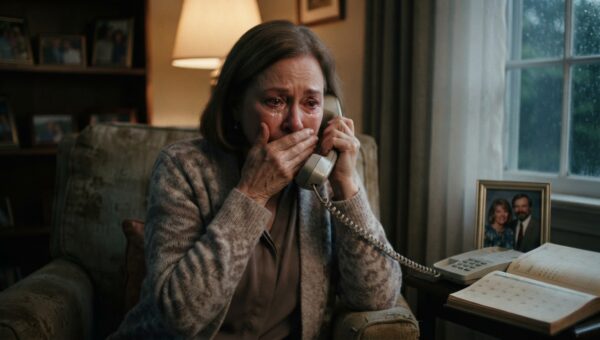
She dropped the can onto the counter, where it clattered against the tile with a dull, heavy ring, and she started crying without making a single sound. Her hands came up to cover her face, shaking so badly her wedding ring nearly slipped off her bony finger. She kept whispering that she didn’t mean to be a burden, that the military had cut my pay because of some disciplinary trouble Frank told her about, and that I had stopped calling because I was ashamed of them. She told me she had to walk down to the First Presbyterian basement every Tuesday morning with a canvas sack just so she wouldn’t faint while sweeping the back porch.
Every word she spoke hit my chest like a physical blow. The Navy hadn’t cut a single dime. My base pay plus sea pay had hit that credit union routing number without missing a beat for three hundred and sixty-five days. Seventy-two thousand dollars. Enough to buy a decent used car outright, enough to keep the pantry stocked with ribeyes and fresh fruit for ten years.
I left her sitting at the laminate table with a glass of tap water and walked straight down the narrow hall to Frank’s home office. That room was always locked when I was growing up, a sacred space where nobody was allowed to track in dirt or touch his leather-bound ledgers. The door was unlocked this time, swinging open an inch on squeaking hinges as if inviting me in to see the wreck.
The room smelled of expensive pipe tobacco and leather armor oil, a sharp contrast to the stale air in the rest of the house. On the heavy oak desk sat a brand new iPad still in its shiny plastic wrapper, a stack of glossy mail-order catalogs for high-end fishing gear, and a leather folder stamped with a local dealership logo. I didn’t hesitate. I pulled open the top desk drawer, shoving aside a pile of empty lottery scratchers, and found what I was looking for: the physical paper statements from our credit union, neatly stacked in date order.
I opened the folder and ran my thumb down the columns of numbers, feeling my pulse hammer in my ears like a drumbeat. There they were, twelve consecutive lines of direct deposit credits, exactly six thousand dollars appearing on the first of every single month. And right beneath them, the outgoing debits that explained where every penny had vanished. Thirty-two hundred dollars a month going straight to an auto finance company for a 2024 Ford F-150 four-by-four. Two thousand to an online sportsbook registered out of Curacao. The rest eaten up by boutique tackle shops, golf club dues at the country club across town, and bar tabs downtown.
Tucked inside the back pocket of the folder was a handwritten notepad in Frank’s neat, looping script, drafting lies to feed my mother about why the pantry was empty and why my letters never arrived. He had engineered her starvation with the casual cruelty of someone balancing a checkbook.
I didn’t yell. I didn’t throw anything against the wall. I pulled my government-issued smartphone out of my pocket, my fingers moving with the cold, mechanical precision I learned during damage control drills in the engine room. I opened the military finance portal first, authenticating with my biometrics, and severed the direct deposit allotment with three taps on the glass. Then I opened the joint banking app, bypassed the two-factor security using my own recovery credentials, and transferred every remaining dollar of the liquid balance into a clean, individual account under my own name.
That left him with thirty-two dollars and forty-six cents.
I walked back out to the kitchen, where my mother was still staring blankly at the saltine crackers on the table. “Get your coat, Mom,” I said, keeping my voice level because if I let the anger out now, I knew I wouldn’t be able to steer it. “We’re leaving right now.”
“He’ll be back from the tackle shop soon,” she whispered, looking toward the front window like she expected the glass to break. “He said he has to check the lines at the lake.”
“Let him check whatever he wants,” I said, already lifting her small nylon suitcase down from the top of the hall closet and tossing in her few decent sweaters, her medicine bottles, and the old family photo album from the sideboard.
We were standing in the front entryway with her bags by the screen door when the low, throaty rumble of a heavy V8 engine rattled the windowpanes. A brand new midnight-blue Ford F-150 pulled into the gravel drive, kicking up a white cloud of dust that settled thick over the unwatered lawn. The truck stopped right behind my sedan, blocking me in, and the driver’s door swung open with a crisp, expensive click.
Frank stepped down onto the gravel wearing a brand new moisture-wicking fishing shirt with the tags still tucked into the collar pocket, swinging a fiberglass rod case in his right hand. He looked fifty pounds heavier than he had three years ago, his belly pressing against his belt like a water balloon, his face flushed red from the sun and cheap beer. He stopped walking when he saw my car parked by the front steps, and a slow, greasy grin spread across his wide mouth.
“Well, look who decided to grace us with his presence,” Frank called out, slamming the truck door shut with unnecessary force. “Thought you were still stuck on some rusty bucket in the Atlantic. Your mother didn’t even tell me you were driving down.”
He walked up the wooden porch steps, smelling strongly of sunscreen and stale IPA, and reached out a hand like nothing on earth was wrong. I didn’t take it. I just reached into my pocket, pulled out the printed bank statements, and tossed them hard onto the porch deck right at his feet. They fanned out across the dusty wood like a dead hand of cards, showing the loan payoff schedule, the sportsbook wire transfers, and the zeroed-out balance.
Frank’s grin didn’t vanish all at once; it kind of cracked, sliding sideways like melting butter. He glanced down at the papers, then back up at my face, his eyes narrowing into small, hard slits.
“What is this nonsense?” he demanded, his voice rising into that sharp, bullying register I used to hide from under the kitchen table when I was eight years old. “You coming into my house acting like you own the place? Checking up on how I manage things while you’re off playing sailor?”
“It’s not your house, Frank,” I said, my voice dropping so low he had to step closer to hear it. “And you aren’t managing anything anymore. The allotment is dead. The account is drained. And the truck payment is due in four days with thirty-two dollars in the bank to cover it.”
He lunged forward, his face turning the color of a bruised plum, raising his hand like he was going to shove my shoulder the way he used to do when I talked back. “You little bastard! You don’t get to pull that, “
I didn’t flinch. I just reached behind me, picked up the cold, half-opened can of church charity beans off the small side table where I’d set it down, and slammed it right onto the hood of his brand new truck with a wet, metallic clang that left a deep, ugly dent in the blue paint.
“She was eating that out of a charity box while you were buying sports cars and fishing gear,” I told him, every word coming out cold and flat as steel. “You lied to her for twelve months, you starved her in her own kitchen, and you thought you could ride my paycheck straight into retirement.”
Frank froze, his hand still hovering in mid-air, his mouth opening and closing once or twice like a fish tossed onto a dry dock. For the first time since I was a kid, I saw real fear in his eyes, not the kind of anger that comes from power, but the cold, sweating panic of a man who suddenly realizes the floorboards have rotted away beneath his feet. He looked from the dent in his new truck hood to the printed statements on the porch, and then past my shoulder to where my mother was standing in the doorway with her bag in her hand, looking at him with something that wasn’t even anger anymore, just a heavy, quiet emptiness.
“Elena,” Frank stammered, taking a half-step toward the door, his voice suddenly sounding thin and pathetic. “Elena, don’t listen to him, he’s lying, the boy always exaggerates, “
“Shut up, Frank,” my mother said. It was the loudest, clearest sentence I had heard her speak all morning.
She walked past him without even brushing his sleeve, her head held up higher than I had seen it in ten years, and climbed into the passenger seat of my car while I held the door for her. I picked up her small suitcase, put it in the trunk right beside the empty gas cans, and got in behind the wheel without looking back at him once.
As I backed the sedan out of the drive, crushing the loose gravel beneath the tires, Frank was still standing by the front steps with his hands out by his sides, staring down at the dented hood of his truck and the cold can of beans sitting right in the middle of it. We didn’t talk for the first twenty miles out of town, just watching the flat desert scrub blur past the side windows under a blinding noon sky.
By late afternoon, we pulled off the highway at a quiet, red-roofed diner outside of town where the waitress knew my name and the coffee always tasted like it had been brewed in an old tin pot three hours ago. We sat in a corner booth by the window where the air conditioning blew cool against our necks, watching the highway trucks rumble south toward the border.
My mother sat quietly with both hands wrapped around a heavy ceramic mug of hot soup, her fingers finally warm, watching the road ahead through the clean glass while the cold charity can stayed a hundred miles behind us on Frank’s driveway.