The morning coffee always took four minutes in the old percolator on the back burner. I stood there by the porcelain sink, watching the dark brown liquid climb the little glass knob on top, listening to the steady chug-chug-chug that had measured out every Tuesday and Thursday of my retirement. Arthur was still out in the garage sorting through some old copper pipe he salvaged from the church basement job.
It was quiet. It was the kind of quiet I had spent fifty-six years building around myself like a dry-stone wall.
I didn’t think about 1969 much anymore. You learn how to put things in boxes in the back of your mind and nail the lids down so tight you forget there was ever anything inside them to begin with. Fairhaven was just a word on a birth certificate I never had to look at. My father made sure of that. When he drove me up that long gravel drive in March of that year, his jaw was set so hard I thought his teeth would crack. He told me I had disgraced his name and ruined my sisters’ chances in town. He told me the paper he shoved in front of me on a metal-legged table was the only clean way out.
I signed my name with a ballpoint pen that skipped on the third letter.
They took her away before they even wheeled me back to the ward. I only had twenty seconds, maybe thirty, while the nurse turned her back to check a chart on the wall. I reached into my canvas bag and pulled out the little flannel square I had stitched in the dark during my third month, before anyone in the parish noticed the swell of my coat. The red embroidery floss was cheap and split at the ends, and the letter M I tried to make for Mary came out lopsided, the left leg leaning over like a fence post in a high wind. I tucked it deep into the folds of the hospital blanket right under her chin.
Fifty-six years went by in a blur of small towns, garden clubs, church suppers, and Arthur. Arthur was a good man, steady as an old oak desk, who loved me without ever asking what I was hiding in the shadows.
I told myself that was enough. I told myself that digging up a grave only stirs the dust and blinds you to the light that’s left.
Then came Tuesday. The library downtown always smells like floor wax and old paperbacks, a comforting, harmless sort of smell where nothing bad ever happens. I went in to return a biography of Eleanor Roosevelt and pick up my large-print mystery. The community board by the drinking fountain was mostly cluttered with notices for church rummage sales, lawn mowing services, and lost tabby cats.
One index card caught my eye because it wasn’t typed on a machine like the others. It was done on an old manual typewriter with a ribbon that needed changing, the letters faded and heavy around the edges.
“Looking for any information regarding a female infant born at Fairhaven Maternity Home in April 1969,” it said. “Adoptive parents kept only one item left in her basket.
A homemade flannel bib with an embroidered letter M. If you were there, or if you know anything, please call.”
The paper blurred instantly. My knees went weak and I had to grab hold of the wooden frame of the corkboard just to keep from sliding down onto the linoleum. My heart didn’t race; it just stopped dead, the way an engine seizes up when you pour sand in the oil. Fifty-six years of nailed-down lids popped open all at once, and the smell of carbolic acid and cold iron from Fairhaven rushed back into my lungs.
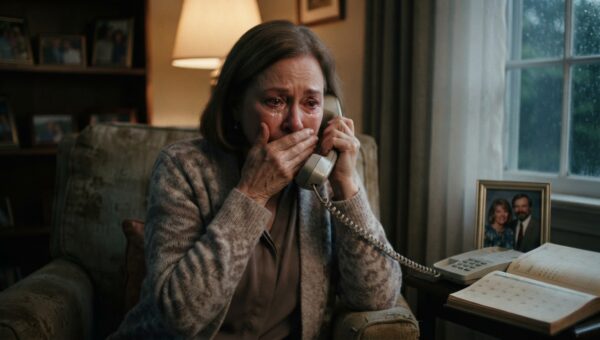
I didn’t wait until I got home to the kitchen phone. I stood right there by the water fountain with people walking past me to the children’s section, punching the numbers into my little flip phone with a thumb that wouldn’t stop shaking. It rang twice before someone picked up.
“Hello?” a woman’s voice answered. It wasn’t sharp or demanding. It was soft, hesitant, worn down by years of quiet wondering.
“I saw the card,” I managed to say. My throat felt like it was lined with dry sand. “At the library.”
There was a long, terrible silence on the other end of the line. Nobody said anything for a second, and honestly that felt worse than shouting.
“Are you still there?” she asked, and her voice cracked just a little bit. “I’ve waited my whole life to hear someone answer that specific board.”
We talked for twenty minutes right there in the middle of the library aisle. She told me her name was Margaret. Her adoptive parents, a carpenter and his wife from three counties over, had given her that name because they found the crooked M stitched into the flannel and figured it was a sign from whatever mother had left her behind. They loved her fiercely, she said. They gave her a good, honest home with a tire swing in the yard and apple trees that dropped fruit every September. They told her the truth about being adopted the day she was old enough to understand what it meant. But when they passed away within a year of each other, the silence around her real beginnings became too heavy to carry alone.
“I can drive out this Saturday,” Margaret said. “If you’re willing. I don’t want to disrupt anything. I just need to know whose eyes I have.”
“Come,” I told her. “Saturday morning. Ten o’clock.”
The rest of that week passed like I was moving underwater. I didn’t tell Arthur. Every time I looked at him across the kitchen table while he buttered his toast or read the farm report, the words sat right behind my teeth, but I couldn’t push them out. What if he looked at me differently? What if fifty years of being his respectable wife dissolved the minute he found out about the girl in 1969? I kept quiet, and that quiet tasted like iron.
Saturday morning broke gray and heavy with a light drizzle tapping against the kitchen windows. Arthur had already driven down to the hardware store for a box of galvanized nails, which gave me an hour of breathing room. I cleaned the counters twice. I made a fresh pot of coffee. I stood by the front screen door watching the gravel driveway through the screen wire, wiping my palms against the sides of my apron over and over again.
At exactly 10:02, a dusty blue sedan turned off the county road and bumped up our long lane. It parked right by the old lilac bushes.
The car door creaked open, and a woman stepped out into the damp morning air. She had my mother’s nose, that little stubborn bridge of bone right between the eyes, and when she turned her head to look up at the porch, she moved her chin the exact same way I did when I was angry. She wore a simple blue raincoat and carried a canvas tote bag by the straps.
I pushed the screen door open and walked out onto the wooden planks. The dampness hit my face, but I didn’t care. Margaret walked up the three porch steps, stopping just a foot away from me. We didn’t shake hands. We didn’t even say hello. She just dropped the canvas bag on the porch bench, opened her arms wide, and folded herself into mine.
She felt solid. She felt like real life instead of a ghost story. Her shoulder pressed against mine, and I could smell lavender soap and wet wool.
“You came,” I whispered into her hair.
“I told you I waited my whole life,” she answered against my neck.
We went inside the kitchen, the air warm and smelling faintly of the coffee I had brewed an hour earlier. Margaret didn’t look around at the cabinets or the framed pictures on the wall; her eyes went straight to the center of the table where I had cleared a space. She unzipped her tote bag and pulled out a flat, clear plastic sleeve. Inside was something yellowed with age, folded square and tight, the cotton fibers thinned almost to gauze where the years had rubbed them.
She laid it down on the laminate table between us. Then, with fingers that trembled just as much as mine, she reached out and turned back the corner of the cloth.
There it was.
The red thread had darkened from scarlet to a deep, bruised rust color over five decades, but the shape was unmistakable. The crooked little M, with its left leg leaning over sideways like a drunken post, sat right there in the corner of the flannel square.
“They kept it in my baby box,” Margaret said softly, her finger tracing the edge of the fabric without touching it. “Every time I had a bad day growing up, I’d go into my closet, open that tin box, and touch this stitch. It was the only proof I had that someone didn’t just throw me away.”
“I didn’t want to let you go,” I said, and the words came out raw and ugly, the way they had been buried inside me since the spring of sixty-nine. “My father stood over that table. He told me if I didn’t sign, I wouldn’t have a roof over my head. I was seventeen years old and I was terrified of him.”
“I know,” she said. She reached across the table and laid her hand right over mine. Her skin was warm, calloused on the pads of her fingers from gardening or sewing, just like mine. “My adoptive dad told me a long time ago. He said whoever stitched that letter poured every ounce of love they had into those few threads because they knew they couldn’t stay. He was right, wasn’t he?”
I looked down at the bib, then down at the reverse side where the clumsy double-knot sat right where I had tied it with shaking teeth in the hospital nursery while the nurse’s back was turned. I had never shown that knot to a living soul.
“Turn it over,” I whispered.
Margaret lifted the fabric carefully. On the back, right in the corner, was the ugly, bunched-up knot of red thread where I had run out of patience and yanked the floss too hard.
She let out a long, shuddering breath that sounded like a sighing wind through the porch screens. “I wondered about that knot for forty years,” she said. “I thought it was just a mistake.”
“It was a mistake,” I said, and for the first time in fifty-six years, I laughed through the burn behind my eyes. “I wasn’t ever any good at needlework.”
We sat there at that kitchen table for two hours, talking about her adoptive parents, about the farm they grew up on, about her own children who were grown now and living out west. She told me she worked as a school librarian, which made me smile so hard my cheeks ached. She had spent her whole life surrounded by books, the very place where her notice finally found me.
Around noon, the gravel crunch in the lane signaled Arthur’s truck coming back from the hardware store.
The sound of the engine cut off outside. Car doors slammed. Heavy boots scraped against the scraper on the bottom step.
Margaret stiffened slightly, looking toward the door. “Should I leave? I don’t want to cause trouble with your husband.”
“No,” I said. I stood up from the kitchen table, my knees popping the way they always did after sitting too long. I walked over to the back door just as Arthur’s hand rattled the brass knob. “Fifty-six years is enough hiding. It’s time the house let some light in.”
Arthur pushed the door open carrying a brown paper bag from the supply store, smelling of galvanized iron and pipe dope. He stopped dead in the entryway when he saw Margaret sitting at the kitchen table with the yellowed piece of flannel spread out before her. He looked from her face to mine, taking in the red rims of our eyes, the open space between us, and the small square of cloth with its crooked red letter.
He didn’t drop his bag. Arthur was never a dramatic man. He just set the brown paper package down on the counter beside the coffee maker very carefully, as if it were made of glass.
“Who’s this, Martha?” he asked, his voice low and steady.
“This is Margaret,” I said, and I walked over to take his rough, grease-stained hand in mine, feeling the calluses I had known for forty years. “She’s my daughter. Born in sixty-nine. And she came home.”
Arthur looked at Margaret for a long moment. He didn’t shout. He didn’t ask questions or demand explanations about how I had kept such a thing from him all our lives. He just looked at her eyes, then looked back at me, and his face softened into that quiet, deep gentleness that made me fall in love with him back when Reagan was just an actor in the movies.
“Well,” Arthur said, clearing his throat and reaching out to shake Margaret’s hand across the table. “Put another cup in the cupboard, Martha. We’ve got a lot of catching up to do.”
The yellowed flannel bib rested in the center of the sunlit kitchen table between three coffee cups, its crooked red letter M no longer hidden in a locked memory, but sitting openly in the daylight.