The laminate kitchen counter in my house has a small burn mark near the toaster where Don dropped a hot skillet back in nineteen-ninety-four, and for twenty minutes I just stared at that black circle while my fingers traced the edge of a white plastic room key.
The keycard was tucked squarely behind a heavy cream-colored card that read Save the Date for an event happening fifty miles away in June.
For three months Don had been slipping out of the house every Thursday morning wearing a pressed shirt and a spicy cedar cologne that didn’t belong to any bottle in our bathroom.
十四 hundred dollars had quietly drained out of our joint savings account in three separate withdrawals that I only noticed when the quarterly statement arrived with the Tuesday mail.
I already had the divorce papers sitting in a manila folder inside my car trunk, printed off the internet on a Tuesday afternoon when the house was too quiet and my chest felt tight with a familiar, bitter certainty.
I didn’t yell when Don walked through the back door at 5:15 that evening with his sleeves rolled up to his elbows and mud on the toes of his work boots.
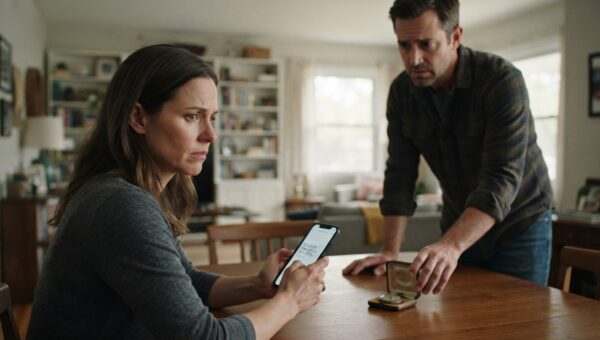
I just slid the white plastic keycard across the scarred wood between us and asked him who she was.
Don didn’t flinch, didn’t turn pale, and didn’t look away toward the hallway the way a guilty man always does in the television movies.
He just pulled his phone from his front pocket, tapped the screen twice with a thumb that had a small grease stain near the knuckle, and hit the speaker button on a saved voicemail.
A young woman’s voice, bright and a little raspy the way it always used to sound when she was tired, filled the quiet room.
“Tell Mom I’ll save her a seat,” the voicemail said.
My hands went entirely still in my lap, the blood rushing in my ears so loud I could barely catch my breath.
Don set his keys down on the counter with a dry click and looked straight into my eyes.
“It’s Jenna,” he said. “She called me back in March. She’s marrying in June, and she wants you there.
I was trying to figure out how to tell you without you saying.”
The kitchen seemed to tilt on its axis for a second, the old floral curtains by the sink blurring into gray shapes while my brain tried to catch up to a name I hadn’t allowed myself to speak out loud in five years.
Jenna was twenty-eight now, living somewhere across the state line, carrying the stubborn set of my own jaw that I had spent years resenting in the mirror.
Five years earlier, our house had torn itself apart in forty-eight minutes of shouting over college choices, unspoken grief, and words thrown like gravel that neither of us ever knew how to sweep back up.
When Jenna walked out that front door with two duffel bags and her car packed to the roof, she didn’t look back, and I spent the first two years waiting for an apology that never came until my pride hardened like concrete around the empty bedroom upstairs.
Don watched me carefully, his hands resting on the edge of the counter the way he used to hold the steering wheel on long drives when the weather turned bad.
“She didn’t know how to reach you,” Don said softly. “She was terrified you’d hang up on her. So she called my cell at the lumber yard.”
I sat there at the kitchen table with my fingers still touching the hotel keycard, feeling the small plastic ridge under my nail.
“You’ve been meeting her,” I whispered, the words tasting dry and strange in my mouth. “Every Thursday for three months.”
“Every Thursday,” Don nodded. “Ninety miles each way. We met at the quiet hotel conference lounge off the interstate because her office is right down the block. We had coffee. We talked about her job, about Mark, about the wedding plans. And yeah, I helped her with the venue deposit because starting out is hard.”
I remembered the fourteen hundred dollars from the bank statement, the number I had spent two days turning over in my head like a sharp pebble in my shoe.
“The money,” I said.
“Bridal boutique deposit,” Don said simply. “She tried to pay me back three times. I told her to buy herself something nice instead.”
The cedar cologne hung in the air between us, suddenly stripped of all the ugly stories I had spent three weeks inventing in my head to keep myself safe from the truth.
“She gave it to me on Father’s Day,” Don said, touching his collar where the scent still lingered faintly. ” She remembered I liked cedar. She asked about you every single week, Martha. Every single week she asked if you looked at old pictures, if you still had her room the same way.”
I didn’t answer because my throat had tightened up so hard I couldn’t get a sound past my teeth, and the silence in the kitchen felt heavier than any argument we had ever had in thirty-two years of marriage.
I thought about the manila folder sitting out in the trunk of my sedan under a pile of grocery bags, full of court-ready forms and financial disclosures that were supposed to be my armor against a lonely old age.
“Why didn’t you tell me in March?” I finally asked, my voice cracking on the last word. “Why keep it from me?”
Don walked around the table, his boots heavy on the linoleum, and pulled out the chair right beside mine instead of sitting across from me as an adversary.
“Because if I came home in March and said Jenna wants to talk, you would have put your chin up and walked into the laundry room,” Don said gently. “You needed time to get tired of being angry, Martha.
And Jenna needed time to feel like she was building something real before she faced the door.”
He reached out and picked up the Save the Date card, turning it over to show the handwritten note scribbled on the back in blue ink.
“She’s scared of you,” Don said, and the plainness of it hurt worse than any insult. “She’s twenty-eight years old and running her own design shop, but she’s still terrified her mother won’t want her at her own wedding.”
I looked down at my own hands, at the wedding band that had grown slightly loose on my knuckle over the last few winters.
“She has my temper,” I muttered, almost to myself.
“She has both of ours,” Don corrected, his hand coming down to cover mine on the cold wood. “Which means she’s waiting for you to make the first real move.”
The house stayed quiet for a long time, the refrigerator humming in the corner and the evening light turning a deep, bruised purple outside the dining room window.
I stood up from the table without saying another word, walked out through the back utility room into the garage, and opened the trunk of my car in the cool dusk air.
The manila folder was right where I left it beneath a spare gallon of windshield wiper fluid.
I pulled it out, brought it back inside under the bright overhead light of the kitchen, and tore the papers across the middle once, twice, and a third time until the edges were ragged and small.
Don didn’t watch me do it; he was standing by the stove turning on the burner to heat up yesterday’s pot of vegetable soup, moving with the slow, steady rhythm of a man who knew how to wait out a storm.
“Give me her number,” I said, dropping the torn pieces into the metal trash can by the sink.
Don reached into his shirt pocket, pulled out a small notepad with a torn corner, and set it beside the coffee maker without a word.
The phone felt heavy in my hand when I punched the ten digits into the keypad at 7:14 in the evening, the screen glowing bright against the darkening room.
It rang three times, four times, and on the fifth ring a voice answered with a quick, nervous breath that sounded so much like my own that I had to close my eyes.
“Hello?” Jenna said.
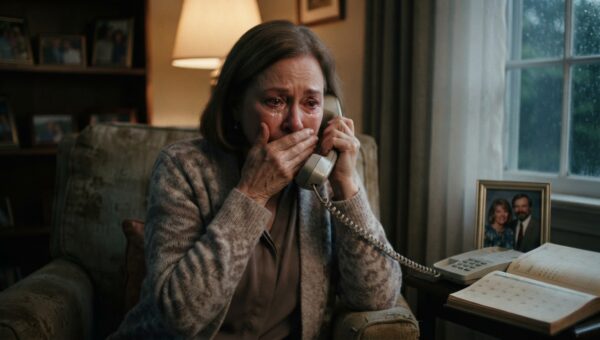
“Jenna,” I said, and my voice didn’t sound like mine at all; it sounded small and old, like a stranger borrowing my throat.
The line went completely dead quiet on the other end, no music, no traffic, just the sound of breathing across fifty miles of telephone wire.
“Mom?” she whispered.
“Your dad told me about the wedding,” I said, leaning my forehead against the cool kitchen wall near the calendar. “He says you’re getting married in June.”
“I am,” Jenna said, and I could hear the sudden, sharp catch in her breath before the tears broke through. “I am, Mom. We’re getting married outside in the garden near the lake. There’s… there’s a seat right up front.”
“I know,” I said, wiping my cheek with the back of my hand. “Your dad brought home the card.”
We stayed on the phone for forty-two minutes, talking about nothing and everything, about the weather in her town, about the shade of blue she picked out for the bridesmaids’ dresses, about how she still used my grandmother’s biscuit recipe on Sunday mornings.
When we finally hung up, the kitchen was dark except for the stove light, and Don was sitting at the table with two mugs of black coffee steaming in front of him.
“She wants us to come down Saturday,” Don said, blowing softly across the surface of his mug. “She wants to take us to that little diner by the hardware store where the pie is decent.”
“Saturday is fine,” I said, pulling out my chair and sitting back down in the exact same spot where I had dropped the hotel keycard an hour earlier.
The following Saturday the highway outside Wichita was clear and bright, the spring grass along the ditches shining a sharp, brilliant green after a week of steady rain.
Don drove the truck with one hand on the wheel while the radio played an old country station we used to listen to back when Jenna was still small enough to sleep across the back seat on trips to her aunt’s house.
When we pulled into the gravel lot of the diner, Jenna was already standing by the screen door in a yellow linen dress with her hair pulled back into a simple clip, shading her eyes against the midday sun.
She looked older than the girl who walked out our front door with two duffel bags, her shoulders broader and her expression carrying that same mixture of pride and terror that I had seen in my own mirror every morning for five years.
I got out of the passenger side before Don could even kill the engine, my boots crunching on the loose gravel as I crossed the open space between us.
Jenna stopped three feet away, her hands clasped tightly in front of her dress, her lips trembling just enough to show she was trying to hold herself together.
I didn’t wait for her to move, and I didn’t care who was watching from behind the diner’s front windows.
I stepped into the gap between us and pulled her into my arms, burying my face in her shoulder where she smelled faintly of vanilla and the same cedar soap Don used in the bathroom.
“You’re late,” Jenna whispered into my hair, her voice breaking completely against my collar.
“Traffic was bad,” I said, holding her tighter than I had held anything in five years.
Three weeks later the sun was hitting the white folding chairs of the garden chapel just past noon, warming the grass and turning the lake behind the altar into a sheet of hammered silver.
I sat in the front-row aisle seat with my hands folded in my lap over a lightweight navy dress that Don told me made my eyes look green.
Don sat right beside me in his charcoal suit, his shoulder warm against mine, his fingers resting casually over the back of the wooden pew.
Resting on the small empty chair beside my bouquet was a small white card written in Jenna’s neat, familiar handwriting, propped up against a sprig of white baby’s breath.
It had two words written on it in black ink that didn’t need any explanation at all.
Saved for Mom.
I reached out and let my hand slip into Don’s palm, feeling the familiar calluses on his fingers as the first notes of the processional music drifted out across the grass from the hidden speakers.