The air down in Arthur’s basement always smelled like damp cedar and old tobacco, even three days after we brought him back from the chapel. My husband, Gary, and his two brothers, Jered and Lyle, had already spent the entire morning arguing over who was getting the riding mower and which one of them had first dibs on the chest freezer in the pantry.
Arthur was ninety-one when his heart finally gave out in his sleep, leaving behind a neat little estate that looked straightforward on paper. There was the brick ranch house on Elm Street appraised at $420,000 and a savings account holding $180,000, split three ways without a single argument between the brothers. They were patting themselves on the back by noon, talking about how smoothly everything went, and how grateful they were that the old man kept his paperwork so organized.
I stayed behind in the house after the brothers drove into town for lunch, mostly because the stale air upstairs was getting to me and I wanted to clear out the pantry shelves before the estate sale company came next Tuesday. Arthur’s workbench sat in the far corner of the basement, buried under decades of sawdust, yellowed issues of Popular Mechanics, and coffee cans filled with rusted drywall screws. I was sweeping up a pile of wood shavings near the old oil-fired furnace when my boot hit something solid beneath the plywood subfloor.
I crouched down and swept the dust away with the edge of the broom, revealing a steel plate bolted directly into the concrete foundation. It was a heavy floor safe, the kind with a combination dial that nobody in the family had ever mentioned.
Gary had lived in this house until we got married twenty-eight years ago, and he swore up and down that his father only ever kept his checkbook in the desk drawer upstairs. But Arthur was a quiet man who kept his own counsel, especially after his wife, Clara, passed away back when the boys were still young men. I didn’t call Gary back from the diner. I didn’t want to listen to him and his brothers bicker over whose turn it was to find a locksmith. Instead, I remembered the heavy, leather-bound family Bible sitting on the nightstand upstairs in Arthur’s old bedroom, the one with the brass clasp that he polished every Sunday morning before church.
I walked up the creaking wooden stairs, my knees aching with every step, and pulled the thick Bible off the dresser. When I opened the cover, something heavy slipped from the onionskin pages and landed softly on the quilt. It was a small brass key, dull with age, attached to a faded luggage tag with a single word written in Arthur’s careful, looping cursive: Basement.
I went back down the stairs, the key heavy and cold in my palm, feeling that quiet, prickly sense of dread that comes right before you find out you have been lied to for thirty years. The key slid into the floor safe with a heavy, satisfying click, and the thick steel door swung open with a dry hiss of released pressure. There was no dust inside, just a neat stack of fourteen heavy gold bars wrapped in gray flannel rags, gleaming softly in the dim light of the overhead bulb.
Right on top of the stack sat a folded piece of lined notebook paper covered in Arthur’s shaky, urgent handwriting.
I unfolded the paper right there on the cold concrete, my fingers trembling slightly as I read the words that would blow our entire family apart. “For my grandson Marcus ONLY,” Arthur had written in bold strokes. “Do not let your father or brothers see this, they don’t deserve it after what they did to your grandmother.”
I just stood there in the quiet basement, holding the letter while my brain tried to catch up with what my eyes were seeing. Each of those fourteen gold bars was stamped with a serial number and a weight that meant they were worth at least $8,200 apiece, putting the total hidden stash at roughly $114,800. But the money wasn’t what made my stomach drop; it was the accusation leveled against Gary and Jered, a direct indictment from a dying father who had kept his mouth shut for decades to keep the peace.
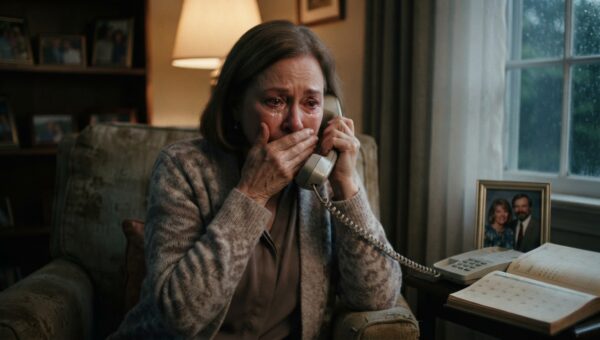
Gary had always told the story of his mother leaving home as a sudden tragedy, claiming Clara just packed a single suitcase one Tuesday morning in nineteen-ninety-two and walked out because she couldn’t handle the quiet of a small town. We all accepted it because nobody ever dared to question Arthur about the woman whose pictures he took down from the hallway walls. I didn’t touch the gold bars. I folded the letter, slipped it into my apron pocket, and walked over to the landline phone sitting on Arthur’s old workbench.
I dialed my nephew Marcus without thinking twice, needing to hear a voice that wasn’t wrapped in the fog of whatever happened in this house before I even knew them. Marcus was twenty-four now, living up in Grand Rapids working as an apprentice electrician, and he had always been Arthur’s favorite for reasons the other cousins grumbled about during Thanksgiving dinners. He picked up on the second ring, sounding distracted by the hum of tools in the background.
“Aunt Helen?” Marcus said, his voice dropping into that polite, cautious register he always used when older relatives called during his work shift. “Is everything okay with Grandpa’s house? Dad said you guys were almost done clearing out the rooms.”
“Marcus, I need you to listen to me very carefully,” I said, my voice sounding thin even to my own ears. “I’m down in the basement. I found the safe.”
There was a sudden, dead silence on the line, so absolute that I could hear the faint scratching of wire strippers in his background stop entirely. “The floor safe?” Marcus asked, his voice tightening up into something sharp and defensive. “The one under the workbench?”
“You knew about it,” I said, stating it not as a question but as the heavy fact it was. “Arthur told you.”
Marcus let out a long, shaky breath that sounded like a sigh of relief mixed with pure terror. “Grandpa told me when I was twelve,” he whispered, the background noise in his shop completely gone now. “He made me swear on his old Bible that I wouldn’t ever say a word to anyone until after he was gone.”
“Promise what, Marcus?” I asked, looking back down at the open steel door and the flannel-wrapped bars resting inside it. “Promise what?”
Marcus went quiet for a long, heavy beat, and when he finally spoke, his voice was barely audible over the phone line. “Never tell Dad. Because Dad is the reason Grandma left. And she left because Dad and Jered did something terrible to her.”
I closed my eyes for a second, leaning my shoulder against the damp concrete wall of the foundation. “What did they do, Marcus?”
“Grandpa caught them,” Marcus said, the words tumbling out like he had been carrying them in his chest for twelve years and couldn’t hold them back another second. “They forged her signature on the second mortgage papers for the farm store, cleaned out her entire inheritance from her mother, and when she found out and threatened to go to the bank, they locked her in the root cellar overnight until she agreed to sign the separation papers. Grandpa found her down there the next morning. She walked out that very afternoon and never came back.”
The silence in the basement felt like it had weight now, pressing down on my chest until it was hard to breathe. All those years of Gary acting like the victim of a cold mother, all those Sunday dinners where he complained about how Clara abandoned them, and it was a lie from start to finish. Arthur had covered for his sons out of some twisted sense of paternal protection, but the guilt had eaten him alive until he salted away every last ounce of gold he could spare to make sure Clara’s bloodline got something back.
“Helen? Are you still there?” Marcus asked, his voice shaking now. “Dad is going to lose his mind if he finds out about that safe. He thinks he owns everything down there.”
“He doesn’t own this,” I said, my voice hardening into something cold and steady as I looked at Arthur’s cursive on the letter. “And neither does Jered.”
Just then, the front screen door upstairs slammed shut with a sharp rattle, followed by the sound of heavy work boots stomping across the kitchen linoleum. Gary’s loud, familiar laugh echoed down the stairwell as he dropped a plastic bag of leftover deli sandwiches onto the counter.
“Helen! You down there in the dark?” Gary called out, his footsteps starting to descend the wooden stairs one by one. “Jered wants to know if we can load that old compressor into his truck bed before the sun gets too high.”
I didn’t answer right away. I reached down, pulled the heavy brass key out of the safe lock, and dropped it into my pocket right alongside Arthur’s letter. Gary reached the bottom of the stairs, wiping his forehead with a paper napkin, and stopped dead in his tracks when he saw me standing in front of the open steel door with my arms crossed over my chest.
“What are you doing messing around with that?” Gary asked, his brow furrowing as his eyes darted from the empty floor plate to the flannel bundles sitting inside the open safe. “Where did you get the key for that thing?”
I didn’t move an inch. I looked at my husband of nearly three decades, seeing the exact same stubborn, selfish tilt of the chin that Marcus had described from that forty-year-old night in the root cellar.
“Your father left a message, Gary,” I said quietly, my voice carrying clear up the stairwell where Jered was starting to come down. “And it wasn’t meant for you.”
Gary took two steps forward, his face turning that dark, mottled red that always meant he was about to lose his temper over something he couldn’t control. “What the hell are you talking about? Hand me those keys right now, Helen. That’s estate property.”
“It’s not estate property,” I said, reaching down to lift the top gold bar out of the flannel wrap, feeling its cold, surprising weight in my hand. “It’s restitution. And Marcus is on his way down here right now to pick up every single piece of it.”
Gary lunged forward to grab my wrist, but I stepped back, holding the bar out toward the stairs where Jered was now standing with his mouth hanging open in shock. The brothers started shouting at once, demanding to know what I had found, threatening to call the sheriff, calling me crazy, but their voices sounded distant and small compared to the silence that had lived in this basement for half a century.
I didn’t drop the gold, and I didn’t back down. Three hours later, the police hadn’t been called because Gary realized that opening a sealed probate safe with a hidden letter attached to a thirty-year-old financial fraud would bring down a lot more questions than he wanted to answer. By late afternoon, the heavy iron safe stood completely empty and unbolted in the center of the basement floor, its steel door left wide open to the dusty air. Marcus pulled his old Ford truck right up to the cellar doors, his jaw set and his eyes dry as he stepped down onto the concrete.
He didn’t say a word to his father, who was sitting upstairs at the kitchen table with his head in his hands, staring at the wall like a ghost had just walked through it. Marcus walked down the stairs, picked up his heavy canvas backpack, and slid the last gold bar into place with a dull, heavy thud. He zipped the bag shut, hoisted it over his shoulder, and looked at me with something that looked like peace for the first time all day.
“Thanks, Aunt Helen,” Marcus said quietly, turning around without looking back at the empty safe.
I watched him walk out through the cellar doors and into the bright afternoon sunlight, his head held high as he climbed into his truck and drove away down Elm Street, leaving the house behind with all its heavy, buried secrets finally brought out into the light.