The house had that heavy, settling quiet that only comes after midnight when the floorboards stop popping and the refrigerator motor finally clicks off. I had woken up with a dry throat, parched from the spiced beef we had eaten for supper, and slipped out of bed without waking Arthur. Thirty-four years of sleeping side by side means you learn the exact rhythm of a person’s breathing, the way his left shoulder rolls toward the edge of the mattress, the faint whistle in his nose when he’s had a long day at the lumber yard.
I padded down the dark hallway in my bare feet, the runner rug soft beneath my instep, heading straight for the kitchen stairs.
The screened porch door was usually latched tight against the night damp, but tonight it stood open an inch, letting a thin wedge of yellow porch light cut across the hardwood floor. I wouldn’t have thought twice about it, except for the low murmur of Arthur’s voice carrying into the kitchen. He was a quiet man by nature, the kind of fellow who could sit on a park bench for an hour without needing to say a word to the pigeons or the passersby. Hearing him speak in that hushed, careful tone made me pause halfway to the sink, my hand hovering over the faucet handle.
“I send the $1,800 on the first,” he was saying, and his voice had a sharp edge to it I had never heard in all our decades together. “I always have. It clears by noon.”
I stayed very still, my palm resting flat on the cool porcelain of the sink. A moth fluttered against the porch screen, making a dry, frantic tapping sound that seemed far too loud in the stillness.
“She can’t ever find out who you really are,” Arthur whispered, and the words dropped into the quiet space between us like lead weights. “Just keep the receipts in the usual drawer. I’ll call you next Tuesday.”
I gripped the edge of the counter until my knuckles ached, staring down into the empty drain. The house felt suddenly enormous, cold, and entirely unfamiliar. I didn’t go out to the porch. I didn’t push the door open and demand an explanation right then, because my chest had gone tight in a way that made drawing a full breath feel impossible. I crept back up the stairs like a trespasser in my own home, listening to Arthur’s measured, heavy footsteps as he finally latched the screen door and came back to bed, sliding in beside me as if nothing in the world had shifted.
The sun came up gray and stubborn through the bedroom window the next morning, throwing long, pale bars across the foot of the quilt. Arthur had already gone downstairs to put the coffee on, his boots making their familiar two-step scuff on the stairs. I stayed sitting on the edge of the mattress for a long time, watching dust motes drift in the gray light, feeling the solid weight of the previous night settling into my bones. When I finally went down, he was sitting at the laminate kitchen table with the local paper folded open to the obituaries, a mug of black coffee steaming at his elbow.
“Morning, honey,” he said, and his voice was completely level, just the way it had been every morning since Jimmy Carter was in the White House. “Coffee’s fresh.”
“Thanks,” I said, keeping my back to him as I poured a cup from the pot.
I didn’t drink it. Instead, I waited until he grabbed his keys and headed out the back door toward the shed to check the mower blades, moving with that slow, deliberate rhythm he had picked up after retiring from the yard.
As soon as the screen door slammed shut behind him, I went straight to the old mahogany desk in the den where we kept the household files, tax returns, and warranty booklets going back to the days when our children were still in grade school.
My hands were shaking slightly, but I knew exactly where to look for the bank statements. Arthur had always handled the digital logins, but we kept paper copies of the primary checking account mailed to the house out of old-fashioned habit. I pulled the grey metal filing box out from the bottom shelf, tipping the manila folders onto the braided rug. The envelopes were there, stacked in neat, chronological rows with rubber bands around them. I started pulling them out from the bottom, working my way back year by year through the dusty stacks of envelopes.
It took me twenty minutes to find the first irregularity, hidden away in a statement from the autumn of 2015. There it was, clear as print, listed under outgoing electronic transfers: eighteen hundred dollars, drawn on the first of every month, routed to an out-of-state routing number in northern Minnesota. I pulled the next statement, and the next, flipping through the brittle pages with a growing sickness in my stomach. Every single month, without fail, eighteen hundred dollars left our joint account, month after month, year after year, totaling up to a figure that made my head spin when I finally scribbled it down on the back of an envelope. One hundred ninety-four thousand four hundred dollars. Nearly two hundred thousand dollars of the savings we had built together, sent away in secret while we debated whether we could afford to replace the leaking roof over the sunroom.
The name on the transfer stub was just a corporate placeholder, a bland, uninformative LLC that sounded like a shell company for real estate holdings or tax management. But beneath the corporate name, printed in small type on the supplementary deposit slips that sometimes slipped through the mailings, was a direct billing telephone number. I sat back in the wooden desk chair, staring at the number until the ink seemed to blur together into a dark smudge against the white paper.
I didn’t think about what I was doing. If I had stopped to think, I probably would have put the folders back and pretended I had never seen any of it. Instead, I reached for the landline on the desk, punched the receiver against my ear, and dialed the ten-digit number from the statement with stiff, unbending fingers.
It rang three times, sharp and electronic, before a click signaled the line had opened.
“Hello?” a young woman’s voice said on the other end.
The sound of her voice hit me right in the center of my chest, knocking the air straight out of my lungs. It wasn’t the voice of a corporate secretary or a bank teller. It was a bright, slightly raspy voice with that exact same hurried cadence my sister Claire always had when she was trying to talk her way out of trouble at the grocery store check-out. It was the voice I had listened to across Thanksgiving turkeys and birthday cakes for the first fifteen years of my life, before the bitter final fight that caused us to draw a line in the dirt and never cross it again.
“Hello?” the girl said again, sounding confused as the line hummed with dead air. “Is someone there?”
I opened my mouth, but no sound came out. My throat had gone completely dry, as if I had swallowed a mouthful of dust from the old filing box.
Then the girl on the other end let out a small, hesitant breath, and the words dropped into the receiver like a stone through ice.
“Aunt Linda?”
The kitchen seemed to tilt on its axis. The grandfather clock in the hallway ticked away the seconds with a hollow, mocking rhythm, while the smell of cold coffee drifted up from the desk. I sat there with the telephone pressed hard against my ear, the plastic casing slippery with sweat, unable to form a single coherent thought as the pieces of a puzzle I never knew existed started slamming together in the dark.
“Maya?” I managed to say finally, my voice sounding thin and cracked, like dry twigs snapping underfoot.
“Yeah,” the girl said, her tone dipping into instant confusion and caution. “Yeah, it’s me. Is everything okay? Did Arthur call you? He said he was going to check in about the trust payment clearing this morning.”
The line buzzed softly with static, but the silence that followed between us was heavier than anything I had ever felt in my life. Arthur had been paying for her life. For nine years, while I sat across from him at our small kitchen table eating toast and drinking black coffee, he had been quietly funding the life of the niece I hadn’t spoken to since the day Claire packed her rusted station wagon and drove out of our lives for good. He had been sending eighteen hundred dollars every single month out of our retirement savings to keep my sister’s daughter afloat, all while looking me in the eye and nodding along whenever I talked about how proud we were to be debt-free and independent.
I didn’t answer Maya. I couldn’t find the words to tell her that I had no idea what trust she was talking about, or that her uncle Arthur had built an entire second life out of deception right underneath my nose. My hand started trembling so badly I could barely hold the receiver steady against my ear, the plastic rattling against my teeth.
“Aunt Linda?” Maya asked again, her voice rising with sudden panic. “Is something wrong with Arthur? Did something happen to him?”
“No,” I whispered, staring blindly at the dusty floral wallpaper across the room. “No, everything’s fine, honey. I just… I dialed the wrong number by mistake.”
“Oh,” she said, sounding deeply unconvinced and unsettled. “Well. Okay. Tell Arthur I said hi, I guess.”
The line went dead with a sharp click, leaving only the steady, flat tone of an open circuit droning in my ear. I lowered the receiver back onto its cradle very slowly, as if it might shatter if I moved too fast.
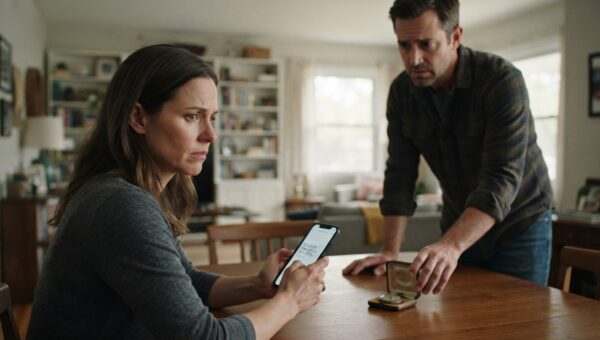
The rest of the morning passed in a strange, muted haze. I didn’t go back outside. I didn’t wash the coffee cup sitting in the sink. I gathered the bank statements into a single neat pile, squaring the edges with my thumbs until they formed a solid, rectangular block, and placed them directly in the center of the laminate table where Arthur always sat to read his paper. Then I pulled out a kitchen chair, sat down facing the back door, and waited for the sound of his boots on the gravel.
It was almost noon when I heard him coming up the wooden steps of the porch. The screen door creaked open, letting in a sharp gust of dry autumn wind that rustled the edges of the printed bank statements on the table. Arthur stepped into the kitchen carrying a small bundle of pruned apple tree branches under his arm, his flannel shirt dark with sweat across the shoulders. He stopped dead the second he crossed the threshold, his eyes dropping immediately to the stack of paper resting between the salt shaker and the napkin holder.
The silence in the room wasn’t the peaceful quiet of the night before. It was the heavy, suffocating stillness of a courtroom waiting for the jury to walk back through the door.
“Linda,” he said, and his voice dropped all the pretense of the morning, sounding old and tired and suddenly very small.
“I talked to her, Arthur,” I said, my voice remarkably steady, sounding like a stranger’s voice echoing in a hallway. “I called the number on the statement. She answered on the third ring. She called me Aunt Linda.”
Arthur didn’t try to run. He didn’t drop the branches. He just let them slide out from under his arm, letting the dry twigs clatter across the linoleum floor with a sharp, dry sound. He pulled out the chair opposite me and sat down very slowly, his big, rough hands folding together on the edge of the table as he looked down at the wood grain instead of meeting my eyes.
“How much did you find?” he asked quietly.
“Enough,” I said. “Nine years. One hundred ninety-four thousand dollars. While you were telling me we had to watch the electric bill during the winter. While you were letting me stress over every little grocery receipt.”
“It wasn’t for me,” he said, and for the first time, a note of desperation crept into his tone, cracking the flat facade he had worn for thirty-four years. “Claire was drowning, Linda. Nine years ago, when you swore you’d never give her another cent after what she pulled with the mortgage, she came to me. She was about to lose Maya. The courts were going to put the girl into state custody because Claire couldn’t even keep the lights on.”
“That was her choice,” I said, feeling the old, familiar burn of anger rising up from my chest, sharp and hot. “We agreed. We both agreed that enabling her was just destroying whatever was left of our family. That was the boundary we set.”
“It wasn’t Claire’s fault this time, not entirely,” Arthur said, his voice dropping to a harsh whisper as he leaned across the table toward me. “It was the little girl. Maya was four years old, Linda. She didn’t have a choice in any of it. I couldn’t just stand by and watch my wife’s niece get thrown into the system because of her mother’s messes. I used the inheritance from my uncle’s timber plot. It wasn’t our retirement money. It was separate. I kept it separate so you wouldn’t have to carry the burden of knowing.”
“You lied to me,” I said, and the words felt like broken glass in my mouth. “Every single day for nine years, you looked me in the face and let me carry my hatred for my sister, while you were playing the savior behind my back. You made me look like a monster to that girl. She thought I knew. She thought I was sitting right here approving every dollar you sent.”
“I wanted to protect you,” Arthur said, his eyes finally rising to meet mine, and I saw the deep, pathetic fear shining in them for the very first time in our lives. “If I told you, you would have made me stop. Or you would have gone to war with Claire, and it would have torn you apart all over again. I took the weight of it so you didn’t have to.”
“You don’t get to decide what weight I can carry, Arthur,” I said, and my voice didn’t shake at all. “That’s not how a marriage works. A marriage isn’t a museum where you hide the ugly parts behind a curtain so I can pretend everything looks nice from the outside.”
He didn’t have an answer for that. He sat there with his head bowed, his hands still folded on the table, looking like an old man who had finally run out of roads to travel. The sun shifted through the window, moving across the linoleum floor and touching the edge of the fallen apple branches near his boots.
We sat across from each other for a long time without speaking another word. The house settled back into its usual afternoon rhythm, the refrigerator kicking on with a low hum, the distant sound of a car passing out on the highway.
Later that afternoon, I watched from the living room window as Arthur walked slowly out to the shed, picked up the scattered apple branches one by one, and piled them neatly into the metal bin by the door. He didn’t look back toward the house. He moved with the heavy, broken deliberation of a man who realized too late that the bridge he built to save someone else had burned the ground out from under his own feet.
The ledger is still sitting on the kitchen table, closed up tight with a clean, dull click of its cardboard cover. Arthur is sitting in the front room now, staring out at the empty street through the screen door as the autumn twilight begins to settle long and gray over the lawn. I know I won’t pack a bag tonight, and I know he won’t leave. Too many decades have grown into the walls of this place for us to simply pack it up and walk away into the dark. But the silence between us has changed shape now, turning hard and cold, and I know with absolute, unshakeable clarity that the thirty-four-year conversation we were having came to an end the moment Maya said my name over the phone.