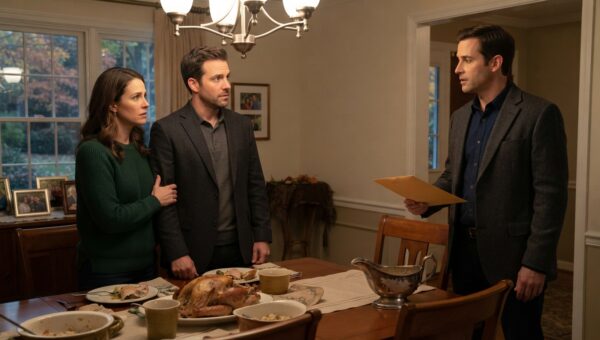
The twenty-five-dollar gift card felt light and cheap between my fingers, like a plastic token handed out at a carnival game where the prizes were already rigged.
I watched my nephew Leo claim every single gift that was supposed to belong to my daughter Lily last December. The labels were written in my own clear handwriting, taped securely over festive paper with silver reindeer, but my parents only laughed as the boy tore into them one by one.
My little girl remained standing right there in the doorway, wrapped in her heavy purple coat because she had not even taken it off yet. She didn’t interrupt, and she didn’t complain a single time.
She simply stood in that drafty hallway, trying with everything she had inside her not to let her lower lip shake. Then Grandma reached into her pocket, pulled out a crinkled pink envelope, and handed her that little plastic card with a dismissive wave.
“Now you can choose what you want, sweetheart,” Grandma said, as if Lily had just been handed a catalog of endless possibilities instead of being publicly robbed of her morning.
I almost laughed at the sheer absurdity of it right then and there. Lily’s presents had been ripped open by a spoiled child, the adults at the table had treated her heartbreak like a funny family floor show, and now a twenty-five-dollar store credit was supposed to neatly close the matter.
I stayed silent through the rest of that miserable celebration. I sat at the end of the dining table, pushed my dry turkey around my good china plate, and kept my mouth shut.
My mother assumed my silence meant I was beaten, the way I had been ever since I was a teenager in that house. But silence doesn’t always mean someone has forgiven you or forgotten what you did.
By the time we drove home that night with Lily crying softly in the back seat, my mind wasn’t broken. It was working.
Because by the following Christmas, I had prepared a very specific surprise for the people who laughed at my daughter, and the moment what was waiting under my tree finally came to light, nobody was laughing anymore.
I remember the drive home from my parents’ house last year like it was played on a looped tape in my head.
The heater in my old sedan made a rhythmic clicking sound, and Lily had her face pressed against the cold passenger window, watching the snowy telephone poles blur past.
“Did I do something wrong, Mama?” she asked in that small, careful voice that always breaks something inside my ribs.
“No, baby,” I told her, gripping the steering wheel until my knuckles turned the color of chalk. “You didn’t do a single thing wrong.”
“Grandma said Leo just gets excited because he’s an only child,” she whispered, her fingers tracing the zipper of her purple coat.
“Grandma says a lot of things that don’t make sense,” I answered, and I made a quiet vow right there in the dark.
I wasn’t going to scream at my mother in her own dining room. I wasn’t going to give my sister Sarah the satisfaction of watching me throw a fit and labeling me the unstable one, which is the exact trick my family has used for thirty years to keep me in line.
Instead, I decided to play the long game. I decided to give them an entire year to forget what they had done, so the trap would snap shut with maximum efficiency when they least expected it.
The first six months of my quiet campaign started with a ledger. I bought a plain black composition notebook at the grocery store and kept it hidden at the bottom of my cedar chest under my old high school yearbooks.
Whenever my mother called to complain about her finances or brag about Sarah buying Leo a new dirt bike, I wrote it down with exact figures. I tracked how much money my parents spent on Sarah’s family versus what they spent on us, down to the penny.
It turned out that over the last five years, my parents had poured roughly twenty-seven thousand dollars into Leo’s private school tuition, sports gear, and extravagant holiday hauls, while Lily had received a total of three hundred and forty dollars in birthday checks that usually arrived two weeks late.
I didn’t feel bitter while I wrote those numbers down. I felt clear.
By July, I started quietly coordinating with my aunt Clara, who lives up in Michigan and has always despised my mother’s transparent favoritism. Clara was the only person in the extended family who saw through Sarah’s entitled act.
“Are you sure you want to host this year?” Clara asked me over the phone one humid Tuesday morning while I was scrubbing my kitchen sink. “You know how your mother gets when she isn’t sitting at the head of her own table.”
“That’s exactly why I’m doing it, Clara,” I told her, rinsing the sponge. “It’s time the table had a different set of rules.”
We spent months fine-tuning the logistics. Clara agreed to bring the financial backing for a very specific project, while I handled the psychological architecture of the entire operation.
We didn’t miss a single detail. Every gift-giving dynamic my family relied upon, their assumptions of priority, their casual dismissal of anyone who didn’t throw a tantrum, and their absolute refusal to acknowledge Lily’s existence as a person of equal worth, was cataloged and turned into a weapon.
By November, the preparations for our household Christmas gathering were moving like clockwork. I sent out formal invitations with strict, non-negotiable protocols attached to every single envelope.
I specified that all gifts brought to the house must be registered, itemized, and cataloged three weeks in advance, under the guise of an “organized family exchange to save time and reduce holiday stress.”
My mother called me within two hours of receiving hers, sounding genuinely offended. “An itemized list? Since when do we need a bureaucracy to open presents, Clara? Or are you turning into some kind of drill sergeant?”
“It’s just the new rule, Mom,” I said smoothly, keeping my voice flat and sweet. “If you want to participate in the family gathering this year, you play by the house guidelines. Otherwise, feel free to stay home.”
There was a long pause on the other end of the line. My mother wasn’t used to me setting boundaries, let alone enforcing them with a polite smile.
“Well, of course we’re coming,” she scoffed finally. “Sarah wants to show off Leo’s new hockey trophies anyway. But I don’t know what’s gotten into you lately.”
“Nothing has gotten into me,” I replied. “I’m just getting organized.”
Sarah didn’t suspect a thing either. She texted me twice in early December to ask if I could buy extra wrapping paper because she was too busy with her salon appointments, and I kindly told her I had everything completely under control.
And I did. Every single box under my tree was meticulously wrapped, tagged, and assigned a strict value index based on a formula that mirrored last year’s exact distribution of power.
The morning of our gathering arrived with a heavy, gray frost coating the grass outside. I watched out the kitchen window as my parents’ silver SUV pulled into the driveway at exactly 11:58 AM, right on schedule.
My mother stepped out first, wearing her expensive white wool coat and carrying a large, brightly wrapped package meant exclusively for Leo. Sarah followed right behind her, her ten-year-old son bouncing on his heels and holding a portable gaming console in his hands.
I opened the front door before they even had a chance to knock, wiping my hands on a plain linen dish towel.
“Merry Christmas,” I said, stepping back to let them track their wet boots across my freshly vacuumed hallway rug.
“It’s freezing out there, sweetheart,” my mother announced, marching straight past me without taking off her gloves. “And your front porch light was flickering. Honestly, you really need to keep up with maintenance.”
“Good to know, Mom,” I said, shutting the door behind them.
Leo didn’t even bother saying hello. He ran straight into the living room, his eyes locking onto the large pile of beautifully wrapped boxes stacked under the tree.
“Are those mine?” he demanded, pointing a sticky finger directly at a massive box wrapped in shiny blue paper that sat right at the front.
“Some of them might be, Leo,” I said, walking into the living room with a slow, deliberate pace. “But everything operates under the new registry rules this year. You know that. We talked about it in November.”
Sarah let out a short, dismissive laugh, shrugging off her designer jacket and tossing it over the back of my floral sofa. “Oh, stop being so dramatic with your rules, Clara. He’s just a kid. Let the boy see what he got.”
“Sit down, Sarah,” I said. My voice wasn’t loud, but there was something in the tone that made my sister pause mid-motion.
Grandma frowned, settling her heavy frame into my favorite armchair with an audible sigh of annoyance. “Don’t start your little moods today, Clara. We came here to have a nice family dinner, not to sit through a court hearing.”
“You’re not going to a court hearing, Mom,” I replied, standing by the mantelpiece with my hands folded neatly in front of me. “You’re just going to participate in a redistribution lottery.”
The room went entirely silent for three seconds. Even Leo stopped poking at the blue package.
“A what?” my mother asked, her eyes narrowing as she looked at the tree.
“A redistribution lottery,” I repeated evenly. “You see, this year, all gifts brought into this house are subject to our merit-based allocation formula. Leo’s packages, for instance, have been reviewed against his overall family contribution score for the past twelve months.”
Sarah stood up from the sofa, her face flushing a bright, angry red. “Are you out of your mind? I spent over two hundred dollars on those video games for Leo. You don’t touch his things!”
“Actually, Sarah, I do,” I said, stepping forward and picking up the very first box, the large blue one Leo had tried to claim. “According to our metrics, Leo’s contribution score for the year stands at a net negative, primarily due to his disregard for other people’s property last Christmas. Therefore, under our new guidelines, his primary gift has been reallocated.”
With a slow, deliberate motion, I turned around and walked over to where Lily was sitting quietly in the corner armchair, wearing a simple blue sweater. I placed the massive blue box right in her lap.
“Here you go, honey,” I said softly. “Open it.”
Leo let out a loud, high-pitched howl of absolute outrage. “Hey! That’s my racing set! Grandma bought that for me!”
Grandma surged out of her armchair, her face twisting in pure disbelief. “Clara! Have you lost your absolute mind? Give that back to your nephew right this instant! Are you punishing a child because you’re holding some childish grudge?”
“It’s not a grudge, Mom,” I said, turning to face her with a calm, unblinking stare. “It’s a mirror.”
“This is completely insane!” Sarah shrieked, marching across the room and trying to snatch the box out of Lily’s hands.
I didn’t yell. I didn’t lunge. I simply reached out and caught my sister’s wrist with a grip that was entirely immovable.
“Don’t touch my daughter,” I said, and the quiet danger in my tone made Sarah recoil as if she had touched a hot stove burner.
“You’re acting like a lunatic!” Sarah yelled, tears of pure rage springing to her eyes. “It’s Christmas! You’re ruining Christmas over some stupid presents from last year!”
“Oh, you remember last year?” I asked, raising my eyebrows. “That’s funny. Because last year you told me I was making a big deal out of nothing when Leo tore open Lily’s things while you all laughed.”
“That was different!” Grandma shouted, her voice shaking with righteous fury as she pointed a trembling finger at me. “Leo was excited! Lily is older, she understands these things! You are embarrassing yourself and traumatizing your own family over a petty little incident!”
“No, Mom,” I said, walking over to the coffee table and picking up a small, crinkled pink envelope that I had placed there earlier. “I’m not traumatizing anyone. I’m just finishing the transaction.”
I opened the envelope and pulled out a single, pristine twenty-five-dollar store credit card, the exact twin of the one my mother had handed Lily twelve months ago.
I walked right up to Leo, who was standing by the tree looking like he was about to burst into tears of pure frustration, and held it out toward him on the flat of my palm.
“Here you go, Leo,” I said, matching my mother’s exact tone from the previous year. “Now you can choose what you want.”
The silence that fell over my living room then was heavy, suffocating, and completely absolute.
Grandma stared at the small plastic card in my hand as if it were a venomous snake. All the color drained out of her face, leaving her looking old, tired, and profoundly small against the backdrop of my clean white walls.
“You kept that,” my mother whispered, her voice dropping down to a fragile, breathless crack. “You’ve been holding onto that stupid card for a whole year just to pull this stunt?”
“I didn’t hold onto it as a stunt, Mom,” I said, keeping my eyes locked on hers. “I held onto it as a receipt. You taught Lily last year that her feelings, her property, and her presence in this family were worth exactly twenty-five dollars. Today, I just wanted to show you what that exchange rate actually feels like from the other side of the room.”
Sarah looked between me and our mother, her mouth opening and closing like a fish out of water, suddenly realizing that the entire foundation of their unearned authority in our family had just dissolved into thin air.
“We’re leaving,” Sarah muttered, grabbing her son by the collar of his sweater and yanking him backward. “Get your coat, Leo. We are getting out of this freak show right now.”
“Feel free,” I said, not moving an inch from my spot by the coffee table. “The front door is right where you left it.”
Grandma stood there for another long moment, her chest rising and falling rapidly under her wool coat, waiting for me to apologize, waiting for me to crack the way I always had when I was a girl.
I didn’t blink. I didn’t soften my expression. I just stood there and breathed.
Slowly, heavily, my mother turned around, grabbed her handbag from the sofa floor, and walked toward the hallway without another single word. Sarah and Leo scurried after her, the front door slamming behind them with a flat, final thud that rattled the glass in the front windows.
When the sound of their SUV tires crunching over the driveway gravel finally faded away into the winter air, the house seemed to drop twenty degrees, but the weight that lifted off my shoulders felt like a physical relief.
I walked back over to the armchair where Lily was sitting. She had the large blue box resting in her lap, but she wasn’t ripping the paper off in a frenzy. She was just looking at the neat silver bow with a quiet, steady expression.
She looked up at me, her big eyes reflecting the warm light of the tree, and slowly reached up to unzip her heavy purple coat, letting it slide off her shoulders and pool around her chair.
“Do you want me to help you open it, honey?” I asked, kneeling down beside her chair and brushing a stray strand of hair away from her forehead.
Lily smiled, a small, genuine, unburdened smile that I hadn’t seen on her face in years, and shook her head.
“No, Mama,” she said softly, her fingers tracing the neat white tag with her own name written clearly in my handwriting. “I think I want to take my time.”