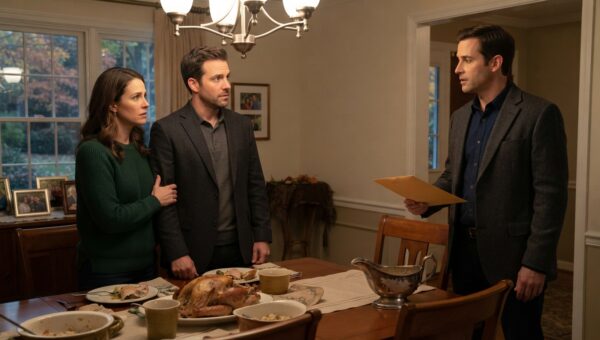
For six years, I wondered if I was making a mistake by staying quiet. I used to sit at the end of this very table, hands folded in my lap, listening to David talk about his brilliant trajectory at Nova Group while my mother-in-law, Eleanor, made polite, razor-thin remarks about my lack of ambition. They thought I spent my days drifting through garden centers and folding laundry.
They thought I was harmless. I let them believe it because I wanted to know who they really were when they thought nobody of consequence was watching. As it turned out, I had my answer long before tonight, but I kept the secret locked away in my desk drawer anyway.
David had always been ambitious in that frantic, insecure way men get when they marry into something bigger than their pedigree and spend every waking minute trying to prove they built it themselves. When we met back in nineteen-ninety-nine, I was already knee-deep in the restructuring of three failing manufacturing plants in Upstate New York. I didn’t look like a financier back then, and I certainly didn’t look like one when David brought me home to meet his mother in our small, drafty rental house. Eleanor took one look at my faded corduroy jacket and told David he needed a woman who understood the social requirements of an executive track.
She never stopped reminding me of it, not even after I quietly financed the venture capital firm that handed David his first real title on a silver platter.
The dining room smelled heavily of roasted goose and cedar boughs, that expensive, manufactured Christmas smell that Eleanor bought in little glass bottles from the boutique downtown. Lily had spent three weeks on that little blue cotton dress. Her fingers were too small for the heavy embroidery needle, so she had pricked them over and over, leaving tiny, faint dots of blood on the lining that only a mother would notice. She wore it tonight because she wanted her grandmother to see that she could make something real with her own two hands, something that didn’t come off a rack in a department store.
Eleanor reached across the mahogany surface, her diamond rings clicking against her water glass, and pulled the hem of Lily’s skirt between two manicured fingers.
Her face tightened into that familiar expression of pinched distaste that always made my spine go cold.
“Where on earth did you dig this rag up?” Eleanor asked, her voice carrying that sharp, carrying timbre that cut right through the clatter of silverware. “It looks like something out of a charity bin in a ghost town.”
“I made it,” Lily whispered, her chin trembling as she looked down at her plate. “I made it for Christmas.”
Eleanor didn’t even bother dropping it back onto the chair. She stood up, her silk shawl slipping slightly down her shoulder, and walked past our chairs toward the service alcove where the modern stainless-steel trash compactor hummed quietly against the wall.
“We don’t wear rags at this table, Lily,” Eleanor said, lifting the heavy metal lid with a sharp clang. “It’s time you learned what standard we keep in this family.”
She dropped the blue cotton dress right into the bin.
“Grandma, no,” Lily choked out, half-rising from her chair before I caught her small shoulder and pulled her back against my chest.
Eleanor pressed the heavy chrome start button with her thumb. The heavy motor ground to life with a dull, sickening thud, chewing through two weeks of tired little fingers and patient, careful stitches in less than three seconds.
The sound filled the high-ceilinged room, loud and violent against the quiet Christmas carols playing from the stereo in the hall. My sister-in-law, Victoria, who sat three seats down as the newly minted regional vice president of corporate communications, looked over the rim of her champagne flute and gave us a small, leisurely smirk. She loved this part. She loved watching the hierarchy get reinforced.
Nobody said anything for a second, and honestly that felt worse than the noise. The forks stayed frozen mid-air. David cleared his throat, adjusting his silk tie with a practiced flick of his wrist, ready to pivot back to his favorite subject.
“Mother’s just trying to teach her standards, Clara,” David said, his voice dripping with that patronizing calm he used whenever he wanted me to disappear. “You coddle her too much anyway. Nova Group just closed another eight-figure acquisition this morning, and frankly, we have to look the part. If my daughter shows up to these functions dressed like an orphan, it reflects poorly on my division.”
I didn’t answer him right away. I reached down and smoothed the wild curls away from Lily’s forehead, feeling the small, fast thud of her heart against my ribs. Her little fingers curled into the wool of my sweater, bunching the fabric until my skin ached.
“Your division, David?” I asked quietly.
He laughed, a short, barking sound that didn’t reach his eyes. Victoria joined in, swirling her wine.
“Well, yes, Clara. Unless you’ve suddenly got a portfolio hidden behind those coupon binders,” David said, turning back to his business associate at the end of the table to make a joke about homemakers and balancing checkbooks.
I pulled my old leather phone out from my pocket. It didn’t look like much, just a cracked screen protector and a plain black case I bought at a gas station three years ago. I tapped the screen three times, opened the encrypted application that required both a retinal scan and a six-digit rolling token, and pressed the speaker icon. I set it right beside David’s heavy crystal wineglass, right where the candlelight caught the rim.
The table went dead silent as the line connected with a sharp, three-tone digital chime.
“Awaiting your orders, Chairman Vance,” a crisp, gravelly voice echoed through the dining room. It belonged to Arthur Sterling, the eighty-year-old senior managing partner who hadn’t taken a direct call from anyone outside the board room since nineteen-ninety-eight.
David’s gold watch tapped hard against the fine China as his hand began to shake, the stem of his wineglass slipping an inch before he caught it. He stared at the little black rectangle like it was a live rattlesnake on the tablecloth.
“What is that?” David whispered, his voice dropping an octave as the blood drained out of his face so fast his skin looked gray under the chandelier. “Clara, what did you just dial?”
“You were telling them about your division, David,” I said, my voice barely above a whisper, but it carried into every corner of the room. “Tell them who owns the controlling interest in the holding structure. Tell them whose signature cleared the expansion loan you’ve been bragging about since the appetizers.”
Victoria dropped her fork. It hit the porcelain plate with a sharp crack that made Eleanor jump. Victoria leaned forward across the mahogany, her eyes wide and fixed on my face, the smirk completely gone, replaced by something frantic and small.
“That’s not, ” Victoria started, her voice catching in her throat as she reached blindly for her own company-issued tablet on the sideboard. “That’s an executive routing line. Only the board chair has that extension. That’s Vance Holdings.”
“My maiden name was Vance, Victoria,” I said, looking right at her until she looked away. “My grandfather built the first three mills in this county before your father even learned how to sign his own name on a bank loan. David didn’t earn his directorship through merit or seventy-hour work weeks. He got it because I signed the waiver that kept him from being fired for embezzlement during the nineteen-ninety-eight restructuring.”
David pushed his chair back so hard it screeched against the hardwood floor. He grabbed his phone out of his jacket pocket with trembling fingers, hitting his contacts, trying to dial his secretary, trying to reach someone, anyone, who could tell him this was a sick joke.
“Arthur?” David shouted at my phone, his voice cracking into something high and thin. “Arthur, are you on this line? This is David Miller. Regional director. Tell my wife this isn’t, tell her who is in charge of this branch.”
The speaker stayed open for three long seconds, the faint hum of the corporate switchboard in Chicago hissing through the tiny speaker grill. Then Arthur Sterling’s voice came back through, dry as winter grass.
“We have no record of an active regional director named Miller on the primary ledger as of four minutes ago, sir,” Arthur said clearly. “The Chairman’s personal directive just executed a total restructuring of the southern division. All executive titles held by David Miller and Victoria Miller are hereby dissolved, pending an immediate forensic audit of corporate travel expenses and subsidiary accounts.”
The room seemed to drop twenty degrees. Eleanor clutched her pearl necklace so hard the silk thread looked like it might snap right then and there.
“Clara,” Eleanor choked out, her voice losing all its sharp, iron edge, sounding suddenly like a very old, very frightened woman sitting in a room that was collapsing around her. “Clara, you can’t, David has responsibilities. The country club board, the mortgage on the lake house, “
“The mortgage is in my name, Eleanor,” I said softly, standing up from the table and smoothing down my skirt. “Every brick of it. Just like the car David drove to work this morning, and the stock options Victoria has been using to buy her designer bags.”
Victoria was staring at her tablet now, her fingers flying across the screen as she pulled up the internal registry. I watched the color leave her lips as the ownership filings loaded one by one, showing five billion dollars in private equity, industrial holdings, and real estate trusts all tracing back to a single name that hadn’t appeared on a public mailing list in twenty years. Vance Holdings LLC. Sole proprietor. Clara Vance.
“You let us live in that house,” Victoria whispered, her hands shaking so badly she dropped the tablet onto the carpet with a dull thud. “You let us talk to you like that for six years.”
“I wanted to see how much cruelty people have in them when they think they’re safe,” I said. “You failed the test, Victoria. All of you did.”
I looked down at David. He was sitting back down in his chair now, his head in his hands, his expensive silk tie looking like a noose he’d tied himself. He didn’t look like a high-powered executive anymore. He just looked like a man who had forgotten who paid the rent.
“Pack your things tonight, David,” I said, taking Lily’s small, warm hand in mine. Her fingers tightened around my thumb, the little prick-marks from her needle hidden safely against my skin. “The movers will be here at eight tomorrow morning. Don’t touch the desk in the study. Those files belong to the company now.”
We walked together out of the dining room, past the heavy mahogany doors and the glittering Christmas tree that looked suddenly cold and artificial in the quiet hall. The heavy oak door swung shut behind us with a soft, final click, leaving them sitting in the dark around an empty table with a dead phone screen.