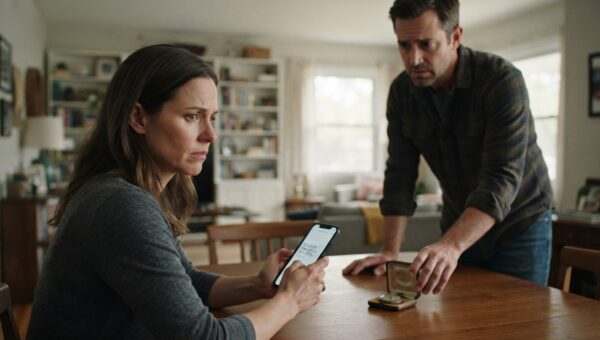
Four hundred and eighty dollars. That was the exact gap Mama found on her paper checking statement when she sat down at the kitchen table with her reading glasses and a yellow highlighter.
Mama is eighty-one, and her mind is sharper than mine on my best Tuesday. She still balances her ledger by hand, using a fountain pen and a backward-slanted cursive she learned at parochial school back when Truman was in office.
But she doesn’t drive across town to the main bank branch anymore. My brother Dale took over those errands two years ago, right after her hip replacement, when we all agreed it made sense to let him handle the digital deposits and monthly bills so she wouldn’t have to deal with the steps and the parking lot.
So when she called me over last month and pointed her pen at a row of figures that didn’t add up, I figured it was just a bank error or some minor fee.
“Look at this column,” Mama had said, tapping the paper with her eraser. “The numbers aren’t making their own sense, Nora. Every month it’s four hundred short. Not forty. Four hundred.”
I told her I would stop by the branch on my lunch break and get it sorted out with a manager. I didn’t think twice about it. Dale is her golden boy, the one who visits on Sundays and brings pastries from the bakery on Fourth Street, the one who always seemed so organized and reliable while I was running ragged with my own kids and my job at the clinic.
The teller at the front desk was a young woman with a neat gold name tag that read Chloe. She looked up from her screen when I handed her Mama’s primary account number and explained that we were missing a steady chunk of change from the monthly Social Security direct deposit.
“Let me pull up the routing history,” Chloe said, her fingers clicking against the plastic keys with a dry, rhythmic clatter.
I stood there on the linoleum floor, waiting for her to find a simple clerical mix-up or a stray insurance deduction. Instead, Chloe stopped typing. She tilted her head toward the monitor, frowned, and scrolled back up.
“There’s a secondary account linked to this Social Security stream,” Chloe said, her voice dropping a fraction. “It’s been running an automatic transfer of four hundred dollars on the first of every month for twenty-four months.”
The lobby was quiet except for the hum of the ceiling vent overhead. I felt the air in my lungs go thin.
“What secondary account?” I asked. “Mama only has one account. She’s had it since the seventies.”
Chloe didn’t answer right away. She printed out a summary sheet from the side tray, folded the top edge over, and pushed it across the counter toward me. At the top of the paper was a signature card.
“Someone opened a parallel savings branch across town,” Chloe said softly. “The signature card has your mother’s name, but Mama writes in cursive with that distinct backward slant. This signature is printed. Block letters.”
I looked down at the clumsy, square letters spelling out my mother’s full name. They didn’t curve or lean. They looked like they were drawn by a mason with a heavy hand.
“That’s not her writing,” I said.
Chloe looked at me, looked back at the card, and what she said next is something I will hear in my sleep for the rest of my life. “He opened it in person two years ago,” Chloe said, her eyes steady. “And he listed his own apartment address for the statements so they never came to your mother’s box.”
The teller didn’t need to name him. I already knew the handwriting.
I had watched Dale fill out deposit slips for our church bazaar using those exact block letters, pressing so hard into the paper the carbon copy tore through the bottom sheet.
I got back in my car and sat in the parking lot for ten minutes with the engine running and the heater blowing stale air against my shins. My hands felt cold on the steering wheel. Two years. Twenty-four months of four hundred dollars skimmed off the top of Mama’s fixed income, siphoned away while she sat at her kitchen table worrying over the price of heating oil and fresh produce.
I drove straight to Mama’s house with the printout folded inside my purse like a heavy stone.
When I walked through the back door, the smell of cinnamon tea hit me. Mama was sitting at her usual spot by the window, the sunlight catching the silver in her hair. She looked up from her crossword puzzle and saw my face before I even took off my coat.
“You found it, didn’t you?” she asked quietly. She didn’t sound surprised. That was the most painful part. There was a tired resignation in her eyes that told me she had been suspecting something was wrong long before she finally asked me to check.
“I found it,” I said, pulling the papers from my bag and laying them out on the oilcloth table cover.
We spent the next hour going through the timeline. I showed her the transfer logs, the secondary account numbers, and the printed signature card. When she saw Dale’s block letters standing in for her own elegant cursive, she didn’t cry. She just reached out with a trembling finger and traced the sharp edges of the fabricated ‘M’ in her name.
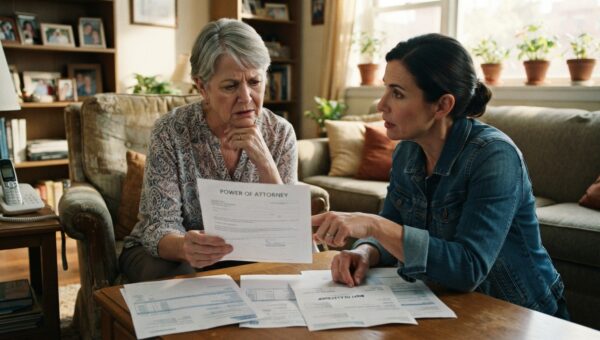
“He used the paper from my hip surgery,” Mama whispered, her voice barely louder than the refrigerator humming in the corner. “That old power of attorney form we signed at the hospital. He said the clerks needed it just in case I couldn’t sign for my own prescriptions while I was under.”
“He reactivated it,” I said. “He kept a copy.”
“My own boy,” she said. She let her hand drop back onto the table. “He comes in here every Sunday and eats my pot roast and talks about how hard things are at his real estate office. And all the while he’s been picking my pocket.”
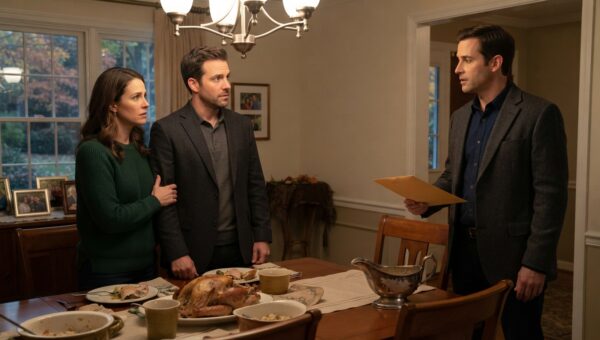
We didn’t call him right away. We waited until Saturday, which was Dale’s usual day to drop by with the weekend groceries and check the mail. Mama insisted on handling the setup. She told me to put the bank documents right in the center of the kitchen table, under the ceramic sugar bowl where he always reached for a cube.
When the front door clicked open at eleven o’clock, Dale walked in carrying a brown paper sack from the market, whistling a tune he must have picked up on the radio.
“Morning, Mama,” Dale called out, kicking off his loafers by the radiator. “Got some nice navel oranges today. The guy at the stand said they were sweet.”
He rounded the corner into the kitchen, stopped dead in his tracks, and the paper bag crinkled in his grip as he saw the two of us sitting there in absolute silence.
Mama didn’t get up. She kept her hands folded over her ledger book, her fountain pen resting neatly in the groove at the top.
“Close the door, Dale,” Mama said. Her voice wasn’t loud, but it had that old schoolteacher ring to it that used to make the whole third-grade row sit up straight.
Dale didn’t move for a second. His eyes flicked from Mama’s face down to the white printouts and the signature card sitting right beside his usual coffee mug. The color drained out from under his tan, leaving his skin looking gray and greasy under the kitchen lights.
“What’s all this?” Dale asked, trying for a laugh that didn’t make it past his teeth. “Is this some kind of audit?”
“Sit down, Dale,” I said, my voice shaking with a cold fury I hadn’t felt since we were kids fighting over the bicycle in the driveway.
He sat down slowly in the wooden chair across from Mama, dropping the grocery bag onto the floor. An orange rolled out and bumped against the table leg.
“I went to the bank yesterday,” Mama said, looking right at him with those sharp gray eyes that didn’t miss a thing. “Chloe showed me the papers. She showed me where you opened that second account across town using my old signature from the hospital.”
Dale swallowed hard. His throat bobbed. “Mama, look. It’s just temporary. The market down in Springfield took a bad turn with those commercial listings. I needed bridge capital. Just for a few months. I was going to pay every dime back before you even noticed.”
“Twenty-four months, Dale,” Mama said, and for the first time her voice cracked just a little bit. “That isn’t a bridge. That’s a highway you built right out of my retirement.”
“I’m your son,” Dale said, his voice rising, sliding into that defensive whine he used whenever he got caught breaking a neighbor’s window ball playing in the street. “You think I wanted to do this? You think I enjoy living like this? Everyone’s squeezing me. The bank wouldn’t look at my loan applications because of my credit score from the divorce. I didn’t have anywhere else to turn.”
“You turned to my purse,” Mama said.
She reached out and tapped the corner of the signature card with her fingernail. “Look at those letters, Dale. Look at how you wrote my name. You couldn’t even bother to learn my slant. You just printed it like a stranger signing a ticket.”
Dale looked down at the table, his fingers twitching against the hem of his sweater. “I’ll sign the transfer back. I’ll get a personal loan from the credit union on Monday and clear out the balance. We don’t need to make a federal case out of this.”
“There won’t be a Monday for you at this bank,” Mama said. She slid a second piece of paper across the oilcloth, a formal revocation of power of attorney and a bank closure request that I had printed out at the branch the day before, complete with lines for her signature and a witness line for me. “You sign this right now. You sign every line, you give back every key to this house, and you walk out that front door.”
“Mama, wait,” Dale said, leaning forward across the table, his hands open and pleading. “You can’t just shut me out like this over some numbers on a ledger. We’re family. Family helps each other through the rough patches.”
“Trust isn’t an open line of credit, Dale,” Mama said, and her voice was as cold and steady as winter ice on the river. “And you closed that account a long time ago.”
He looked at me then, looking for an ally, looking for the sister who used to cover for him when he stayed out past curfew. But I just stared back at him without saying a word, my arms crossed over my chest. The silence in the room was heavy, thick with twenty years of shared history snapping apart like dry pine under a boot.
Dale reached for the pen. His hand was shaking so badly he dropped it twice against the oilcloth before he finally managed to grip the barrel. He scribbled his name across the bottom of the revocation papers, his own handwriting looking just as messy and small as the block letters he had used to rob her.
He didn’t look up again. He stood straight up, grabbed his jacket off the back of the chair, and walked out through the mudroom. The front door swung shut behind him with a dull, hollow thud that echoed through the quiet house.
Neither of us moved for a long time after he left.
I went to the sink and picked up the orange that had rolled out of his bag, setting it back on the counter next to the bread box. Then I walked back to the table where Mama was sitting alone in the afternoon light.
The kitchen was quiet again. Not the heavy, suffocating quiet of a secret, but the clean, open silence of a room where the windows have finally been thrown wide open after a long storm.
Mama picked up her fountain pen. She didn’t say anything about Dale, and she didn’t talk about the money he took, because some losses are too large for words and you just have to rebuild the fence around what’s left. She opened her leather-bound ledger to a fresh page, dipped her nib into the blue ink, and began to write down her own figures in her own hand, her pen moving smoothly across the paper with that familiar, beautiful backward slant she had kept safe for all these years.