The laminate kitchen counter in my house has a small grease stain near the kettle where I spilled beef broth back in November, and for weeks I kept looking at it while I added up receipts in my head. I am a charge nurse at the county hospital down on Fifth Street, which means my brain works in shifts, vitals, and hard tallies.
I do not miss a drop in blood pressure. I did not miss a single detail of what my parents did to Maya last December in that overheated living room in Dayton.
My father Arthur always liked a packed house. He liked the noise of wrapping paper tearing and the way the tree lights hit his silver collection behind the glass cabinet. My sister Clara and her husband brought Leo, who was twelve then and treated every family gathering like a private auction where he was the only bidder. I stood by the sideboard with a cup of cold cider while the boxes came out from under the pine boughs one by one.
The tags were written in my mother Evelyn’s looping hand with the green felt-tip pen she used for church committee notes. Maya’s name was right there on the thick card stock, clear as church bells. But when the first large rectangular package came out, Arthur tossed it across the braided rug straight to Leo.
“Go on, big guy, see what the old folks got you,” Arthur said, laughing before the paper even ripped.
Maya was nine. She had spent three weeks using her own allowance to buy her grandfather a tin of peppermint drops and her grandmother a pair of woolen reading socks. She stood over by the archway leading to the kitchen, her heavy purple winter coat still zipped all the way to her chin because the radiator near the door was broken. She did not say a word. She just watched Leo tear into a paint set I had spent two weeks saving for, the professional grade tubes with the heavy wood case.
“Hey, wait a minute, that one has Maya’s-” I started, taking half a step forward.
“Oh, hush up, Loretta,” Evelyn waved her hand at me without looking up from her coffee cup. “Leo’s doing art at the junior high now.
He needs better supplies than a little girl playing with finger paints. We’ve got plenty more under there for her.”
There were no more for her. Not real ones. By the time the boxes were empty, Leo was surrounded by a drift of blue and silver paper like an overturned boat, and Maya had two paperback books from the discount bin at the pharmacy and a twenty-five-dollar plastic gift card for a coffee shop she was too young to visit alone.
Grandma Evelyn held out the little paper sleeve across the coffee table like she was handing a tip to a waitress. “Now you can choose what you want, sweetheart.”
I looked at the card. Then I looked at Maya. Her chin was shaking just a fraction of an inch, right where her jaw met her neck, but she kept her lips pressed together so tight they were nearly white.
She reached out with two fingers, took the card, and dropped it into her coat pocket without a sound.
“Thank you, Grandma,” Maya whispered.
I didn’t yell. That is the thing people who know me always get wrong. They think a nurse loses her temper when things go sideways. We don’t. We check the pulse, we note the time of the crash, and we start writing down what needs to be fixed. I sat back down on the floral armchair, smoothed my skirt, and stayed until the ham was cleared away. But the whole drive home, neither of us turned on the radio. The tires just hummed against the wet interstate, rhythm after rhythm, measuring out the miles.
By January second, I went to see an elder law attorney whose office smelled of old paper and peppermint lozenges. I didn’t tell Clara. I didn’t tell Arthur or Evelyn when they called on Sunday afternoons to ask why I wasn’t coming over to help clear out the garage or weed the side flower beds.
“We just don’t have the spare hours this season,” I told Evelyn on the phone three weeks into February, my voice flat and even like I was reading a chart. “Maya has track practice after school, and I picked up an extra three shifts on the cardiac wing.”
“Well, family comes first, Loretta,” Evelyn said, her voice dropping into that familiar church-committee purr that usually meant she wanted something fixed. “Your father was saying we ought to plan the Easter dinner at your place this year. My hip’s been acting up with this damp air.”
“No,” I said.
There was a silence on the line long enough for me to hear her grandfather clock ticking in the hallway three counties away. “No?”
“We’re keeping things quiet this spring,” I said. “Goodbye, Mom.”
I hung up before she could find her footing. It felt small at first, like turning off a faucet that had been dripping for forty years. Every month after that, I took the exact sum of money I used to spend on the massive holiday groceries, the expensive hams from the butcher downtown, the specialty wines Arthur liked to keep in the sideboard, and the birthday gifts I usually bought for Clara’s family out of sheer habit. I didn’t spend it. I opened a separate custodial account at the credit union downtown, putting every single paycheck difference straight into a dedicated fund under Maya’s full name.
Spring turned to sticky Dayton summer. The maples outside the hospital dropped their heavy green pods, and Maya grew three inches, stretching out of her old jeans until I had to buy her two new pairs at the thrift store off Route 4. She didn’t complain about the second-hand clothes. She spent her afternoons at the kitchen table with a sketchpad she bought herself, drawing old barns and water towers with the steady, quiet patience of someone who had learned early on that nobody was going to hand her a smooth page.
“Is Grandma still mad?” she asked me one evening in August while I was folding laundry.
“Grandma isn’t mad, honey,” I said, flattening a dish towel against my knee. “Grandma is just used to things going a certain way.”
“Are we going back there for Christmas?” she asked, her pencil stopping against the paper.
“We’ll go,” I said, and the way I said it made her look up from her drawing. “We will definitely go.”
November arrived with a hard frost that killed the last of the mums by the back porch. The formal invitation from Arthur arrived in a square envelope with cream-colored stock, the kind they only used for church anniversaries and milestone birthdays. Inside was a printed card asking us to arrive by two o’clock on Christmas Eve for the traditional turkey dinner and gift exchange.
I didn’t RSVP by mail. I waited until the second week of December, then called Evelyn while she was eating her mid-morning toast.
“We’ll be there,” I told her. “We’ll arrive right at two. But we’re bringing our own contribution to the afternoon.”
“Oh, bring whatever casserole you like, dear, though your father’s roasting the prime rib this time,” she laughed, dismissing me with a light cough. “Leo’s been talking about his list for weeks. He wants that new digital keyboard. We’ve all been chipping in to make sure he gets what he’s set his heart on.”
“I’m sure he has,” I said.
The drive over on Christmas Eve was quiet again, but this time the heater in my old sedan rattled like a tin can full of nails. Maya sat beside me in the passenger seat wearing a new navy blue coat I had bought her with my own overtime money, the kind with thick wool that actually kept the wind out. In my lap sat a heavy manila envelope sealed with red wax from the craft store down on Main Street, inside of which were three certified copies of the trust documents, the credit union audit for the past eleven months, and a formal legal notice regarding the division of my late grandmother’s estate which Arthur had been sitting on since the probate back in ninety-eight.
When we walked through the front door of the old house on Elm Street, the smell of roasted garlic and pine sap hit my throat immediately. Arthur was standing by the fireplace with a drink in his hand, and Clara was already sitting on the sofa next to Leo, who looked bigger, wider in the shoulders, and just as greedy as he had twelve months before.
“Well, look who made it,” Arthur boomed, clinking the ice in his glass. “Thought you might get stuck at that hospital of yours, Loretta. Always working yourself into the ground.”
“Someone has to keep the monitors running, Dad,” I said, stepping past him into the hall.
Maya didn’t take off her coat right away. She stood just inside the threshold, her hands tucked deep into her pockets, her eyes fixed on the massive pile of wrapped boxes sitting under the tree. The silver paper gleamed under the colored bulbs, almost identical to the year before.
Dinner was eaten in that particular kind of loud, forced cheerfulness families use when they want to pretend nothing is broken. Arthur talked about his lawn tractor while Clara passed the buttered rolls twice to Leo, making sure his plate was three times higher than anyone else’s. Nobody asked Maya about school. Nobody asked her how her drawing was coming along. She sat between us, eating her turkey with small, measured bites, her back straight as a fence post.
“Right then,” Arthur said, wiping his mouth with a linen napkin as the last plates were cleared. “Time for the tree. Leo, bring that large box from behind the armchair. The one with your name right on top.”
Leo leaped up with a grin that showed his new orthodontic braces, hauling a square package wrapped in gold foil straight toward the center of the rug. Evelyn settled back into her wingback chair, her hands folded over her apron, smiling like an empress at her own coronation.
“Go on, open it up,” Evelyn urged. “Your aunt and uncles all chipped in for that one.”
Leo tore the gold paper in half with a loud ripping sound, revealing a brand-new electronic tablet box. He let out a whoop and looked right at Maya with a sideways grin that had all the old cruelty in it.
“Thanks, Grandma,” Leo yelled, shaking the box. “This is awesome.”
Arthur laughed, leaning against the mantelpiece. “That’s my boy. Always landing on his feet.”
I didn’t move from my chair. I waited until the laughter died down and Clara reached out to hand Leo the next package, one that clearly bore Maya’s name written in that same green felt-tip pen.
“Hold on, Clara,” I said. My voice wasn’t loud. It didn’t need to be. It had that flat, clinical charge-nurse tone that makes doctors stop walking down the hospital corridor.
Clara froze, her fingers hooked into the red ribbon. “What did you say, Loretta?”
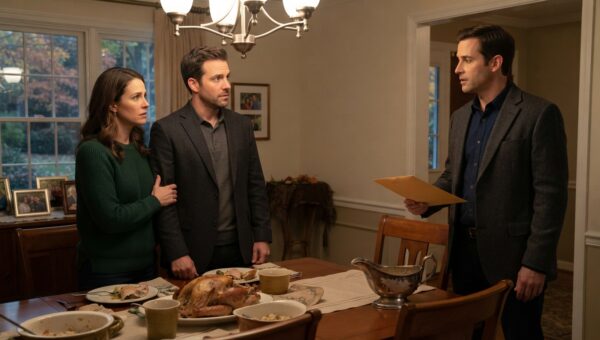
I stood up, smoothing the front of my wool skirt. I reached into my bag, pulled out the heavy manila envelope with the red wax seal, and laid it right on the center of the coffee table, right on top of the untouched copy of the Dayton Daily News.
“That package is not for Leo,” I said, looking straight at my mother. “And neither are any of the others with Maya’s name on them this year.”
Evelyn’s smile didn’t vanish all at once; it just cracked around the edges like old varnish. “Don’t be ridiculous, Loretta. We buy for the household as a whole. You know how your father is with the lists. Leo just gets things first because he’s impatient.”
“I know exactly how my father is,” I said, and for the first time in my life, I let my voice carry every single ounce of the last twelve months. “And I know how you spent last Christmas laughing while my daughter stood by the door in her winter coat trying not to cry over a twenty-five-dollar plastic card.”
The room went dead silent. The only sound was the electric logs hissing in the artificial fireplace. Arthur’s drink stopped halfway to his mouth, the ice clinking against the crystal rim.
“Loretta, watch your tone in this house,” Arthur barked, his face turning the color of a bruised plum. “We’ve fed you and yours under this roof for thirty years. You don’t come in here making scenes over wrapping paper.”
“It isn’t wrapping paper anymore, Dad,” I said, tapping the corner of the manila envelope with one finger. “That’s an independent financial accounting of every holiday subsidy, grocery offset, and birthday exchange you’ve tried to tie to our names since nineteen-ninety-eight. It’s also the closed-out trust account in Maya’s name that contains every dollar I used to spend on your hams and your wine.”
Leo stared at me from the floor, the tablet box half-open in his lap, his mouth slightly parted. Clara looked like she had swallowed a lemon, her eyes darting between Arthur and me.
“You didn’t,” Evelyn whispered, her hands gripping the arms of her chair until her knuckles turned the color of chalk. “You didn’t keep a ledger.”
“I’m a nurse,” I said, looking down at her with absolute, unshakeable calm. “Keeping ledgers is what keeps people alive. And it’s what keeps us from being beholden to people who think a twenty-five-dollar token pays for a child’s dignity.”
I turned to Maya, who was still standing by the archway, her navy coat unbuttoned now at the top.
“Come here, honey,” I said.
Maya walked across the braided rug, her shoes clicking softly against the hardwood floor. She didn’t look at Arthur. She didn’t look at Leo. She stood right beside my shoulder, small and straight and entirely self-possessed.
“Take your box,” I told her, pointing to the one Clara had been holding.
Maya reached down, picked up the package with her own name on it, and held it against her chest.
“Now,” I said, looking around the circle of faces that had governed my family’s world for forty years. “We’re going home. The turkey smells wonderful, but we have dinner waiting on our own table this year. One that we paid for ourselves.”
Arthur started to speak, his mouth working silently like a fish out of water, but no sound came out. Evelyn simply turned her face toward the window, her lips pressed into a thin, white line of pure, helpless rage.
We walked out through the hallway without another word. The heavy oak front door clicked shut behind us with a solid, reassuring sound that echoed off the porch pillars. Outside, the air was sharp and bit straight through my scarf, smelling of woodsmoke and old snow.
Maya stopped at the bottom of the concrete steps. She reached into the pocket of her old purple coat, pulled out the worn paper sleeve with the twenty-five-dollar gift card from the year before, and dropped it into the green curbside recycling bin beside the driveway. It made a dry, hollow rattle against the plastic bottom.
Then she slid her hand securely into my glove, her fingers warm and steady against my palm, and we walked together down the dark sidewalk toward the car.