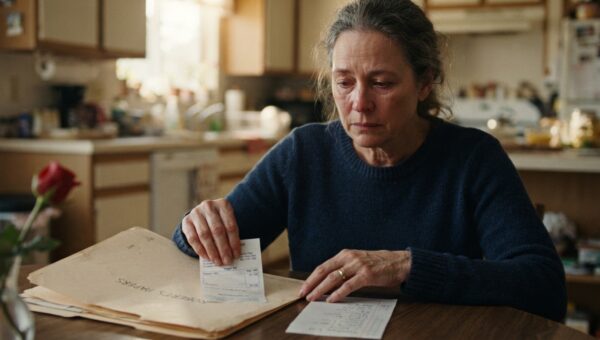
The autumn air had that sharp, dry smell of dead leaves and cold iron, and it bit right through my thin cardigan as I walked up the concrete steps to the house where I grew up. My hand was shaking a little bit, but I shoved the Manila folder deeper into my canvas tote bag and told myself to quit being foolish.
After ten years of scrubbing floors in the medical billing office until my knuckles cracked, after ten years of eating peanut butter toast for dinner and watching my friends buy cars while I drove a rusted-out Ford with a failing transmission, I had actually done it.
I had the deed sitting right there in my bag. My own name. No co-signers, no help, no loans from anyone. Just my thumbprints and my sweat and ten years of every extra dollar I could scrape together tucked into an account nobody else knew about.
My mother, Cheryl, didn’t even look up from the kitchen table when I let myself in through the side door. She was cutting heavy ivory cardstock with a silver-bladed paper cutter, her glasses sliding down the bridge of her nose. Claire, my younger sister, was sprawled across the floral sofa with a bridal magazine spread over her knees, her phone pressed to her ear as she argued about catering costs with someone named Madame Renee.
“Take your shoes off at the mat, you’re tracking in grit,” my mother said without looking up. The silver blade came down with a sharp *thwack* that made me jump. “And hand me those ribbon spools from the counter. The teal ones, not the sage. Claire decided sage looks too much like a hospital scrub room.”
I stood there in the entryway for a second, my heart hammering against my ribs not from fear, but from this strange, heavy sense of lightness I hadn’t felt since I was a teenager. I didn’t take my shoes off. I just walked right into the middle of the linoleum kitchen and pulled the thick legal envelope out of my tote.
“I bought a house,” I said. My voice sounded thin, almost like it belonged to someone else.
The silver paper cutter stopped moving. Claire dropped her phone onto her chest, the screen flashing with some pink-hued TikTok video.
My mother slowly took off her reading glasses, folding them with deliberate slowness, and raised her chin.
“What did you just say?” she asked. Her voice didn’t have any warmth in it. It never did when it was directed at me, but today it had that flat, dangerous edge that usually meant someone was about to pay for a broken dish.
“The papers cleared about two hours ago,” I said, and I pulled the blue-backed deed out of the envelope just far enough for her to see the county seal stamped in gold at the bottom. “It’s small, out on the south edge of town near the old mill road, but it has a yard. I have my own keys.”
The silence in that kitchen was so thick you could have sliced it with my mother’s paper cutter. Then Cheryl stood up so fast her wooden chair scraped a loud, ugly line across the floorboards.
She didn’t smile. She didn’t ask to see the address or how many bedrooms it had. Her eyes just went hard and small, fixed on the corner of the blue paper.
“You bought a house,” she whispered.
“I did,” I said. “Ten years of saving, Mom. I finally did it.”
She didn’t congratulate me. She didn’t tell me I worked hard. She didn’t even breathe. She just crossed the kitchen floor with a speed that defied her fifty-eight years, her hand coming out of nowhere to grab a fistful of my hair right at the crown of my head. She yanked my head back so hard my neck popped, and before I could even gasp, her other hand flicked open the heavy brass lighter she always kept on the stove for her menthol cigarettes. She snapped the wheel. A greasy, yellow flame hissed to life, dancing less than three inches from the loose strands of my hair.
“You’re not even married,” she spat, her face purple and twisted with a rage that didn’t make any sense. “That money was for your sister’s wedding.”
“Mom, stop it, let go, ” I choked out, trying to twist away, but her grip was like a steel trap. The heat of that tiny flame licked at the side of my face, smelling faintly of lighter fluid and cheap butane.
“You miserable, selfish little thief,” she hissed right into my ear, her fingers tightening until my scalp burned. “Everything you make belongs to this family until Claire is settled. You think you get to squirrel away thousands of dollars behind our backs while your sister wears a discount dress? I ought to burn the whole thing down right here.”
Claire didn’t get off the couch. She just watched from the cushions, her expression mildly annoyed, like I was holding up her afternoon soap opera. “Just give her the papers, Grace,” Claire mumbled, rolling her eyes. “You’re making Mom’s blood pressure go up, and you know how she gets when you pull this independent act.”
I didn’t give her the papers. I reached up, grabbed my mother’s wrist with both hands, and twisted until she let out a sharp gasp and dropped the lighter. It clattered against the linoleum, the flame winking out. I shoved her back hard enough that she stumbled against the counter, her hip catching the corner of the microwave cart.
“Don’t you ever touch me again,” I said, my voice shaking so badly I could barely form the words. “And don’t ever touch my money. It was never yours.”
I turned around and walked out of that house without looking back, my scalp throbbing and my chest heaving for air. I drove straight to my new little house on Mill Road, locked the front door behind me, and sat on the bare wooden floorboards of the empty living room until the sun went down.
The next three days were the quietest of my entire life. I bought an air mattress, a small camping stove, and a single folding chair. I spent my mornings wiping down the baseboards with soapy water and watching the dust motes float through the afternoon sunlight that slanted across the pine floors. It was mine. Every scuff mark, every drafty window frame, every square foot of it belonged to me and the ghost of ten years of missed lunches and sore feet.
On the fourth morning, right around 8:45, a sharp, heavy rapping echoed against my front door.
I was sitting at the folding table with my coffee mug, going over the utility transfer notices. The sound made me drop my spoon into the ceramic bowl with a loud clatter. Two raps, heavier this time.
When I pulled the door open, two local deputies in dark green uniforms stood on the porch, their hands resting naturally near their duty belts. The taller one, a middle-aged man with graying temples named Officer Vance, looked down at a clipboard in his hand and then up at my face.
“Ms. Grace Miller?” he asked.
“Yes?” I said, my throat instantly tightening up until it felt like swallowed glass. “Is something wrong?”
“We’re here regarding a formal complaint filed this morning by Cheryl Miller,” Vance said, his tone entirely professional, devoid of any warmth. “An allegation of grand larceny and fraudulent conversion of shared family assets totaling sixty-eight thousand four hundred dollars.”
I just stood there in the doorway because my brain kind of stopped working for a second. The coffee mug in my hand felt heavy, impossibly heavy.
“What?” I finally managed to whisper. “Shared family assets? That’s my money. I earned every dime of it at the medical billing office.”
“The complaint states you acted as an unauthorized trustee for a consolidated family savings pool intended for household and dependent expenditures,” Vance read off his clipboard, his eyes scanning the paper with bored routine. “She claims you embezzled the down payment funds from an account bearing her signature and used them to purchase this property under false pretenses. We’re going to need to inspect the premises and secure any financial documents related to the purchase.”
For a wild, panicked second, I thought about my mother’s face in that kitchen, her hand coming down with the lighter, the cold, dead look in Claire’s eyes as she watched from the couch. She hadn’t just been screaming out of anger. She had planned this the moment I walked out the door. She had filed a police report claiming the house was bought with stolen family money, intending to force the county to freeze the deed and redirect the equity straight into Claire’s downtown ballroom reception.
“She doesn’t have a signature on my account,” I said, and suddenly the panic cleared away, leaving behind a cold, sharp sort of anger that tasted like metal. “She doesn’t even know the name of my bank. Step inside, Officer. Please. Come right in.”
I didn’t yell. I didn’t cry. I walked over to my canvas tote bag sitting by the kitchen boxes and pulled out the gray accordion folder I had carried with me through every job change, every tax season, and every late-night shift for a decade.
“Sit down at the table,” I told them, my voice dropping an octave into that flat, steady register I used when a doctor’s office called screaming about lost billing codes. “Take your time. Look at every single page.”
I didn’t just hand them the closing disclosure for the house. I handed them ten years of W-2 forms from the medical billing office, every single tax return stamped by the IRS since I was twenty-two years old, and sixty consecutive statements from an online credit union account that only my Social Security number could unlock. I showed them the direct deposit receipts matching my hourly pay scale down to the last cent, the overtime logs signed off by my floor manager, and the exact paper trail of wire transfers moving from my payroll account straight to the title company’s escrow ledger.
Officer Vance flipped through the pages, his thumb running down the columns of numbers. The other deputy, a younger woman with short brown hair, leaned over his shoulder and pointed at the employer identification numbers on the 2018 tax filing.
“There’s no joint holder on any of these,” the younger deputy murmured, looking up at me with a new expression in her eyes. It wasn’t suspicion anymore. It was a kind of grim, tired understanding. “And the routing numbers all trace back to the commercial payroll service out of the state capital.”
“My mother doesn’t even have a computer,” I said quietly. “She wouldn’t know how to log into my portal if her life depended on it. She just decided that because I live alone and don’t have a husband, my bank account was public property for my sister’s open bar.”
Officer Vance closed the accordion folder with a soft *thud*. He rubbed the back of his neck, looking down at the wooden floorboards for a long moment before he met my eyes.
“If she filed a false police report alleging grand larceny knowing the funds were independently acquired, that’s a felony charge under state statute,” Vance said slowly. “We have to follow up at the precinct, of course. We’ll need you to bring these documents down to the station this afternoon to formally sign an affidavit denying her claims and establishing the sole-source origin of the funds.”
“I’ll be there by noon,” I said.
That afternoon, the fluorescent lights of the county precinct hummed with that same sterile buzz I knew so well from the hospital basement offices. I sat across a metal desk from Detective Miller, no relation, thankfully, and watched as my mother was led into the adjacent intake consultation room by a female officer.
Cheryl looked different under the harsh white lights. Without her kitchen and her paper cutter, she looked smaller, her shoulders slightly hunched inside her floral blouse. When she saw me sitting there with my gray accordion folder open on the table, her face mottled with a sudden, ugly red.
“Grace!” she shouted, trying to lunge toward the glass partition before the officer gently but firmly guided her back by the elbow. “You tell these men right now! You tell them you took that money from the family safe! You’re ruining your sister’s life over a cheap piece of tin!”
Detective Miller didn’t even look up from the certified bank verification letter the branch manager had faxed over an hour ago. He stamped the bottom of the intake dismissal form with a heavy red ink pad *ka-clack*, the sound echoing off the concrete walls.
“Mrs. Miller,” Detective Miller said, his voice entirely deadpan as he addressed my mother through the open door. “Your daughter’s payroll records have been verified by federal tax filings and independent banking institutions going back ten years. Furthermore, our investigator spoke with your bank; you have no joint accounts, no shared deposits, and no legal claim to any portion of those funds. Filing a false financial instrument and lodging a fraudulent larceny report is a Class E felony.”
My mother froze. The angry color drained right out of her cheeks, leaving her looking old and gray and suddenly very frail. She looked at the detective, then at the stamped paper in his hand, and finally through the glass at me.
“Grace,” she muttered, her voice dropping down to a pathetic, cracked whine that she probably hadn’t used since I was twelve years old. “We’re family. You can’t let them put a record on your mother. What will people at the church say? What about Claire’s shower on Saturday?”
I stood up from my chair and closed my gray accordion folder with a crisp, clean snap. I didn’t yell at her. I didn’t bring up the lighter or the hair-grabbing or the ten years of working sixty-hour weeks while she treated me like an unpaid servant.
“The debt is paid in full, Mom,” I said, my voice steady and cold as winter river water. “Don’t ever call my phone again. Don’t ever come to my door. If you do, I won’t just let the deputies handle it.”
I turned my back on her before she could answer, walking out of the precinct doors and into the bright, sharp autumn sunlight. My car was waiting in the gravel lot, the engine ticking as it cooled down in the wind.
An hour later, I was back on Mill Road. I walked up the wooden front steps of my house, pulled the small brass key out of my coat pocket, and slid it into the brass lock. It turned smooth as butter, clicking twice before the heavy deadbolt slid back into the frame.
The hallway inside was empty and quiet, smelling faintly of fresh pine and clean paint that belonged to nobody else in the world. I locked the door behind me, shutting out the noise of the past ten years for good, and walked down my own hallway to watch the sun go down through my own kitchen window.