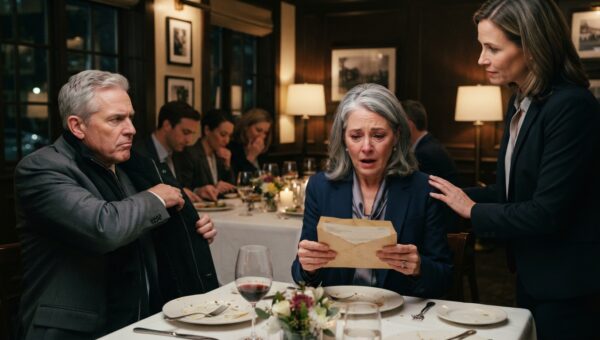
I was seventy-one years old, kneeling on my own kitchen floor, when my son deliberately stepped on my fingers with his heavy boots. “Watch where you’re crawling,” he grunted, while his wife giggled from the hallway. I slowly pulled my bruised hand away, stood up, and picked up my heavy cast-iron skillet. The kitchen smelled like lemon cleaner, cold gravy, and the burnt coffee Caleb had left sitting on the counter all morning.
Sunlight came through the back window in a hard white square, bright enough to show every smear on the tile and every crumb his wife had watched me crawl around to collect. I was seventy-one years old, kneeling in my own kitchen. Caleb stood behind me in polished boots that had never seen a day of real work, tapping one heel like I was taking too long. Marissa leaned in the hallway with her red nails wrapped around a champagne flute, smiling the way people only smile when they think cruelty is private. “Missed a spot, Mother,” Caleb said.
My fingers throbbed where the thick leather heel had ground them against the ceramic tile. Six months earlier, they had shown up on my front porch with four suitcases, two oversized flat-screen televisions, and a dog that shed golden hair on my good rugs. Caleb had hugged me with that heavy, false warmth he only used when he needed something signed.
He had told me the rental market was brutal and that they just needed a few weeks to get back on their feet. I had made up the guest room, changed the sheets, and cleared out half the pantry. My late husband, Arthur, built this house with his own hands back in nineteen-eighty-two, hammering every stud and painting every baseboard. Arthur always said a home was a sanctuary, a place where a person deserved peace at the end of a long day. But peace had packed its bags and left the moment Caleb and Marissa brought their noise and their entitlement through my front door.
I did not strike out with the skillet. Instead, I simply lifted it off the burner where it had been resting, feeling its heavy, comforting weight settle into my palm. I turned around slowly, my joints making a faint, familiar popping sound that seemed to echo in the sudden quiet.
Caleb stopped tapping his boot. Marissa lowered her champagne flute just an inch, her eyes darting from my face to the black iron in my hand. “Put that down, you’re going to scratch the stove,” Caleb muttered, though his voice lacked its usual booming confidence. I did not put it down. I walked past them without a word, my old house slippers making a soft scuff on the floorboards, and set the skillet firmly onto the front burner with a sharp clank that made Marissa flinch.
“Sit down at the table, both of you,” I said. My voice did not shake. It came out steady and low, the way I used to speak to my fourth-grade students when the classroom got too loud. Marissa laughed a high, nervous sound, looking at Caleb for backup. “Are you serious right now? We are in the middle of unpacking our weekend bags,” she said.
Caleb crossed his arms over his chest, his expensive flannel shirt stretching across a stomach that had never known honest hunger. “Mom, stop being dramatic. My feet hurt, I’m tired, and we need to talk about dinner anyway. Marissa wants takeout from that Thai place downtown.” He spoke like an employer addressing a clerk who had fallen behind on her filing. I looked at him, really looked at him, seeing the soft, spoiled lines of a man who had never faced a real consequence in his entire life.
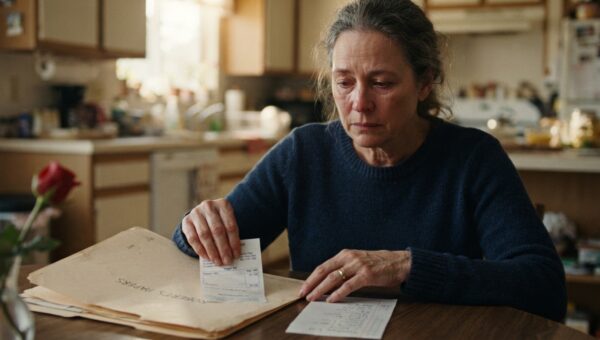
I walked over to the small oak desk by the pantry where I kept my household files. My hand went straight to the blue leather folder tucked behind the old appliance manuals. Inside sat the original warranty deeds, the tax receipts, and the papers Caleb had persuaded me to look at back in October. He had called it estate planning, a simple formality to save on probate fees, sliding a stack of thick white papers across this very table with a pen already uncapped. I had pretended to squint at the fine print, nodding slowly while my heart beat a quiet, steady rhythm against my ribs. I had let them believe I was a confused old widow who could be managed, nudged, and signed away into a corner. They thought they had secured my home, my savings, and my future with a few strokes of a cheap ballpoint pen.
I carried the folder back to the table and laid it squarely between them. “Open it,” I said. Caleb frowned, finally uncrossing his arms and stepping forward. “What is this, Mom? I told you we already filed the preliminary forms down at the county recorder’s office.” He reached down and flipped open the cover, expecting to see the quitclaim deed transferring sole ownership into his name. His eyes scanned the first page, moving down the lines of neat black type, then jumping back to the top. The color drained from his face so fast it looked like someone had turned off a lamp behind his skin. “Wait. This isn’t…” he muttered, his fingers suddenly clumsy as he flipped the page over. Marissa stepped closer, leaning over his shoulder, her expensive perfume smelling like sweet chemicals in my kitchen. “Caleb, what does it say? Why are you stopping?” she asked, her voice sharpening with sudden anxiety.
Caleb did not answer her. He looked up at me, his eyes wide and blank. “You didn’t sign the final pages,” he whispered. I pulled out a chair and sat down at the head of the table, resting my hands flat on the polished wood. “No, Caleb, I didn’t,” I said. “I watched you spend four months draining my patience, treating my home like a cheap hotel, and treating me like hired help. I wanted to see just how far your gratitude went. And today, you showed me right down to the bottom of your boots.” Marissa snatched the paper from his hand, her eyes darting across the paragraphs. Her face went tight and pinched. “You can’t just do this! We have a legal agreement! We have our things here!” she snapped, slamming her hand down on the table so hard the water pitcher rattled.
I looked at her without blinking. “You have forty-eight hours to pack every single thing you brought into this house,” I said. Caleb finally found his voice, rising halfway out of his chair with a scowl that looked terrifying when he was a boy, but looked pathetic on a grown man who still lived off his mother. “You can’t kick us out! We’ll sue you for elder abuse, we’ll tell the family you’re losing your mind!” he shouted, his face flushing dark red. I didn’t raise my voice to match his. “Go ahead and call anyone you like, Caleb. Tell them how you stepped on my fingers while I cleaned your mess. Tell them about the loans I paid off and the cars I bought you that you never thanked me for.” Marissa grabbed her phone off the counter with trembling fingers, dialing frantically while glaring at me with pure venom. “Fine. We’ll leave. But don’t expect us ever to speak to you again,” she hissed.
The next hour was a blur of slamming doors, raised voices, and the heavy thump of suitcases being dragged down the hallway. Marissa didn’t look at me as she stormed out the front door, her heels clicking angrily against the concrete porch before she shoved herself into the passenger seat of their sedan. Caleb lingered for a moment by the screen door, his face pale, holding a plastic garment bag over his shoulder. He looked like he wanted to say something, some final jab to save his pride, but he just swallowed hard and stepped out into the afternoon heat. I watched through the living room window as he climbed into the car and slammed the door. The gravel crunched under the tires as they backed out of the driveway, speeding down the empty street until the sound of the engine faded into the distance.
I walked back to the kitchen and stood in the middle of the room. The air felt different, lighter somehow, as if the oxygen had finally returned to the walls Arthur built. I picked up the damp rag from the floor and tossed it straight into the garbage bin without a second thought. I walked over to the front door, turned the deadbolt with a solid, satisfying click, and slid the chain into place. Then I walked back to the kitchen counter and picked up the kettle. I filled it with fresh, cold water from the tap, placed it on the front burner, and waited for it to heat. When the water boiled, I poured it slowly over a dark roast in my favorite ceramic mug, watching the steam rise in a clean, straight line toward the ceiling. I sat down at the kitchen table alone, looking out the back window at the afternoon sun, without a single crumb left to sweep.