$151,200. That is the exact amount my sister Brenda drained from an 84-year-old widow who spent her final years eating expired milk and canned corn while Brenda lived in a $340,000 house in Lake Worth. I still count the numbers in my head like a bad dream that will not go away. Six years of monthly pension checks, $2,100 at a time, funneled right into Brenda’s mortgage escrow while my mother sat alone in her rusted mobile home in Nebraska.
I used to think family was the one thing you could count on when everything else went sideways. I was wrong.
My mother, Clara, had been living in that same faded cream-colored mobile home since Dad passed away seven years ago. Dad left her a small pension and Social Security, which came out to $2,100 a month. It was not a fortune, but in a small town where property taxes were low and the mortgage on the mobile home was long paid off, it should have been plenty for an old woman living by herself. I lived three states away, working long shifts at the county hospital, but I tried to do my part. Every month I mailed her a check for $200 out of my own pocket just so she could buy fresh produce, keep her little window air conditioner running through the brutal July heat, and maybe get her hair done once in a while.
Brenda had volunteered to handle the official paperwork and the bank deposits after the funeral. She said it would be easier for Mom. I trusted her. That was my first mistake, and looking back, it is the one I will never forgive myself for making.
Last Christmas, I decided to drive out instead of flying so I could bring Mom some heavy winter blankets and spend a real week with her. The weather was gray and bitter, the kind of cold that bites right through your coat before you even make it from the car to the porch. When I walked into the mobile home, the air smelled stale, like old dust and damp carpet. Mom was sitting in her old floral armchair with a knitted throw over her knees, looking smaller than I remembered. I went straight to the kitchen to make some tea, and that is when I opened the refrigerator.
There was nothing inside except a half-empty carton of milk that had expired twelve days ago, three dented cans of store-brand corn, and a withered lime rolling around the crisper drawer. The pantry was just as bare. When I hugged her goodbye later that afternoon, I could feel her shoulder blades pressing right through her cardigan like dry sticks. She had lost eighteen pounds.
I didn’t yell right then. I just nodded and told her we were going to the grocery store immediately, but my mind was already racing in circles. How could she be starving? Brenda swore she was managing the $2,100 monthly pension like clockwork. The next morning, instead of waiting around, I drove straight to the local branch of the bank where Mom’s account was held. The lobby was quiet, smelling of floor wax and old paper. I walked up to the teller window, laid out Mom’s statements, and asked why the account balance was hovering around forty-two dollars when the pension had hit three days prior.
The teller, a young woman with a neat name tag that read Chloe, took the papers and scanned them into her terminal. Her face changed instantly. The polite, retail smile drained right out of her eyes, and she looked over her shoulder at the supervisor’s desk before leaning in close.
“Your mother’s pension doesn’t stay in this account,” Chloe whispered, her voice dropping so low I almost couldn’t catch it over the hum of the fluorescent lights. “It goes straight to a linked checking account.” I stood there with my hands flat on the cold laminate counter, my brain refusing to process what she was telling me. “Whose name is on that linked account?” I asked. Chloe tapped her screen twice, swallowed hard, and looked up at me with genuine pity in her eyes. “Brenda Miller. Your sister.”
I walked back out to my car and sat in the driver’s seat for a long time with the engine running and the heater blasting, staring at the steering wheel while my hands shook so hard I couldn’t even unlock my phone. Six years. Six years of Mom eating canned corn while Brenda paid off a three-bedroom house in Florida with a pool and a manicured lawn. I didn’t wait to calm down. I pulled my phone out of my pocket and dialed Brenda’s cell phone number directly. She picked up on the third ring, her voice bright and breezy, sounding like she was sitting in a sunroom sipping iced tea while the Florida breeze blew through the screen doors.
“Hey stranger, I thought you were still up north with Mom,” Brenda said, her tone dripping with that casual sisterly annoyance she always reserved for when I called during her workday.
“I am at the bank right now, Brenda,” I said, my voice dropping into a register I didn’t even recognize as my own. “Why is Mom’s pension going into your personal account?”
There was a three-second pause on the line, just long enough for me to hear a blender whirring in the background at her house. When she answered, all the warmth was gone, replaced by a cold, defensive snap. “Mom doesn’t need that money. She barely goes anywhere.”
I gripped the steering wheel until my knuckles turned the color of chalk. “She barely EATS, Brenda. Her fridge has expired milk and three cans of corn. She’s starving.”
“Oh, stop being so dramatic,” Brenda sighed, as if she were talking to an unruly child in a grocery store aisle. “I’m investing the surplus for her future care. It’s smart money management. You wouldn’t understand because you’ve never owned a real piece of property.”
She hung up on me before I could find another word to throw at her. The click of the disconnect tone sounded loud in the quiet car. I sat there for another five minutes, staring out the frosted windshield at the slush in the parking lot, and realized right then that talking was over. Family loyalty didn’t mean a damn thing if one person was eating steak in Lake Worth while the other was dying of slow neglect in Nebraska.
I drove straight from the bank to the local office of Adult Protective Services. The waiting room smelled of damp wool and antiseptic. I sat across the desk from a caseworker named Marcus Vance, a tired-looking man with kind eyes and a desk piled three feet high with manila folders. I laid out the bank slips, the dates, the totals, and my sister’s phone admission. Marcus didn’t interrupt me once. He just pulled a yellow legal pad toward him and started writing in slow, deliberate strokes.
“How long has this been going on?” he asked, not looking up from his notes.
“Six years,” I told him. “Ever since our dad died.”
Marcus let out a long, slow breath through his nose. “That’s going to be a very large number once we audit the statements.”
It took Marcus three weeks to pull the full paper trail, and when he called me back into his office, he didn’t just have bank records. He slid a single piece of paper across the desk toward me. It was a Power of Attorney document, dated six years back, granting Brenda full legal and financial control over our mother’s estate. At the bottom was a signature in my name. Except I had never signed it. I stared at the looping, unfamiliar curves of my own name spelled out by someone else’s hand, complete with a purple notary stamp from a shipping center two miles from Brenda’s house in Florida.
“Is this your signature?” Marcus asked quietly.
“No,” I said, my voice barely audible over the hum of the office radiator. “I’ve never even been to that notary in my life.”
“That makes it elder financial exploitation and wire fraud, crossing state lines,” Marcus said, tapping his pen against the corner of the desk. “Which means this is no longer just a civil matter for social services. The state’s attorney is going to be very interested in this paperwork.”
We didn’t wait for a court summons. Two days later, with Marcus and a local sheriff’s deputy named Deputy Miller standing by in unmarked cars down the street, I drove my rental car straight up the palm-lined driveway of Brenda’s house in Lake Worth. The house was even bigger than I had pictured from her photos, a sprawling stucco ranch with a tile roof and a brand-new white Honda SUV parked in the paved double garage. I walked up the decorative stone steps and hammered my fist against the heavy mahogany front door until the brass knocker rattled.
Brenda pulled the door open herself, wearing a silk blouse and gold hoop earrings, a look of righteous irritation already forming on her face. But when she saw me standing there alone on the porch with a manila envelope clutched in my hand, her expression faltered for a fraction of a second.
“What are you doing here?” she demanded, stepping out onto the porch and trying to pull the heavy door shut behind her. “I told you on the phone, I’m busy.”
“You’re done, Brenda,” I said, holding the folder up so she could see the county seal stamped across the tab. “The bank accounts are frozen as of this morning. APS has the audit, and the sheriff is waiting for the warrant on that forged Power of Attorney you filed with my name on it.”
Brenda’s face went from flushed to an ugly, mottled gray, though she tried desperately to keep her chin up. “You can’t do that. I’m taking care of Mom! She’s old, she doesn’t know what she’s doing!”
“She knows enough to know she was starving,” I said, stepping right up to the threshold so she couldn’t shut the door in my face. “And the judge in Lincoln is going to find it real interesting when he sees where her pension checks went. $151,200. Every cent of it accounted for, right down to your mortgage escrow payments.”
“You’re ruining me!” she hissed, her voice finally breaking, the polished suburban veneer cracking right down the middle to reveal the desperate coward underneath. “Do you have any idea what this is going to do to my credit? My house?”
“I don’t care about your house, Brenda,” I told her, my voice dead flat and cold as the Nebraska wind I had left behind. “You can explain it to the prosecutor.”
I didn’t stay to watch her cry or scream. I turned around, walked down her perfect stone steps, and got back in the car. Within forty-eight hours, the court had appointed an emergency conservator, transferring Mom’s remaining assets and custody directly to me. I packed up every single thing she owned out of that rusted mobile home, loaded it into the back of a rented van, and brought her back home with me where the air smells like coffee and hot meals instead of dust and old cold.
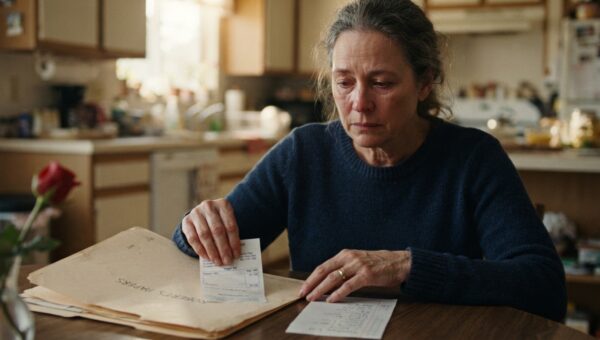
Now, Mom sits in my kitchen every afternoon in the golden light coming through the window, eating a warm bowl of chicken soup with real carrots and celery while the pantry behind her stays stocked to the brim with canned goods she never has to ration again. Sometimes, when she gets tired, she reaches across the table and rests her thin, quiet hand right over mine without saying a word. Outside my kitchen window, there is no mobile home, no rusted tin roof, and no monthly panic over whether there’s milk in the fridge. There is just a wide, open horizon, a steady roof over our heads, and the quiet, hard-earned peace of knowing the truth finally won.